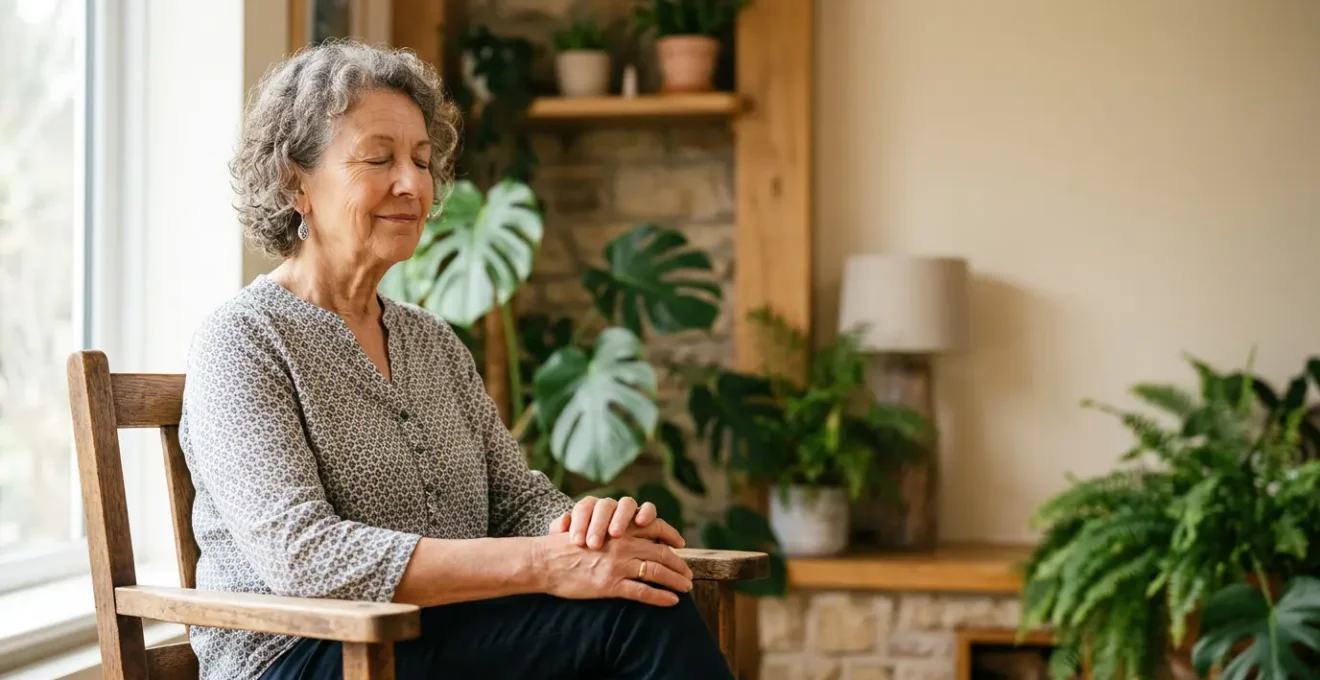
Contrary to popular belief, the profound benefits of yoga are not reserved for the flexible or the fearless; they are unlocked through mindful movement, which is perfectly accessible from the safety of a chair.
- Gentle, seated movements activate a “synovial pump” that lubricates and nourishes stiff joints more effectively than rest.
- Specific exercises can actively reduce the perception of chronic pain through a process known as neurological gating.
Recommendation: Instead of avoiding movement due to pain, the key is to understand and apply the right kind of gentle motion to reclaim comfort and strength.
Perhaps you’ve seen the images: a lithe figure twisted into an impressive pretzel on a yoga mat, the picture of serene flexibility. For many of us, especially as we navigate the realities of stiff knees, a touch of arthritis, or a healthy concern about balance, that image can feel more intimidating than inspiring. It can feel like an exclusive club we can’t join. The common assumption is that to reap the rewards of yoga—the flexibility, strength, and peace of mind—you must get down on the floor. But what if that assumption is entirely wrong?
The truth is, the magic of yoga doesn’t happen in the complexity of a pose. It happens in the quality of attention we bring to simple, conscious movement. It is about reconnecting with the body’s intelligence. This is where chair yoga shines, not as a “lesser” form of yoga, but as a smarter, safer, and profoundly effective path to well-being. It meets you exactly where you are, transforming your humble dining chair into a powerful tool for health. The practice is not just about stretching; it’s about understanding the remarkable science of how gentle motion can heal.
This guide moves beyond simply showing you poses. We will explore the fascinating ‘why’ behind the practice. You will discover how a few minutes of seated movement can lubricate your joints, why walking on sore knees can paradoxically reduce pain, and how to build the confidence to move freely again. We will unpack the science in a simple, accessible way, empowering you to become the expert of your own body.
To help you navigate this journey into gentle, effective movement, this article is structured to answer the most pressing questions you might have. We will explore the science, the practical steps, and the safest ways to begin.
Summary: The Science of Gentle Movement for Lasting Well-being
- Why Does 20 Minutes of Chair Yoga Lubricate Your Joints Better Than Walking?
- How to Start Your Day with Chair Yoga in Under 10 Minutes Without Special Equipment?
- DVD Programmes vs YouTube Chair Yoga: Which Format Suits Seniors Who Distrust Technology?
- The Shoulder Stretch That Injures 1 in 5 Beginners Over 70
- When Are You Ready to Graduate from Chair Yoga to Gentle Standing Sequences?
- Why Does Walking on Painful Knees Reduce Pain More Than Staying in Your Chair?
- Why Does 34°C Pool Water Reduce Joint Pain and Increase Range of Motion Within Minutes?
- Why Do Tai Chi Practitioners Over 70 Fall 50% Less Often Than Non-Practitioners?
Why Does 20 Minutes of Chair Yoga Lubricate Your Joints Better Than Walking?
When our joints feel stiff and achy, the instinct is often to move less, to protect them from further discomfort. Yet, the science of our bodies tells us the opposite. Our joint cartilage, the smooth tissue that cushions the ends of our bones, has no direct blood supply. It relies on a different mechanism for nourishment: the movement of synovial fluid. Think of the cartilage in your knee or hip as a sponge. When you rest, the sponge is stagnant. When you move it through its full, gentle range of motion, you create a “synovial pump.”
This gentle compression and release cycle squeezes out old, waste-filled fluid and, upon release, soaks up fresh, nutrient-rich synovial fluid. Chair yoga is exceptionally good at this. Whilst walking is excellent for overall health, it primarily moves the joints in one plane of motion. Chair yoga, by contrast, encourages you to explore gentle twists, side bends, and circular movements. This varied motion ensures that the synovial fluid reaches all the nooks and crannies of the joint capsule. As a yoga and arthritis specialist noted, gently moving the joints can improve flexibility as well as the movement of this vital lubricating fluid. It’s not about the intensity of the movement, but its completeness.
This isn’t just theory; it’s backed by research. Studies have shown that a consistent routine of simple leg exercises, like those easily adapted for a chair, can make a measurable difference. For instance, a study on osteoarthritis patients found that just 12 weeks of quadriceps exercise significantly improved synovial fluid thickness. This demonstrates that gentle, targeted movement directly enhances the very substance that keeps our joints healthy and pain-free.
How to Start Your Day with Chair Yoga in Under 10 Minutes Without Special Equipment?
The beauty of chair yoga is its simplicity. You don’t need special leggings, a sticky mat, or even much time. All you need is a sturdy chair (without wheels!) and the intention to give yourself ten minutes. Starting the day with mindful movement can set a positive tone for hours to come, easing morning stiffness and waking up both body and mind. Consistency is far more important than duration; a dedicated ten minutes every day will yield more benefits than one long session per week. The goal is to create a gentle, sustainable habit.
Here is a simple sequence to begin your day:
- Seated Cat-Cow: Sit tall, away from the back of the chair, with your feet flat on the floor. Place your hands on your knees. As you inhale, gently arch your spine, drawing your chest forward and looking slightly up (Cow). As you exhale, round your spine, tucking your chin to your chest and gently pulling your navel in (Cat). Repeat this 5-8 times, moving with your breath. This warms up the entire spine.
- Gentle Neck Rolls: Sit tall again. Gently drop your right ear towards your right shoulder, feeling a light stretch on the left side of your neck. Hold for three breaths. Slowly roll your chin down to your chest, then over to the left side. Hold for three breaths. Never roll your head backwards. Repeat twice on each side.
- Mindful Breathing: Rest your hands comfortably on your lap, perhaps with palms facing up. Close your eyes if you feel comfortable. Simply notice your breath. Feel the air enter through your nostrils and fill your lungs. Feel it leave your body. Don’t try to change it. Just observe for 2-3 minutes. This is a practice of active stillness, calming the nervous system.
This simple routine addresses the spine, neck, and nervous system, combating the stiffness that can accumulate overnight. It’s a gentle “good morning” to your body.
The final part of the sequence, mindful breathing, is perhaps the most crucial. It requires no physical effort, yet its benefits are immense, helping to quiet a busy mind and reduce stress before the day has even truly begun.
DVD Programmes vs YouTube Chair Yoga: Which Format Suits Seniors Who Distrust Technology?
Once you’ve decided to try chair yoga, the next question is where to find guidance. The digital world offers a dizzying array of options, primarily between traditional DVD programmes and the vast ocean of content on YouTube. For those of us who feel a bit of “tech-distrust” or simply prefer a more straightforward experience, this choice is significant. It’s not just about technology; it’s about reducing the cognitive load and decision fatigue that can prevent us from even starting.
DVDs offer a finite, curated experience. You purchase a programme from a trusted instructor, and that’s it. There are no distracting ads, no algorithms suggesting a dozen other videos, and no buffering if the internet connection is poor. The path is clear: insert the disc, press play. This simplicity can be incredibly calming and allows you to build a relationship with a single, vetted teaching style. Conversely, YouTube is a treasure trove of free content, but its sheer volume can be overwhelming. The quality is highly variable, and it can be difficult to determine an instructor’s credentials. The constant pop-ups and suggestions can fragment your attention, pulling you away from the calm, focused state you are trying to cultivate.
To help clarify the best choice for your personal preference and comfort level, this comparison highlights the key differences.
| Feature | DVD Programs | YouTube Videos |
|---|---|---|
| Accessibility | Requires DVD player; one-time purchase | Free; requires internet connection |
| Cognitive Load | Finite content; no decision fatigue | Endless algorithm; overwhelming choices |
| Instructor Quality | Vetted, professional instructors | Variable quality; credentials unclear |
| Distractions | No ads or pop-ups | Frequent ads; related video suggestions |
| Technical Skills | Minimal (press play) | Moderate (search, select, navigate) |
| Reliability | Always works when needed | Depends on internet connectivity |
Ultimately, the best format is the one you will actually use. If the thought of navigating YouTube feels like a chore, a high-quality DVD from an accredited instructor (such as one from the British Wheel of Yoga) is an excellent investment in your well-being. If you are comfortable with technology, you can find wonderful teachers on YouTube, but it’s wise to stick to one or two channels to create consistency.
The Shoulder Stretch That Injures 1 in 5 Beginners Over 70
As a yoga instructor for seniors, my first priority is safety. Whilst chair yoga is incredibly safe, there is one type of movement that I see causing more harm than good: reaching the arms behind the back. This might involve trying to clasp the hands behind you, or using a strap to pull the arms into a position like in the “Cow Face” pose (Gomukhasana). For a younger person with flexible shoulders, this can be a deep stretch. For many of us over 70, it can be a direct route to injury.
The reason lies in common, age-related postural changes. Many of us develop a slight rounding in the upper back, known as kyphosis. This posture causes the shoulder blades to slide forward and the head of the arm bone to sit in a compromised position. When you then force the arm back and up, you can cause a direct pinching, or scapular impingement, of the rotator cuff tendons. These are the small, crucial muscles that stabilize your shoulder. This is a significant issue; research on yoga injuries found that 19% of practitioners reported shoulder problems, making it a key area for caution. Forcing this movement on a stiff, kyphotic shoulder is asking for trouble.
Instead of risky behind-the-back movements, focus on stretches that keep your arms in front of you or out to the sides, within your pain-free range of motion. Gentle movements like raising your arms forward and overhead, or reaching them out to a ‘T’ shape and making small circles, are far safer and more beneficial for improving shoulder mobility.
A safe practice is a long-lasting practice. The goal is not to replicate a “perfect” pose, but to find nourishing movement for your unique body. Always listen to your body’s signals; sharp pain is a clear sign to stop immediately. Gentle stretching should feel like a pleasant release, never a sharp or burning sensation.
When Are You Ready to Graduate from Chair Yoga to Gentle Standing Sequences?
Chair yoga is a complete and valuable practice in its own right. There is absolutely no pressure to ever “graduate.” However, for some, the confidence and strength gained from a consistent chair practice can inspire a desire to explore gentle standing poses. This is a wonderful goal, but it’s important to approach it safely and mindfully. The transition isn’t a sudden leap; it’s a gradual process of building what we might call Kinetic Intelligence—your body’s innate sense of where it is in space (proprioception) and your brain’s ability to trust its signals.
So, how do you know when you might be ready? It’s less about how long you’ve been practicing and more about a combination of physical stability and mental confidence. You are not measuring yourself against anyone else; you are simply checking in with your own body. This isn’t a test to be passed, but rather a gentle self-assessment to ensure your safety and enjoyment as you expand your practice. The key is to have a very sturdy support nearby, such as the back of your chair or a wall, so that you always feel secure.
The journey from seated to standing is deeply personal. Moving slowly and with great awareness is the essence of yoga, whether you are in a chair or on your feet. It is about celebrating what your body can do today, with gratitude and without judgement.
Your Readiness Checklist: Moving from Chair to Standing Yoga
- Body Awareness: You can comfortably sit tall on the edge of your chair, without leaning on the backrest, for at least two minutes, feeling your core muscles gently engaged.
- Single-Leg Stability: Whilst seated, you can lift one foot a few inches off the floor and hold it for 10 seconds without feeling wobbly or needing to grab on for balance.
- Medical Clearance: You have spoken with your GP or a physiotherapist about your intention to try gentle standing exercises, especially if you have specific conditions like osteoporosis or vertigo.
- Confidence over Anxiety: The thought of standing and holding onto a chair for support feels empowering and interesting, rather than frightening or anxiety-inducing.
- Safe Environment: You have a clear, uncluttered space to practice, with a sturdy chair or a wall readily available for support at all times.
Why Does Walking on Painful Knees Reduce Pain More Than Staying in Your Chair?
It is one of the great paradoxes of joint pain: the very thing that hurts—movement—is often the very thing that heals. If you live with knee arthritis, you know the feeling. The joint is stiff, sore, and the last thing you want to do is put weight on it. Yet, after a gentle walk, you might be surprised to find the pain has actually eased. This isn’t just in your head; there are two powerful physiological reasons for this counter-intuitive experience.
The first, as we’ve discussed, is the synovial pump. As joint health researchers explain, “Knee cartilage has no direct blood supply and relies on the gentle compression/release cycle of walking to ‘squeeze out’ waste products and ‘soak up’ nutrient-rich synovial fluid.” Inactivity starves the cartilage, while gentle walking feeds it. The second reason is a fascinating neurological process called the Gate Control Theory of pain. Imagine the nerves leading from your knee to your brain are like a gateway. The slow, dull signals of chronic arthritis pain pass through this gate easily.
However, when you walk, you create a flood of other sensations: pressure on the soles of your feet, the feeling of muscles contracting, the sense of movement. These signals are stronger and travel on faster nerve pathways. They essentially get to the gateway first and “close it,” blocking the slower pain signals from reaching the brain’s awareness. It’s as if the brain’s telephone line gets busy with the news of “movement” and can’t take the call from “pain.” This theory explains why a gentle activity like walking can provide such effective, albeit temporary, pain relief. Chair yoga and walking create a perfect partnership: chair yoga improves your pain-free range of motion, and walking strengthens the joint within that newly expanded range.
Why Does 34°C Pool Water Reduce Joint Pain and Increase Range of Motion Within Minutes?
For anyone with stubborn joint pain, stepping into a warm hydrotherapy pool can feel like magic. Within minutes, stiffness begins to melt away, and movements that were painful on land become possible, even pleasant. This rapid relief is due to a powerful combination of heat and water’s natural properties. The typical hydrotherapy pool is heated to around 33-36°C, which is significantly warmer than a standard swimming pool. This warmth is key.
As exercise scientist Kat Smith explains, “Warm water, usually around 34 degrees Celsius, along with the natural compression of water, can help to improve blood flow, reducing stiffness and swelling in the short term.” This increased circulation delivers more oxygen and nutrients to the tissues around the joints, helping to relax tight muscles and ease pain. But the heat is only half the story. The other magical ingredient is buoyancy. When you are submerged in water up to your neck, your body is bearing only about 10% of its actual weight. This dramatically unloads the joints of the spine, hips, and knees, freeing them from the compressive force of gravity.
This combination of warmth and weightlessness creates a uniquely safe and effective environment for movement. It allows you to explore a greater range of motion without pain, which in turn helps lubricate the joints and strengthen the supporting muscles. The benefits are substantial; studies published by the Arthritis Foundation show that patients with arthritis who participated in warm water exercise programmes had significantly less pain and improved function. Many local leisure centres and physiotherapy clinics across the UK offer hydrotherapy or “aqua-fit” classes specifically for people with arthritis, providing a wonderful complement to a home-based chair yoga practice.
Key Takeaways
- The “Synovial Pump”: Gentle, varied movement is essential for nourishing joint cartilage, which has no direct blood supply.
- Neurological Gating: The sensation of movement can travel to the brain faster than chronic pain signals, effectively blocking their perception.
- Kinetic Intelligence: Balance and stability are skills that can be re-learned and improved through mindful practices like yoga and Tai Chi, boosting confidence.
Why Do Tai Chi Practitioners Over 70 Fall 50% Less Often Than Non-Practitioners?
A fear of falling is a perfectly rational concern that can significantly limit one’s freedom and quality of life. This is where we can learn a great deal from another ancient, gentle practice: Tai Chi. Often described as “meditation in motion,” Tai Chi involves slow, flowing, and deliberate movements. Whilst it looks very different from yoga, it shares a core principle: the development of profound body awareness, or what we’ve termed Kinetic Intelligence. It trains the body and brain to work together seamlessly to maintain balance.
The evidence for Tai Chi’s effectiveness in fall prevention is extraordinary. It’s not just anecdotal; it is confirmed by rigorous scientific research. One of the most compelling studies in this area was a randomised controlled trial involving physically inactive adults aged 70 to 92. The results were remarkable. The group that participated in a Tai Chi programme for six months had a stunning 55% reduction in the risk for multiple falls compared to a control group that only did simple stretching. The benefits didn’t stop there; they also showed significant improvements in all measures of functional balance and, just as importantly, a reduced fear of falling.
So why is it so effective? Tai Chi constantly challenges your balance in a very slow, controlled, and safe way. By shifting your weight slowly from one foot to the other, you are continuously retraining the neural pathways between your feet, your inner ear (your vestibular system), and your brain. You are practicing the skill of recovery, making tiny adjustments to stay upright. This builds not only physical stability in the ankles and hips but also the mental confidence to trust your body’s ability to keep you safe. Both chair yoga and Tai Chi are powerful tools that teach us to move with intention and awareness, which is the ultimate foundation for staying steady on our feet.
To begin this gentle journey of rediscovery, the most important step is simply to start. Explore these movements for yourself, starting today with a simple seated stretch, and listen to the wisdom your body has to share.