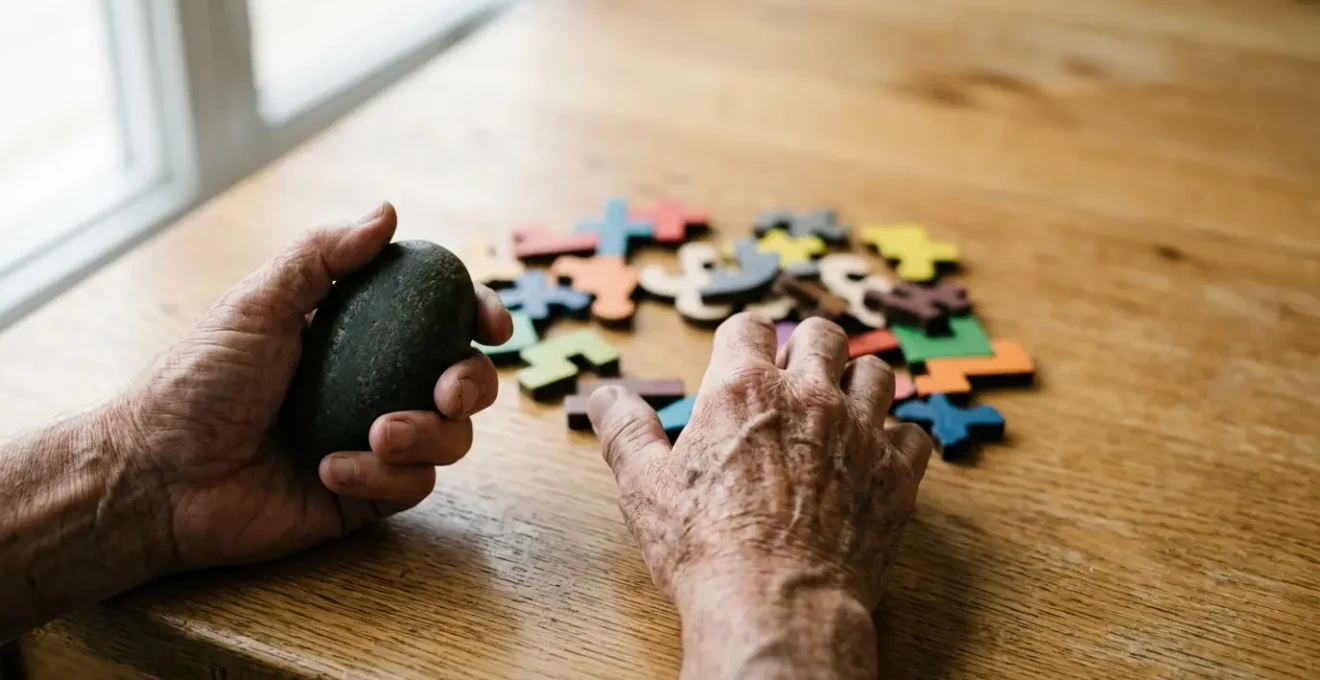
Contrary to popular belief, most commercial brain training games do not prevent dementia; they primarily improve your performance on the game itself, a phenomenon with little real-world benefit.
- True cognitive resilience is built by acquiring new, complex skills that create flexible neural pathways, not by repeating simple digital puzzles.
- Socially and mentally demanding activities, like joining a bridge club or learning a new language, have been shown to be significantly more protective against cognitive decline than isolated app-based training.
Recommendation: Prioritise engaging in challenging, novel, and social real-world activities over spending significant time on repetitive brain training apps to genuinely invest in your long-term brain health.
If you’re a senior in the UK, you’ve likely spent some time with a memory app, diligently tapping away at patterns or matching pairs, driven by the hope that this digital ritual is fortifying your mind against age-related decline. The promise is seductive: a simple, accessible way to fight back against the fear of forgetting, to keep dementia at bay. The market is saturated with these solutions, from Lumosity to Elevate, all suggesting that a few minutes a day can sharpen your mind. You see your scores improve, you get faster, and you feel a sense of accomplishment.
But then, a nagging question emerges. You may be a master at the app’s specific ‘face recognition’ game, yet you still struggle to place the name of a neighbour you bump into at the shops. You can solve the platform’s ‘shopping list’ puzzle in record time, but you still find yourself returning from the supermarket having forgotten the milk. This disconnect between in-game performance and real-world memory is not your imagination. It is the central, critical flaw in the logic of most commercial brain training.
As a clinical neuropsychologist, my focus is on evidence. The crucial question is not whether these games can make you better *at the games themselves*—they can. The question is whether that skill *transfers* to the complex, unpredictable cognitive demands of daily life. This article will dissect the research to explain why getting faster at a memory app often fails to help you find your keys. We will move beyond the marketing hype to explore the neuropsychological principles of cognitive reserve, neuroplasticity, and the ‘transfer fallacy’. Most importantly, we will identify which types of mental exercise, from social clubs to new languages, genuinely build a more resilient brain.
This article examines the evidence behind brain training effectiveness, helping you distinguish between scientifically-backed methods and mere digital pastimes. The following sections will guide you through the key findings.
Summary: The Real Efficacy of Brain Training for Cognitive Health
- Why Does Getting Faster at a Memory App Not Help You Remember Where You Put Your Keys?
- Which Memory Games Actually Improve Shopping List Recall and Face Recognition?
- Elevate App vs Weekly Bridge Club: Which Exercises More Memory Pathways?
- The Smartphone Reminder Habit That Is Quietly Eroding Your Natural Memory
- Morning or Evening Memory Games: When Does Your Brain Actually Retain New Information Best?
- Why Does Learning New Skills Build Brain Resilience Better Than Repetitive Puzzles?
- Lumosity vs Learning a Language: Which Actually Protects Your Brain After 70?
- Why Do 80% of Brain Training Apps Fail to Improve Real-World Memory?
Why Does Getting Faster at a Memory App Not Help You Remember Where You Put Your Keys?
The fundamental reason for the disconnect between game performance and real-world memory lies in a concept called neural pathway specificity. Think of your brain’s pathways like footpaths in a forest. When you repeatedly practice a specific task, like a particular memory game, you are walking the same narrow footpath over and over. That path becomes well-trodden, clear, and easy to navigate. You become faster and more efficient at *that specific journey*. However, this doesn’t help you navigate the rest of the forest.
Finding your keys isn’t a single, repeatable task. It involves a complex interplay of different cognitive functions: spatial memory (Where did I last see them?), episodic memory (What was I doing when I came home?), and executive function (Let’s create a systematic search strategy). These functions use a vast, interconnected network of neural roads, not one single footpath. The highly specific training from the app has not built or reinforced this wider network. This is known as the ‘transfer fallacy’—the mistaken belief that mastery of one specific skill will automatically transfer to broader, related abilities.
Research from leading institutions consistently confirms this limitation. As one research team from Cambridge University bluntly concluded in a comprehensive study:
The benefits of brain training programmes appear to be limited to practice effects of trained tasks, while no evidence is found for transfer effects to other, related or unrelated, untrained cognitive tasks.
– Research team, Cambridge University, Practice makes perfect, but to what end? Computerised brain training has limited cognitive benefits in healthy ageing
Essentially, you are training for the test, not for life. Your brain becomes wonderfully efficient at the precise logic and interface of the app, but those gains remain siloed, failing to generalise to the messy, unpredictable cognitive challenges of your daily routine. The skill you’ve built is too rigid and context-specific.
Which Memory Games Actually Improve Shopping List Recall and Face Recognition?
While most commercial apps fail to deliver on their broad promises, this does not mean all cognitive training is useless. The key is to shift from passive, repetitive tasks to active, strategy-based techniques that force your brain to encode information in a more meaningful way. These aren’t necessarily ‘games’ but are powerful mental exercises that have real-world applications.
For shopping list recall, one of the most effective methods is the ancient Greek technique called the ‘Method of Loci’, or ‘memory palace’. Instead of just repeating the list of items, you mentally place each item in a specific location within a familiar place, like your home. To recall the list, you take a mental walk through your home and ‘see’ the items. This works because it engages your powerful visuospatial memory, linking new, abstract information (the list) to a robust, existing neural structure (your house). It’s an active process of creation and association, not passive repetition.
This image symbolises the deep, structured nature of techniques like the Method of Loci, which build on established mental architecture. For face and name recognition, the strategy involves creating vivid, often humorous, associations. When you meet a new person named ‘Mr. Baker’, you might vividly imagine him wearing a baker’s hat. This creates a stronger, multi-sensory memory trace. Furthermore, some specific, scientifically designed training protocols have shown promise. For instance, certain ‘speed of processing’ exercises, which train you to identify objects quickly in your peripheral vision, were found in a major US study to be associated with a 29% lower risk of developing dementia over 10 years. The crucial difference is that these are highly specific, validated interventions, not general-purpose entertainment apps.
Your Action Plan: Auditing Your Cognitive Exercises
- Identify the Core Skill: For each ‘brain game’ you play, precisely define the single task it trains. Is it pattern matching, rapid calculation, or vocabulary?
- Track Real-World Transfer: For one week, consciously observe if your improved game performance has had any measurable effect on a real-life task (e.g., remembering names, calculating a tip, finding items).
- Compare Active vs. Passive: Spend 15 minutes on a passive app game. Then spend 15 minutes actively using a strategy like the Method of Loci. Which felt more mentally engaging and creative?
- Assess Complexity: Does the activity involve multiple cognitive domains (e.g., logic, social cues, strategy, motor skills) or is it a single, repetitive loop?
- Plan Your Shift: Based on your audit, identify one low-transfer app to reduce your time on, and one new, complex, real-world skill (like learning a card game) to start practicing instead.
Elevate App vs Weekly Bridge Club: Which Exercises More Memory Pathways?
The comparison between a solo digital app and a social group activity like a weekly bridge club is where the limitations of brain training apps become starkest. While an app like Elevate exercises a narrow set of cognitive skills in a predictable environment, a game of bridge engages a vast and dynamic network of neural pathways simultaneously. It represents a far richer and more holistic form of cognitive exercise.
Consider the mental demands of a single hand of bridge. You must engage your working memory to track cards that have been played, your strategic thinking to plan your bids and plays, your probabilistic reasoning to assess your opponents’ likely hands, and your social cognition to read your partner’s signals and your opponents’ behaviour. All of this happens in a fluid, unpredictable, and time-pressured social context. The rules are fixed, but the application is infinitely variable. This complexity forces your brain to be flexible, to integrate multiple streams of information, and to adapt its strategy on the fly. It is the mental equivalent of a full-body workout versus a single bicep curl.
The scientific evidence overwhelmingly supports the superior benefits of social engagement. It’s not just about keeping the mind active; it’s about the unique quality of that activity. Research from the Rush Alzheimer’s Disease Center provides compelling data on this front. As Dr. Lisa Barnes and her colleagues reported:
More social activity was associated with less cognitive decline during average follow-up of 5.2 years. A one point increase in social activity score was associated with a 47% decrease in the rate of decline in global cognitive function.
– Dr. Lisa Barnes et al., Rush Alzheimer’s Disease Center, Late-Life Social Activity and Cognitive Decline in Old Age
This highlights that the social dimension is not a minor add-on; it’s a powerful protective factor. A weekly bridge club, a book group, or a dance class provides a level of multi-modal brain stimulation—cognitive, social, and sometimes physical—that a solo digital experience simply cannot replicate. It actively builds cognitive reserve by forcing different brain networks to work together in concert.
The Smartphone Reminder Habit That Is Quietly Eroding Your Natural Memory
While some technology fails to help, other forms can actively hinder our natural memory functions. The ubiquitous smartphone, with its endless reminders, calendar alerts, and digital lists, has encouraged a pervasive habit known as ‘cognitive offloading’. This is the act of outsourcing our prospective memory—the ability to remember to perform a planned action in the future—to an external device. While convenient, this habit is akin to using a crutch when you don’t need one; it can lead to the atrophy of the underlying cognitive ‘muscles’.
Every time you set a reminder to take medication, call a friend, or buy bread on the way home, you are telling your brain that it doesn’t need to bother with the internal process of encoding and retrieving that intention. The hippocampus and prefrontal cortex, key brain regions for memory formation and planning, are bypassed. Over time, our reliance on these digital prompts can reduce our confidence in our own memory, creating a feedback loop where we offload even more, further weakening our innate abilities.
This isn’t just a theoretical concern. Studies are beginning to quantify this effect. For example, research from the University of California, Santa Cruz revealed that our tendency to rely on the internet for information—a form of cognitive offloading—increases after just one use. Once we know the information is stored externally, our brain learns not to expend the energy to store it internally. This phenomenon, sometimes called ‘digital amnesia’, means we become experts at knowing *where* to find information, but not at knowing the information itself. While useful for facts and figures, this habit is detrimental when applied to the personal intentions and plans that structure our daily lives.
The solution is not to abandon technology, but to use it mindfully. Use digital reminders for critical, high-stakes tasks (like a crucial doctor’s appointment) but make a conscious effort to rely on your natural memory for everyday intentions. Practice active recall by mentally rehearsing your to-do list for the day instead of immediately reaching for your phone. This deliberate practice helps maintain the strength and flexibility of your brain’s own prospective memory system.
Morning or Evening Memory Games: When Does Your Brain Actually Retain New Information Best?
For individuals who choose to incorporate cognitive exercises into their routine, a common question arises: when is the best time to do them? The search for a single ‘optimal’ time for brain training is tempting, but from a neuropsychological standpoint, the answer is more personalised and complex. The effectiveness of learning and memory consolidation is heavily influenced by our individual circadian rhythms, often referred to as our ‘chronotype’—whether we are a natural ‘morning lark’ or a ‘night owl’.
A morning person (‘lark’) typically experiences their peak cognitive alertness and performance in the hours after waking. For them, engaging in a challenging mental task in the morning aligns with their brain’s natural readiness to learn and encode new information. Conversely, a night owl’s brain may not reach its peak performance until the late afternoon or evening. Forcing them to engage in demanding cognitive exercise first thing in the morning could be counterproductive, as their brain is not yet operating at full capacity. Trying to learn when your brain is in a low-arousal state is like trying to sow seeds in frozen ground.
This principle of personalised timing is not just theoretical; it has been observed in studies of digital cognitive training tools. The goal isn’t just to complete the exercise, but to do so when your brain is most receptive to forming and strengthening neural connections.
Case Study: The Impact of Chronotypes on Digital Training
Research on digital cognitive training apps has shown that user engagement and performance patterns vary significantly based on individual circadian rhythms. An analysis of user data found distinct clusters of activity: some users consistently showed optimal performance and longer engagement during morning sessions, while others peaked in evening sessions. This suggests that a one-size-fits-all recommendation is ineffective. The data supports the idea that personalised timing strategies, aligned with an individual’s natural chronotype, are essential for maximising the potential benefits of any cognitive training regimen.
Therefore, the most effective approach is to experiment and identify your own window of peak cognitive function. Pay attention to when you feel most mentally sharp, clear-headed, and able to concentrate. Schedule your most demanding mental activities—whether it’s learning a new skill, playing a complex game, or planning your week—for that period. Working *with* your brain’s natural rhythm, rather than against it, will yield far better results for information retention and skill acquisition.
Why Does Learning New Skills Build Brain Resilience Better Than Repetitive Puzzles?
The superiority of learning a new, complex skill over completing repetitive puzzles lies in the demands each activity places on neuroplasticity—the brain’s remarkable ability to reorganise itself by forming new neural connections. Repetitive puzzles, like daily crosswords or Sudoku, are excellent for maintaining existing cognitive pathways. However, they are less effective at building new ones, which is the true foundation of cognitive reserve.
When you learn a completely new and challenging skill—such as a musical instrument, a new language, or digital photography—you are forcing your brain out of its comfort zone. You are not just retrieving stored information; you are acquiring new knowledge, coordinating different brain regions, and building entirely new procedural and semantic memories. This process requires the brain to physically change its structure. It strengthens connections between neurons, grows new dendrites (the branches that receive signals), and improves the efficiency of entire neural networks. This is the very essence of building a more resilient, adaptable brain.
Recent research using advanced neuroimaging techniques has started to visualize these structural changes. For instance, a 2024 study on lifestyle improvement interventions found that participants who engaged in such programmes showed significant improvements in the white matter integrity of their brains. They observed “significant improvements in fractional anisotropy of whole brain, corpus callosum, and multiple neural pathways.” In layman’s terms, this means the ‘wiring’ and communication highways of the brain became more robust and efficient. The brain didn’t just get better at a task; the organ itself became healthier and better connected.
A simple puzzle, by contrast, is a closed system. Once you understand the logic of Sudoku, each new puzzle is a variation on a theme, not a novel challenge. It reinforces a specific problem-solving circuit but does little to expand your brain’s overall toolkit. Learning a new skill is an open-ended journey of discovery that demands constant adaptation, problem-solving, and the integration of new information, providing a far more potent stimulus for neuroplasticity and building a brain that is more resistant to the effects of ageing and disease.
Lumosity vs Learning a Language: Which Actually Protects Your Brain After 70?
When directly comparing a typical brain training app like Lumosity to the endeavor of learning a new language, the difference in cognitive benefit is profound, especially after the age of 70. Learning a language is not just a ‘memory game’; it is a comprehensive cognitive workout that builds substantial cognitive reserve in a way that simple, repetitive drills cannot.
Consider the mental processes involved in learning and speaking a new language. You must master a new vocabulary (semantic memory), learn grammatical rules (procedural memory), and practice pronunciation (motor skills). When you speak, your brain must constantly manage two competing language systems, selecting words from one while inhibiting the other. This constant mental juggling act is a powerful exercise for your brain’s executive functions—the high-level cognitive skills managed by the prefrontal cortex that include attention control, task switching, and problem-solving. These are the very functions that are often among the first to decline in ageing and dementia.
The protective effects of bilingualism are not just theoretical; they are backed by significant clinical evidence. The constant workout it provides the brain appears to delay the onset of dementia symptoms. The brain of a bilingual individual might show the same level of Alzheimer’s-related pathology as a monolingual person, but their superior cognitive reserve allows them to function normally for longer. A landmark UCLA study of 253 Alzheimer’s patients found that bilingualism was associated with a delay in the onset of dementia symptoms by as much as four years.
In contrast, the skills practiced in an app like Lumosity are narrow and isolated. Excelling at a pattern-matching game does little to strengthen the complex, interconnected networks required for executive function. While it may provide short-term mental stimulation, it does not offer the deep, structural, and lasting benefits of engaging with a rich, complex, and open-ended system like a new language. For genuine, long-term brain protection after 70, the choice is clear: engaging with the world through a new language is a far more powerful investment in your cognitive future.
Key Takeaways
- The primary benefit of most brain training apps is improved performance on the specific games themselves, with little to no “far transfer” to real-world cognitive tasks.
- Building true cognitive reserve comes from learning new, complex, and challenging skills (like a language or musical instrument) that force the brain to create new, flexible neural pathways.
- Socially engaging and mentally demanding activities, such as book clubs or card games like bridge, provide a far more holistic and protective cognitive workout than isolated digital training.
Why Do 80% of Brain Training Apps Fail to Improve Real-World Memory?
The high failure rate of brain training apps to produce meaningful, real-world improvements can be distilled down to two core issues: the scientific principle of ‘near transfer’ versus ‘far transfer’, and the commercial problem of publication bias. The entire business model of many brain training companies rests on the implicit promise of far transfer, a promise that scientific evidence has largely failed to support.
‘Near transfer’ is the improvement on tasks that are very similar to the one you trained on. If you practice a specific type of memory game, you will get better at it, and you might see slight improvements in very similar games. This is what most apps achieve. ‘Far transfer’, however, is the holy grail: the idea that training on one task (like a game) will improve a broad, different ability (like general memory, intelligence, or executive function). As a study in the *Brain and Behavior* journal summarised, “many previous studies have shown that brain training only leads to improvements in specific skills or ‘near transfer,’ but not ‘far transfer’ that involves improvement.” This is the fundamental disconnect. The apps deliver near transfer, but consumers are paying for the hope of far transfer.
This issue is compounded by publication bias. Positive results are more likely to be published than studies showing no effect, creating a skewed public perception of the evidence. When researchers conduct meta-analyses—studies of studies—and correct for this bias, the already small effects of brain training often vanish. A recent, rigorous meta-analysis of brain training randomized controlled trials revealed that once this bias was statistically accounted for, most of the claimed transfer effects were no longer significant. The evidence base is simply not as robust as the marketing materials suggest.
Therefore, the 80% failure rate is not surprising. It’s the natural outcome of a business model built on a scientifically dubious premise. The apps are not necessarily fraudulent; they are simply selling a product whose real-world efficacy is minimal. They are selling a highly specific form of practice, while the consumer is hoping to buy a general shield against cognitive decline. The evidence shows that this is a transaction that, for the most part, fails to deliver on its most important promise.
Ultimately, the most effective path to a resilient brain is not found on a screen, but in the challenges of the real world. Instead of focusing on improving your score in a digital game, invest that time and energy in learning a new skill, engaging in your community, and staying physically active. These are the strategies with robust, scientific backing for building a brain that is not just better at games, but better at life.