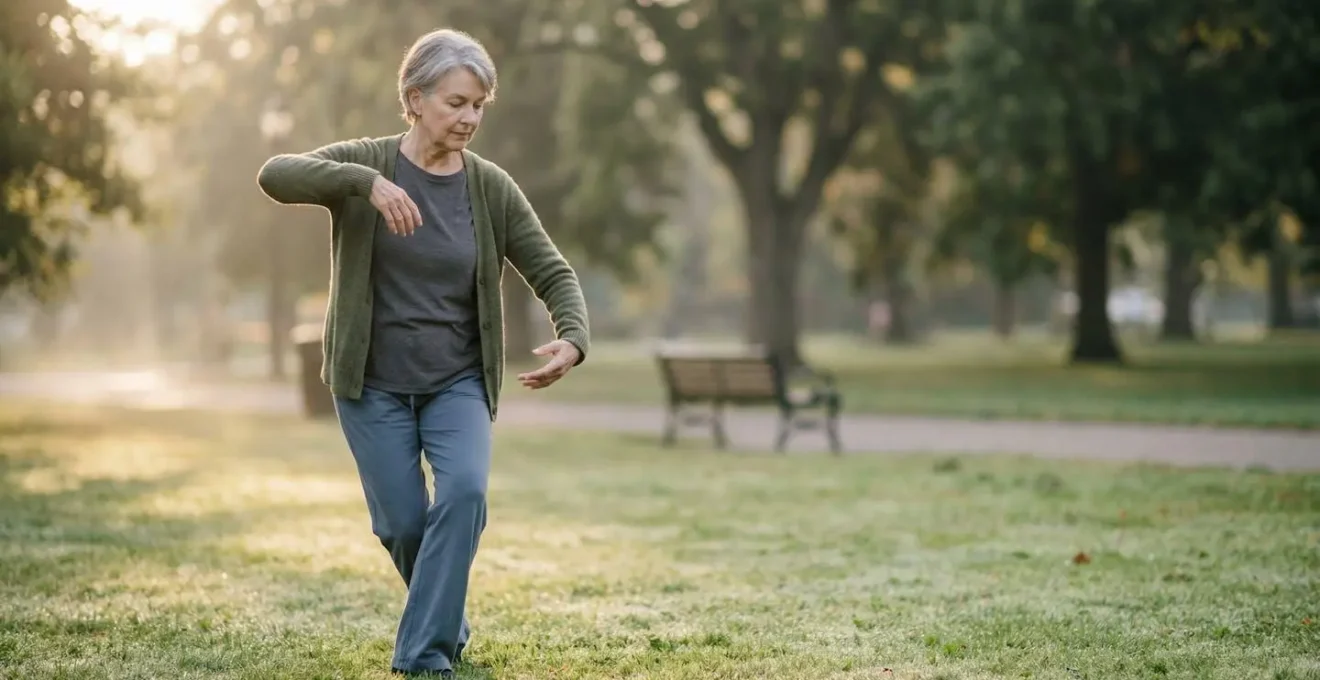
The remarkable 50% reduction in falls among Tai Chi practitioners isn’t magic; it’s the result of systematically retraining the body’s core balance and awareness systems.
- Slow, deliberate movements rebuild the brain-body connection (proprioception) far more effectively than regular walking.
- Specific styles, like the Sun style, are designed with higher stances to be gentle and beneficial for arthritic joints.
Recommendation: Begin not by trying to learn a full routine, but by mindfully practising a single weight-shifting movement for a few minutes each day to reawaken your sense of balance.
The fear of a fall can cast a long shadow over daily life. For many of us, it becomes a quiet, persistent worry that can limit our activities and our confidence. We are often told to simply “be more careful,” perhaps use a walking stick, or to arrange our homes to minimise hazards. While this advice is sensible, it only addresses the external environment. It does little to strengthen our body’s own, internal system for preventing falls.
What if the most profound solution wasn’t about avoiding risk, but about fundamentally rebuilding our stability from the inside out? This is where the ancient practice of Tai Chi offers a perspective that is both gentle and revolutionary. It’s more than just a “low-impact exercise.” The true power of Tai Chi lies in its ability to re-establish the intricate communication between your brain and your body, a process I call neuromuscular re-education. It’s about teaching your muscles and nerves to work together again with precision and confidence.
This article will not just tell you that Tai Chi is good for you. It will deconstruct the specific reasons why it is so effective. We will explore how its slow, deliberate movements build balance faster than walking, which style is best for sensitive knees, and how to find accessible classes right here in the UK. We will even see how the practice can make you more aware and safer in your own home, transforming your approach to stability and restoring your freedom of movement.
Let’s delve into the principles that make this gentle art such a powerful tool for maintaining independence and living without fear. This guide breaks down the core components, from the science of slow movement to practical steps for getting started.
Summary: Why Tai Chi is a Senior’s Best Ally Against Falls
- Why Does Slow Movement Strengthen Balance Faster Than Walking at Normal Speed?
- How to Find a Free or Subsidised Tai Chi Class Through Your GP or Local Council?
- Yang or Sun Style Tai Chi: Which Is Gentler on Arthritic Knees?
- The Cold Morning Mistake That Stiffens Joints and Defeats the Purpose of Tai Chi
- In What Order Should You Learn the 8 Basic Tai Chi Movements for Fastest Balance Gains?
- The 10-Day Bed Rest Mistake That Costs Seniors 10% of Their Leg Muscle
- When Should You Install Bathroom Grab Rails: After a Near-Miss or Before Any Incidents?
- Why Does Installing a Grab Rail Reduce Hip Fracture Risk by 30%?
Why Does Slow Movement Strengthen Balance Faster Than Walking at Normal Speed?
It seems counter-intuitive, doesn’t it? We associate strength and stability with speed and power. Yet, the secret to Tai Chi’s profound impact on balance lies in its deliberate slowness. When you walk at a normal pace, your body relies on momentum and ingrained, often inefficient, habits. Your brain is on autopilot. Slowing down forces a completely different process: a proprioceptive dialogue between your body and your brain.
Proprioception is your body’s ability to sense its own position, motion, and balance. It’s an internal GPS run by millions of tiny sensors in your muscles, tendons, and joints. As we age, or after periods of inactivity, this communication system can become sluggish. Slowing a movement down, like shifting your weight from one foot to the other over several seconds, gives your brain the time it needs to receive, process, and respond to this flood of sensory information. You are consciously feeling the tiny adjustments in your ankle, the engagement of your thigh muscles, and the subtle shift of your centre of gravity. This is active learning for your nervous system.
This mindful process builds new, stronger neural pathways. It’s like upgrading your body’s internal software from a dial-up connection to high-speed broadband. Instead of reacting to a loss of balance, your body learns to anticipate and prevent it. This is the foundation of dynamic stability—the ability to remain balanced and in control while moving through the world.
As you can see in the subtle muscle engagement here, every part of the foot and lower leg is participating in the act of balancing. Walking fast masks these details, but moving slowly makes them the entire focus of the exercise. You are not just moving; you are re-learning the very skill of balance itself, one deliberate, mindful motion at a time.
How to Find a Free or Subsidised Tai Chi Class Through Your GP or Local Council?
One of the most significant barriers to starting a new activity can be finding the right class and managing the cost. The good news is that within the UK, the benefits of Tai Chi for fall prevention are so well-recognised that many opportunities are available through public health initiatives. Your journey can often start with a simple conversation with your GP or a social prescriber at your practice. They are increasingly aware of local wellness programs and can often refer you to “exercise on referral” schemes that include subsidised Tai Chi.
Beyond your GP, local councils are a fantastic resource. As part of their Falls Prevention Campaigns, many UK local authorities have implemented free or very low-cost Tai Chi classes specifically for adults over 50. These sessions are designed to be welcoming, safe, and taught by instructors who understand the needs of older adults. You’ll find a supportive, criticism-free environment where everyone works at their own pace, making it an ideal setting for new members to build confidence alongside their balance.
To start your search, check the “Adult Social Care” or “Public Health” sections of your local council’s website. You can also contact community centres, local libraries, and Age UK branches, as they frequently host or have information about these valuable programmes. The focus is on community well-being, so these classes are often incredibly affordable, sometimes just a few pounds per session or even completely free.
Your Action Plan: Finding a Local Tai Chi Class
- Contact your local senior centre: Ask specifically about wellness programs or Tai Chi classes designed for older adults.
- Check with community centres and parks departments: These public bodies frequently host free or low-cost exercise programs in community halls or even outdoors in good weather.
- Visit your local library: Many libraries have evolved into community hubs and often organise free Tai Chi sessions in collaboration with local instructors.
- Attend local health fairs: Keep an eye out for events organised by the NHS or local health bodies, as they often feature free demonstrations and workshops.
- Research local organisations: Charities like the YMCA or even some martial arts studios may offer free introductory sessions for seniors to try Tai Chi.
Yang or Sun Style Tai Chi: Which Is Gentler on Arthritic Knees?
A common and very valid concern when starting any new physical activity is the impact it will have on existing conditions, particularly arthritis in the knees. The world of Tai Chi is diverse, with several major “styles,” each with its own characteristics. For those with knee sensitivity, the choice of style is crucial. While the Yang style is the most popular and widely practised, the Sun style is often the superior choice for anyone with arthritis.
The Sun style was developed by Sun Lutang, a renowned martial arts expert who integrated his knowledge to create a form with higher stances, less deep knee bending, and smoother, flowing movements. It incorporates a unique “follow-step” pattern, where one foot moves and the other follows, which avoids the twisting and turning of the knee joint that can occur in other styles. This design makes it exceptionally gentle on the joints while still providing all the core benefits of balance, coordination, and strength training. In fact, its benefits are so clear that research published in the Journal of Clinical Nursing demonstrated that Sun-style Tai Chi significantly reduced perceived arthritic symptoms in older women.
The table below breaks down the key differences to help you make an informed choice. It highlights why arthritis foundations and health institutes specifically recommend the Sun style for joint health.
| Feature | Sun Style | Yang Style |
|---|---|---|
| Stance Height | Higher stance with less knee flexion | Moderate to low stances requiring deeper knee bending |
| Knee Stress | Minimal compressive load on knees | Moderate to high stress depending on stance depth |
| Movement Pattern | Follow-step pattern avoiding knee twisting | Turning movements that may stress knee ligaments |
| Flow Continuity | Smooth, unbroken flow keeps joints lubricated | Flowing with occasional pauses |
| Arthritis Suitability | Specifically recommended by Arthritis Foundation | Suitable with modifications for joint protection |
| Accessibility for Seniors | Designed for older adults and joint conditions | Most popular style, widely available but may require adaptations |
The Cold Morning Mistake That Stiffens Joints and Defeats the Purpose of Tai Chi
There is a certain romance to the idea of practising Tai Chi in the crisp morning air, as is often seen in parks. However, for anyone with joint stiffness or arthritis, this can be a significant mistake. Cold muscles and joints are less flexible and more prone to strain. Plunging straight into even the gentlest Tai Chi movements without a proper warm-up can lead to discomfort and stiffness, undermining the very purpose of the practice, which is to promote fluidity and ease of movement.
The purpose of a warm-up is to increase blood flow to the muscles and lubricate the joints with synovial fluid. This is not about vigorous stretching; it’s about gentle, preparatory motion. Simple actions like slowly rotating your wrists, ankles, shoulders, and neck, or gently marching on the spot for a few minutes can make a world of difference. This preparation sends a signal to your body that it’s time to move, making your Tai Chi practice safer, more comfortable, and far more effective.
Think of it like starting a car on a frosty morning; you let the engine run for a minute before driving off. Your body deserves the same consideration. As a leading expert from the Tai Chi for Health Institute advises, listening to your body is paramount, especially when managing conditions like arthritis.
Students with arthritis should stand up between movements to avoid excessive stress to their knees, until they develop strong muscles and ligaments.
– Dr. Paul Lam, Tai Chi for Health Institute – Teaching Tai Chi Safely Guidelines
This principle of listening to your body starts before the first Tai Chi form. Always begin your practice with a dedicated warm-up to awaken your joints and muscles, ensuring every movement is one of healing, not strain.
In What Order Should You Learn the 8 Basic Tai Chi Movements for Fastest Balance Gains?
When you first see a Tai Chi form, it can look like a complex, flowing dance. The key to learning it effectively, especially for balance, is not to try and memorise the whole sequence at once. Instead, you should approach it as a progressive journey, mastering one foundational skill before moving to the next. The “correct” order is one that builds stability from the ground up, starting with stillness and gradually introducing more complex, coordinated motion.
The goal is not to learn a certain number of movements, but to deeply understand the *feeling* of each one. The “One Movement, One Week” principle is a powerful approach. By focusing on a single movement for a full week, you prioritise quality over quantity, allowing your body to internalise the principles of weight-shifting and rooting—the sensation of being firmly connected to the ground. This methodical pace ensures that you are truly performing neuromuscular re-education, not just imitation.
While different schools may vary slightly, a logical progression for building balance generally follows the sequence outlined below. This progression starts with mastering your centre before adding arm movements, and then finally integrating stepping and turning.
Progressive Learning Sequence for Tai Chi Balance Training
- Movement 1 – Commencement Form: Master stillness and rooting by learning proper stance alignment with feet shoulder-width apart and gentle knee softening.
- Movement 2 – Basic Weight Shift: Practice transferring weight slowly between legs while maintaining upright posture to build foundational balance control.
- Movement 3 – Part the Wild Horse’s Mane: Introduce coordinated contra-body movement, combining arm flow with weight transfer to challenge stability.
- Movement 4 – Brush Knee and Push: Coordinate upper and lower body while moving, integrating arm movements with stepping patterns.
- Movement 5 – Single Whip: Develop rotational balance and core engagement through controlled turning movements.
- Movement 6 – Wave Hands Like Clouds: Practice continuous lateral weight shifts to build dynamic stability and fluidity.
As you learn, remember that each movement is an opportunity to practice the core skill of mindful weight transfer. Many free lessons from respected sources like the Tai Chi for Health Institute emphasise this principle of building a solid foundation first.
The 10-Day Bed Rest Mistake That Costs Seniors 10% of Their Leg Muscle
After an illness, surgery, or even just a period of significant inactivity, the temptation to rest completely can be strong. While rest is a vital part of recovery, prolonged bed rest comes with a hidden and rapid cost: muscle loss, a condition known as sarcopenia. The statistic is startling but true: for an older adult, just 10 days of significant inactivity can lead to a loss of up to 10% of their leg muscle mass. This isn’t just a loss of strength; it’s a loss of your body’s primary support structure.
Your leg muscles, particularly the large quadriceps in your thighs, are your body’s shock absorbers and stabilisers. They are what allow you to get up from a chair, climb stairs, and, most importantly, catch yourself during a momentary loss of balance. When this muscle mass diminishes, your stability is severely compromised. Your base of support becomes weaker, and your risk of falling increases dramatically. This can create a vicious cycle: muscle loss leads to a fear of falling, which leads to more inactivity, which in turn leads to further muscle loss.
Breaking this cycle requires a gentle, safe, and effective way to re-engage those muscles. This is where a practice like Tai Chi becomes invaluable during a recovery period. Its slow, controlled movements allow you to rebuild strength without putting undue stress on your body. The simple act of shifting your weight from one leg to the other in a Tai Chi stance gently reactivates those crucial stabilising muscles. It helps to reverse the effects of sarcopenia, restoring not just muscle, but confidence in your body’s ability to support you.
Therefore, after any period of enforced rest (and with your doctor’s approval), the goal should be to introduce gentle movement as soon as is safely possible. Resisting the urge to remain completely sedentary is a crucial step in preserving the muscle that protects you from falls.
When Should You Install Bathroom Grab Rails: After a Near-Miss or Before Any Incidents?
The answer to this question is unequivocally: before any incidents. A grab rail is not a sign of defeat; it is a smart, proactive tool for maintaining independence. Waiting for a near-miss or, worse, a fall, is a reactive strategy that puts your health at risk. The time to install safety aids is when you are still strong and mobile, viewing them as an enhancement to your environment, not a concession to frailty.
But how do you decide where they are needed? This is where your Tai Chi practice provides an unexpected and powerful benefit. Tai Chi cultivates an incredibly high level of body awareness, or proprioception. You become acutely sensitive to how your body feels as it moves through space. You can harness this newfound sensitivity to perform a “mindful audit” of your own home. As you move through your daily routines, pay close attention to the moments and places where your balance feels most challenged.
Is it when you step out of the bath or shower? Is it when you lower yourself onto or rise from the toilet? These are the precise locations where a grab rail will provide the most benefit. The heightened awareness gained from your practice acts as a diagnostic tool. As noted by experts in the field, this is a direct application of skills learned in class to the real world. According to insights from research on proprioceptive awareness application, practitioners can use this skill to identify personal stability challenges in their living environment.
Use the heightened body awareness gained from Tai Chi to mindfully move through their home and identify spots where their balance feels most challenged.
– Tai Chi for Health practitioners
Think of it this way: your Tai Chi practice helps you identify the vulnerabilities, and the grab rail is the simple, effective solution to fortify them. It’s a partnership between your own internal stability and a well-prepared external environment.
Key takeaways
- Slow movement isn’t just gentle; it’s a form of deep neurological training that rebuilds your balance system from the ground up.
- The right style of Tai Chi, such as the Sun style with its higher stances, makes the practice accessible and beneficial even for those with arthritic knees.
- The body awareness gained from Tai Chi is a practical tool you can use to audit your own home for fall risks, guiding where to place safety aids like grab rails.
Why Does Installing a Grab Rail Reduce Hip Fracture Risk by 30%?
The 30% reduction in hip fracture risk associated with something as simple as a grab rail may seem surprisingly high, but it makes perfect sense when you understand the mechanics of a fall. A hip fracture is rarely caused by simply falling downwards. It is most often the result of a slip that involves a sudden, uncontrolled twisting or rotational force as the body attempts to regain balance, followed by an impact on the side of the hip.
A grab rail intervenes at the most critical moment in this chain of events. When you begin to slip on a wet surface, your immediate, instinctive reaction is to reach out for something stable. If your hand finds a secure grab rail, you instantly create a third point of contact with a stable structure. This immediately arrests the body’s rotation. It prevents the uncontrolled spin that puts so much torque on the hip joint and femur.
By providing an anchor point, the grab rail allows you to stabilise your core and guide your body safely, either by preventing the fall entirely or by allowing for a much more controlled descent if a fall is unavoidable. It turns a potentially catastrophic, sideways impact into a far less dangerous situation. The grab rail isn’t just preventing a fall; it’s preventing the *specific type* of twisting fall that is most likely to result in a hip fracture. This is why its impact on this particular injury is so significant. It directly neutralises the most dangerous force at play.
Ultimately, a safe home is one that combines your own internal, cultivated stability with smart, external supports. Tai Chi builds your internal “grab rail” through better balance and awareness, while the physical rail provides the external safety net. Together, they create a powerful system for preserving your health and independence.
The first step on this journey is often the simplest. Begin today by standing in a clear space and mindfully practising a slow weight shift from one foot to the other. Feel the connection with the ground and start the conversation with your body. This small action is the beginning of rebuilding your foundation of stability.