After a fall or a health scare, the conversation in many British families quickly turns to one difficult topic: is it time for a care home? It’s a question filled with anxiety, for both the senior who values their independence and the family worried about their safety. We’re often told the solution lies in a few standard fixes—installing a grab rail, getting a personal alarm, or considering a move. But from my professional experience as an Occupational Therapist (OT) specialising in home adaptations, this approach is fundamentally flawed. It’s reactive, not proactive.
The stark reality is that thousands of seniors in the UK enter residential care not because their health has failed them, but because their home environment has. The tragedy is that this decline is often preventable. The key to extending independence isn’t found in a single gadget or a drastic move. Instead, the solution is to treat aging in place as a strategic project. It requires understanding the dangerous friction between separate systems—the NHS, local council housing departments, and social care—and learning how to make them work for you, not against you.
But what if the true path to staying in your own home for longer wasn’t about simply adding safety features, but about fundamentally redesigning the relationship between you and your environment? This guide moves beyond the generic advice. We will explore the specific, evidence-based interventions that make a real difference, from navigating the Disabled Facilities Grant (DFG) system to understanding the hidden risks of hiring private carers. It’s time to stop seeing the home as a collection of risks and start seeing it as the single most powerful tool for maintaining autonomy and quality of life for years to come.
This article provides a practical, OT-led roadmap to securing those extra years of independence. We will break down the crucial decisions you’ll face, providing clear, actionable steps based on years of frontline experience with UK homeowners.
Summary: How to Reclaim Years of Independence in Your Own Home
- Why Poor Lighting in Your Hallway Could Be the Reason for Your Next Hospital Stay?
- How to Get a Council-Funded Stairlift Without Waiting 18 Months?
- Adapting Your Current Home vs Moving to a Retirement Village: Which Costs Less Over 10 Years?
- The Dangerous Grab Rail Mistake That 40% of Families Make When Helping Elderly Parents
- In What Order Should You Install Ramps, Rails, and Lighting to Get Maximum Safety for £2,000?
- What Are the 7 Systems You Must Coordinate to Keep Someone Home Instead of in a Care Home?
- Why Does Hiring a Private Carer Directly Leave You Without CQC Protection?
- Why Does Coordinating Aging in Place Require 7 Different Services to Work Together?
Why Poor Lighting in Your Hallway Could Be the Reason for Your Next Hospital Stay?
From an OT’s perspective, the most dangerous areas in a home are not the obvious ones. They are the ‘transition zones’—doorway thresholds, the top of the stairs, and hallways. Poorly lit corridors are a primary culprit in falls, yet they are one of the most frequently overlooked risks. As we age, our eyes require up to three times more light to see with the same clarity as a younger person, and our ability to adapt to changing light levels diminishes. A quick walk from a bright living room into a dim hallway can cause momentary disorientation, which is all it takes to miss a step or misjudge a turn.
The solution is not simply a brighter bulb. It’s about creating ‘task lighting’ for navigation. This means using low-level, motion-activated LED strips along skirting boards or installing wall lights that create pools of light at key decision points, such as the entrance to a room or the first step of a staircase. The colour of the light also matters. A warm, amber-toned light (around 2700K) is less jarring to the eye at night than a harsh, blue-white light, preserving night vision and reducing confusion.
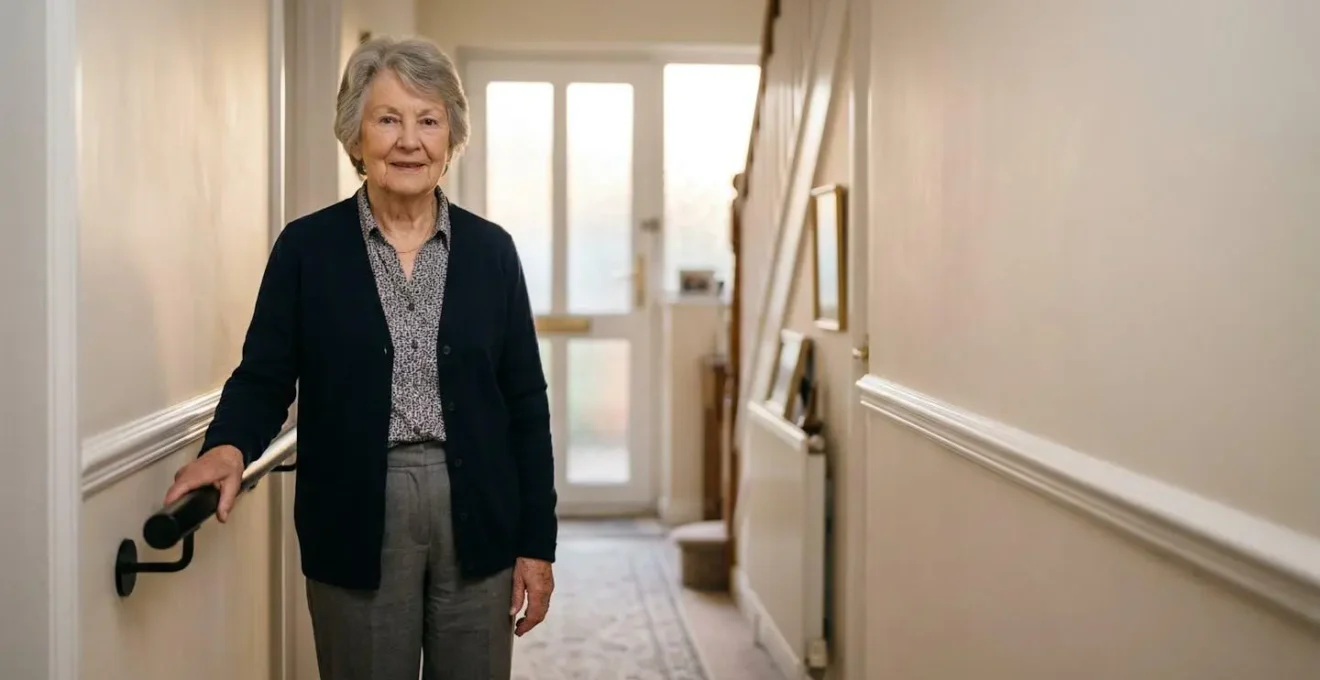
As you can see in the image, strategic lighting doesn’t just illuminate; it guides. It turns a potential hazard into a safe and clear pathway. The evidence strongly supports this proactive approach. A landmark study by Health Data Research UK of over 600,000 older people found that home interventions, like improved lighting, are highly effective at reducing fall-related hospital admissions. Investing in good hallway lighting is not a decorating choice; it’s a critical healthcare decision.
How to Get a Council-Funded Stairlift Without Waiting 18 Months?
For many, the staircase becomes the single biggest barrier to remaining at home. A stairlift seems like the obvious solution, and the Disabled Facilities Grant (DFG) is the primary route to funding it. However, what most families discover is a bureaucratic maze with devastatingly long waiting times. It’s not an exaggeration to say that delays can stretch over a year. In fact, recent Ombudsman data from North Yorkshire revealed an average of 262 days just from the OT referral to the DFG approval, with hundreds of cases pending.
This ‘system friction’ leaves people trapped, often living in one room downstairs while they wait, which rapidly accelerates physical and mental decline. From my experience on the front line, however, there are proven strategies to navigate this system more effectively. You don’t have to be a passive victim of the waiting list. The key is to be proactive and understand the pressure points within the local authority system. Here are the steps I advise families to take:
- Request an Urgent Home Assessment BEFORE Hospital Discharge: This is the single most effective tactic. A request linked to a hospital discharge is automatically re-categorised from a standard need to the ‘Discharge-to-Assess’ pathway, which councils are under immense pressure to prioritise to free up NHS beds.
- Commission a Private Occupational Therapist Report: While waiting for the council OT, a private report (costing £300-£500) can be submitted with your DFG application. This preemptively answers the council’s clinical questions and demonstrates a high level of need, often cutting months off the decision-making process.
- Accept a Council-Approved Reconditioned Stairlift: Many councils have contracts with suppliers for reconditioned units. While some may want a brand-new model, being flexible and accepting a reconditioned one can place you in a much shorter queue, with installation often happening within weeks rather than months.
- Apply for Bridge Funding from UK Charities: While the DFG is being processed, don’t wait. Charities like local Age UK branches and The Royal British Legion (for veterans) often provide grants or short-term loans to get essential equipment installed quickly. This can bridge the gap and prevent a crisis.
By taking these steps, you shift from being a passive applicant to an active manager of your own case, significantly increasing the chances of getting the adaptation you need in a timeframe that preserves, rather than erodes, independence.
Adapting Your Current Home vs Moving to a Retirement Village: Which Costs Less Over 10 Years?
When managing at home becomes a concern, the glossy brochures of retirement villages can seem like an attractive, all-in-one solution. They promise safety, community, and peace of mind. However, it is absolutely critical to look past the marketing and conduct a cold, hard financial comparison. From a purely economic standpoint, adapting your current home is almost always a fraction of the cost over a ten-year period.
The initial outlay for a comprehensive home adaptation, including major changes like a stairlift and a wet room, can be largely covered by a Disabled Facilities Grant (up to £30,000 in England). Even if you need to self-fund through savings or equity release, the cost is a one-off investment. A retirement village, on the other hand, involves not only a high purchase price but also a cascade of ongoing and hidden fees that accumulate year after year. These include substantial annual service charges, ground rent, and, most significantly, punishing ‘exit fees’ or ‘event fees’ when you sell the property.
The following table, based on data from the HomeOwners Alliance, breaks down the staggering difference in long-term costs. It’s a comparison that every family considering a move should see.
| Cost Element | Adapting Current Home (10 years) | Retirement Village (10 years) |
|---|---|---|
| Initial Cost | £15,000-£30,000 (adaptations via DFG or equity release) | £250,000-£600,000 (purchase price average UK) |
| Annual Service Charge | £0 | £6,288-£8,786/year = £62,880-£87,860 over 10 years |
| Ground Rent | £0 | £400-£500/year = £4,000-£5,000 over 10 years |
| Exit Fee (Event Fee) | £0 | 8%-24% of resale value (£20,000-£144,000 on £600k property) |
| Stamp Duty (moving cost) | £0 | £12,500-£30,000 (one-time on purchase) |
| Total 10-Year Cost | £15,000-£30,000 | £350,000-£867,860 |
The numbers speak for themselves. Beyond the financial argument, adapting your current home allows you to retain your primary asset, stay within your community, and maintain the priceless comfort of familiar surroundings. While retirement villages offer a valid lifestyle choice for some, they should not be seen as the default ‘safer’ or ‘easier’ option without a full and transparent understanding of their true long-term financial impact.
The Dangerous Grab Rail Mistake That 40% of Families Make When Helping Elderly Parents
A grab rail seems like the simplest of home adaptations. A quick trip to a DIY store, a few screws, and the job is done, right? This is a dangerous misconception. In my work, I regularly see incorrectly installed or poorly placed grab rails that have either failed under pressure or, worse, inadvertently created a new hazard. As the experts at Solent Bathrooms note, “A poorly placed grab rail can sometimes be more dangerous than having none at all, as it may lead to overbalancing or muscle strain.”
The most common mistake isn’t technical; it’s psychological. Many well-meaning families install clinical, hospital-style rails without consulting the person who will use them. This can feel disempowering, leading to the rail being rejected or ignored. An unused grab rail is useless. The key is to reframe the installation not as a symbol of frailty, but as a ‘smart home upgrade’ for everyone’s convenience and safety. Modern, stylish rails that double as towel holders or toilet roll holders can be integrated seamlessly into the decor, increasing acceptance and use.
Another critical error is using the wrong fixings for the wall type. A standard plastic wall plug in a plasterboard wall offers almost no structural support. Under the sudden load of a slip or fall, the rail will simply be ripped from the wall, causing a more severe injury. It is essential to use specialist fixings for hollow walls or, ideally, to have rails professionally installed. Before you install any grab rail, it is vital to perform a quick audit to ensure it will be safe, accepted, and effective.
Your 5-Point Audit for a Safe and Accepted Grab Rail Installation
- Points of Contact: Identify all the key ‘touchpoints’ where support is needed during a movement (e.g., pushing up from the toilet, stepping into the bath, navigating an internal step). This defines where a rail is truly necessary.
- Wall Structure & Decor: Inventory the existing wall material (plasterboard, brick, tile) to select the correct, heavy-duty fixings. Collect information on the bathroom’s style to choose a rail that complements the decor.
- User Coherence: Discuss the options with the user. Does the proposed rail feel empowering or institutional? Does its placement match their natural movement pattern? A rail at the wrong height or angle can cause strain.
- Emotional Impact: Evaluate the emotional framing. Present the installation as a “convenience upgrade” for the whole family, focusing on ease and comfort rather than disability. This is key for user acceptance.
- Integration Plan: Create a plan that pairs the physical installation with a simple, OT-approved balance and strength exercise routine. This ensures the rail is a support tool, not a crutch that leads to deconditioning.
Finally, installing a rail can create a false sense of security, causing a person to neglect the essential strength and balance exercises that truly prevent falls. A grab rail should always be part of a wider strategy that includes maintaining physical capability.
In What Order Should You Install Ramps, Rails, and Lighting to Get Maximum Safety for £2,000?
When a health scare happens, families often feel an urgent need to “do everything” at once, leading to scattered spending and inefficient safety improvements. With a limited budget, prioritisation is everything. As an OT, I advise clients to focus on a phased approach that addresses the highest-risk areas first. For a budget of around £2,000, you can create a powerful safety net that tackles the most common causes of falls, which cost the NHS more than £2.3 billion per year.
Forget a complete home overhaul. Instead, think in terms of ‘high-impact safety zones’. The goal is to spend your money where it will have the greatest preventative effect. The evidence—and my clinical experience—points to a clear hierarchy of risk. The following sequence is designed to deliver the maximum safety return on investment.
Phase 1: Secure the Transitions (£500)
The highest risk of falling occurs during transitions. Start here.
- Lighting: As we’ve discussed, this is the top priority. Install motion-sensor LED lighting in the hallway, at the top and bottom of the stairs, and on the path to the bathroom. This is a low-cost, high-impact intervention.
- Thresholds: Remove or secure any loose rugs. Install high-visibility, non-slip threshold strips between rooms with different flooring levels.
Phase 2: Conquer the Bathroom (£800)
The combination of hard surfaces and water makes the bathroom the second most critical zone.
- Grab Rails: Professionally install high-contrast, correctly-placed grab rails next to the toilet and in the bath/shower area. Don’t DIY this.
- Non-Slip Surfaces: Use a high-quality non-slip bath mat inside the tub and ensure the floor outside is safe. Consider a professional non-slip treatment for the floor.
- Seating: A sturdy shower stool or bath board can dramatically reduce fatigue and the risk of slipping.
Phase 3: Master the Stairs & Access (£700)
Only after securing transitions and the bathroom should you address the bigger structural elements.
- Handrails: Ensure there is a sturdy, continuous handrail on both sides of the staircase. This provides much more stability than a single rail.
- Ramps: For one or two steps at the entrance, a modular, non-slip ramp can be installed. This is far more cost-effective than major concrete work for low-level access issues.
This phased approach ensures that every pound spent directly mitigates a specific, high-probability risk. It moves you from a state of reactive panic to one of strategic, proactive environmental control, creating a genuinely safer home within a realistic budget.
What Are the 7 Systems You Must Coordinate to Keep Someone Home Instead of in a Care Home?
Keeping a loved one safe and independent at home is not about a single solution; it’s about successfully orchestrating a complex network of services. Too often, families focus on one piece of the puzzle, like hiring a carer, without realising it’s just one cog in a much larger machine. A breakdown in any one of these seven interconnected systems can lead to a crisis and an avoidable hospital or care home admission. As a coordinating OT, my role is often to act as the project manager, ensuring these systems communicate and work in harmony.
Thinking you can manage just one or two of these is a common mistake. They are all interdependent. For example, neglecting the social network (System 5) means you may have to pay for services that neighbours or friends once provided for free. Failing to have Power of Attorney in place (System 4) can completely halt your ability to manage finances or make health decisions in a crisis. Here are the seven essential systems that must be actively managed:
- Proactive Health Monitoring (GP & Pharmacist Link): This isn’t just about attending appointments. It’s about coordinating regular medication reviews with the community pharmacist to prevent adverse drug reactions and sharing data from home health monitors (like blood pressure cuffs) with the GP’s practice nurse to spot trends before they become emergencies.
- The Home Environment (OT & Trusted Trader): An initial OT assessment is the start, not the end. The crucial next step is to find a council-approved ‘Trusted Trader’ or ‘Age UK Handyman’ to perform adaptations. This prevents you from falling victim to rogue traders who perform shoddy, unsafe work.
- Daily Personal Care (Agency vs. Direct Hire): This is a major decision point with significant legal implications. You must understand the administrative burden of directly hiring a carer in the UK, which includes managing payroll, National Insurance, pension contributions via NEST, and securing Employer’s Liability Insurance.
- Financial & Legal Safeguards (Power of Attorney & DFG): You must have a Lasting Power of Attorney (LPA) for both Health & Welfare and Property & Financial Affairs in place before it is needed. Without it, you have no legal authority. You also need to designate one organised person to manage the complex and lengthy DFG application paperwork.
- Social Connection Network: This is a vital, non-clinical support system. Maintaining strong ties with neighbours, local community groups, and even the local shopkeeper provides informal monitoring and social interaction that is proven to delay cognitive decline and reduce loneliness.
- Emergency Response System: This goes beyond a simple pendant alarm. Modern systems include wearable fall detection devices that automatically call for help, and smart home sensors that can alert family if, for example, the kettle hasn’t been boiled by 10 am, indicating a potential problem.
- Nutrition and Meal Support: Poor nutrition leads to weakness, confusion, and increased fall risk. This system involves coordinating with meal delivery programs (like Wiltshire Farm Foods) or ensuring a care agency’s plan includes meal preparation to maintain strength and hydration.
Successfully managing these seven domains is the true definition of ‘aging in place’. It is a proactive, managerial role that is the most powerful determinant of long-term independence.
Why Does Hiring a Private Carer Directly Leave You Without CQC Protection?
When the need for daily help arises, many families believe that hiring a carer directly—an ‘independent’ or ‘private’ carer—is a more personal and cost-effective solution than using a regulated care agency. This is one of the most significant and dangerous misunderstandings in social care, and it’s a primary reason why seemingly stable home care plans suddenly collapse. A fall is often the trigger, and research demonstrates that 40% of care home admissions record a fall as a contributing factor, often occurring when a care plan has failed.
The critical point families miss is this: the Care Quality Commission (CQC), the independent regulator of all health and social care in England, does not regulate individual carers. They only regulate businesses and agencies. When you hire a carer directly, you are stepping into a ‘regulatory black hole’. You effectively become the care manager, but without the training, the legal framework, or the safety nets that an agency provides. You are entirely on your own if something goes wrong.
This isn’t just about quality control. By hiring directly, you become an employer in the eyes of UK law, with a host of legal and financial responsibilities you may not be aware of. You are legally required to handle PAYE, National Insurance contributions, holiday pay, sick pay, and pension auto-enrolment. Crucially, your standard home insurance does not cover you; you must take out Employer’s Liability Insurance. Failure to do so can result in significant fines and personal liability in the event of an accident.
Perhaps the most significant risk is the lack of backup. If your directly-hired carer is sick, goes on holiday, or quits suddenly, you have no cover. This is a common trigger for a crisis, leading to family members taking emergency time off work or, in the worst-case scenario, a hospital admission because the senior cannot be left alone. A regulated agency is contractually obliged to provide continuity of care, sending a substitute carer who has been properly vetted and trained. While the hourly rate of an agency may seem higher, it includes insurance, contingency planning, professional supervision, and regulatory protection—a price worth paying for peace of mind and genuine safety.
Key Takeaways
- Independence is lost through system failure, not just health decline. Proactive management is key.
- Small, prioritised home adaptations (lighting, rails) offer the highest safety return on investment.
- Navigating UK care and housing systems (DFG, CQC) with insider knowledge is more critical than the adaptations themselves.
Why Does Coordinating Aging in Place Require 7 Different Services to Work Together?
The fundamental reason coordinating care in the UK is so challenging is that the systems were never designed to work together. From a user’s perspective, it should be a single journey, but in reality, it’s a maze of disconnected silos. As the Social Care Institute for Excellence points out, the “NHS (health), Local Council (social care & housing adaptations), DWP (benefits) are funded and managed separately, creating communication gaps that families fall into.” It’s this system friction that causes delays, conflicting advice, and ultimately, preventable crises.
You might have the NHS physiotherapy team recommending specific exercises, but the council-funded care agency isn’t trained to assist with them. Or, as seen in a real case, the housing department installs a ramp, but the health team fails to provide the training to use it safely, rendering the adaptation useless or even dangerous. Each service optimises for its own budget and targets, not for the person’s overall outcome. The family is left to act as the unpaid, untrained, and exhausted project manager, trying to bridge these gaps.
Case Study: The Human Cost of System Friction
A stark example from North Yorkshire illustrates this failure perfectly. A family waited for essential home adaptations while the council and NHS failed to coordinate. The council’s housing service installed a ramp, but the NHS physiotherapy service never provided the crucial training for the senior to learn how to use it safely with their walker. This lack of a simple, joined-up action meant the family lived in unsafe, overcrowded conditions for over two years. The Ombudsman’s investigation found this was not an isolated incident, highlighting a systemic failure where separate services did not communicate, causing immense distress and putting the individual’s safety at risk every single day.
This is why simply ‘buying a service’ is not enough. The key to successful aging in place is recognising that you are the CEO of a personal support enterprise. Your role is to force communication between these services. This means getting the GP to write a letter to the housing department, ensuring the care agency has a copy of the OT report, and making sure the pharmacist is aware of the side effects the consultant warned you about. Without this active, central coordination, the plan will inevitably fail, not for lack of services, but for lack of integration.
Frequently Asked Questions on UK Home Care and Adaptations
What is the ‘regulatory black hole’ when hiring a private carer directly?
The CQC (Care Quality Commission) only regulates agencies and businesses, not individuals. When you hire a carer directly, you effectively become the ‘manager’ with no external quality control, no mandatory background checks, no formal complaints procedure, and no regulatory body to turn to if standards are poor. You are operating without a safety net.
What legal responsibilities do I have as an employer in the UK when hiring a carer?
When you hire a carer directly, you are their employer. This means you are legally responsible for managing their income tax and National Insurance (PAYE), providing paid holiday, paying Statutory Sick Pay, and contributing to a workplace pension. Crucially, you must also have Employer’s Liability Insurance, as standard home insurance will not cover you if your employee has an accident in your home. Failing to meet these responsibilities can lead to significant fines from HMRC and legal action.
What happens if my directly-hired carer is sick or quits suddenly?
You have no backup. Unlike a regulated agency, which is contractually obligated to provide a replacement (often at very short notice), a directly-hired individual leaves a void if they are unable to work. This creates an immediate care crisis, forcing family members to take emergency leave or, in a worst-case scenario, leading to a hospital admission for the person needing care due to safety concerns.
Can I access Enhanced DBS checks as a private individual?
No. While you can (and should) ask a potential carer to provide a Basic or Standard DBS (Disclosure and Barring Service) check, you cannot request the highest level of check as a private individual. Only registered organisations like care agencies can request an ‘Enhanced with Barred Lists Check’, which confirms if an individual is on the official lists of people barred from working with vulnerable adults. This provides a significantly higher level of safeguarding.