Understanding ageing isn’t about accepting decline; it’s about gaining control over your health trajectory.
- Your ‘biological age’ is more important than your chronological age and can be influenced by specific lifestyle choices.
- Many ‘age-related’ issues like joint pain are driven by specific cellular processes, like senescent ‘zombie cells’, that you can learn to manage.
Recommendation: Use this scientific knowledge to ask targeted questions to your GP and distinguish evidence-based strategies from a market of costly, ineffective scams.
What does it truly mean to be 70 in the 21st century? For decades, the narrative of ageing has been one of inevitable decline, a passive slide into frailty. We’re told to eat our greens, go for a walk, and hope for the best. While this advice isn’t wrong, it’s profoundly incomplete. It treats the complex process of ageing like a black box, offering generic instructions without explaining the intricate machinery inside. This approach leaves us feeling powerless, like passengers in our own bodies rather than pilots.
But what if the most powerful tool wasn’t another diet plan, but a deeper understanding of the biological script being written inside your very cells? What if you could distinguish between the parts of getting older that are truly fixed and the vast areas that are negotiable? The field of geroscience is revealing that we have far more agency than we ever thought possible. The goal is no longer just to add years to life, but to add life to years—to close the gap between our lifespan and our “healthspan.”
This article moves beyond the platitudes. As a gerontology professor, my aim is to equip you with the fundamental scientific literacy you need to become an active participant in your own health journey. We will demystify the core mechanisms of ageing, from rogue ‘zombie cells’ to the clocks that tick within your DNA. By understanding the ‘why’ behind the advice, you’ll be empowered to make genuinely informed decisions, have more effective conversations with your GP, and navigate the path of your 70s and beyond with confidence and clarity.
Table of Contents: The Science of Ageing and Your Decisions at 70
- Which Parts of Getting Older Are Inevitable and Which Can You Actually Slow Down?
- What Are Zombie Cells and Why Do They Make Your Joints Ache After 60?
- How Can Two 75-Year-Olds Have 10 Years of Biological Age Difference?
- The Telomere Supplement Scam That Costs UK Seniors £200 Million a Year
- When Should You Start Intermittent Fasting Based on Your Biological Age Markers?
- When Does Forgetting Names Cross the Line Into Something Your GP Should Assess?
- Why Does Your Body Start Breaking Down Muscle Faster Than It Builds After 60?
Which Parts of Getting Older Are Inevitable and Which Can You Actually Slow Down?
One of the most empowering shifts in modern medicine is the distinction between primary and secondary ageing. Primary ageing refers to the intrinsic, genetically determined processes that occur over time—the inevitable cellular changes that happen to everyone. Think of it as the body’s baseline programming. Secondary ageing, however, refers to the decline caused by external factors like lifestyle, environment, and disease. This is where you have significant agency.
The crucial goal is not to stop ageing, which is impossible, but to extend your “healthspan”—the period of life spent in good health. The unfortunate reality is that for many, healthspan does not match lifespan. Globally, there is an average gap of 9-10 years between life expectancy and healthy life expectancy. This is the period of chronic illness and reduced quality of life we often mistakenly see as a mandatory part of getting old.
The exciting news from geroscience is that we can actively work to “compress morbidity.” This means shortening the period of sickness at the end of life. Powerful research published in Nature Communications demonstrates that the most effective health interventions are those that don’t just prolong life but also increase the proportion of life lived in good health. By focusing on the modifiable factors of secondary ageing—nutrition, targeted exercise, and stress management—we can influence our health trajectory far more than previously believed.
What Are Zombie Cells and Why Do They Make Your Joints Ache After 60?
If you’ve noticed more persistent aches and a general feeling of inflammation as you’ve gotten older, you’re not just imagining it. A key culprit is a phenomenon known as cellular senescence. As cells age or sustain damage, they are supposed to enter a self-destruct sequence called apoptosis. However, some damaged cells refuse to die, lingering in a state of suspended animation. These are senescent cells, often nicknamed “zombie cells.”
These cells are far from harmless bystanders. As a research team noted in the journal *Cells*, “Senescent cells accumulate in the body with age and secrete harmful substances known as the senescence-associated secretory phenotype (SASP), causing chronic inflammation…” This SASP is a cocktail of inflammatory proteins, growth factors, and enzymes that spills out into surrounding tissues, creating a low-grade, chronic inflammatory environment—sometimes called “inflammaging.” This is why studies show that around 40% of SASP factors are also found at increased levels in the blood of older adults.
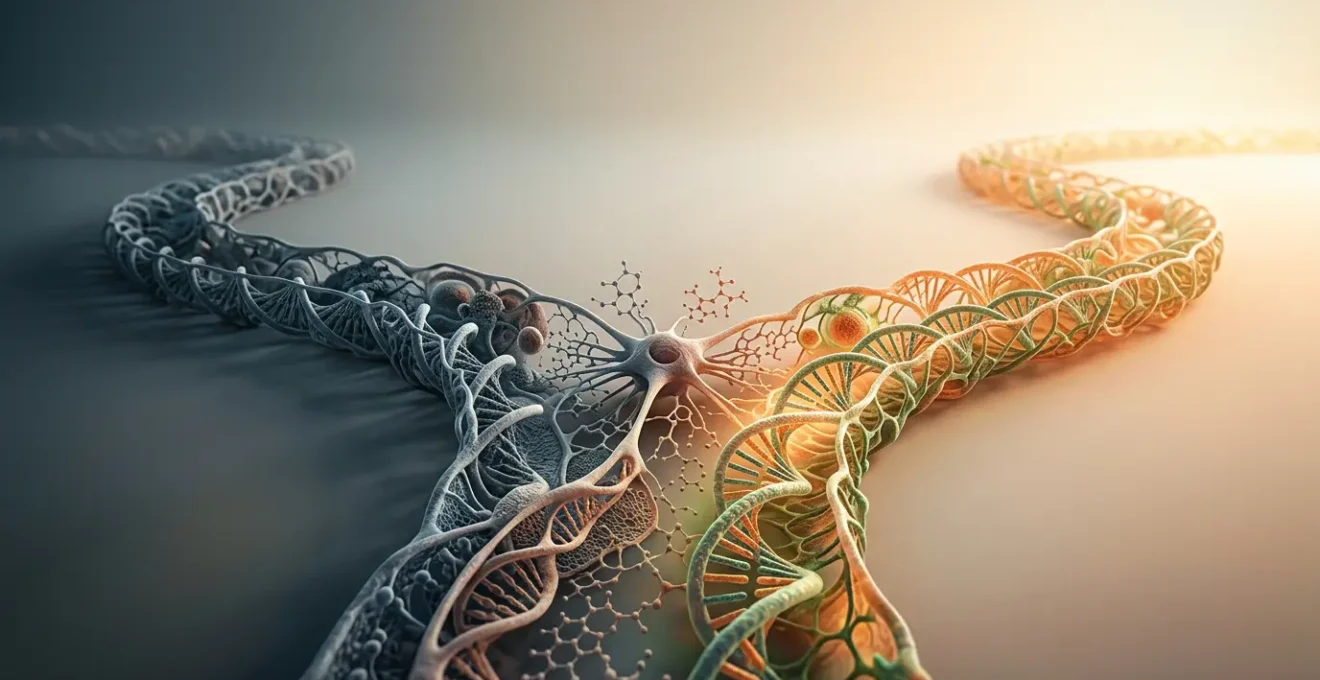
This image provides a conceptual view of how these senescent cells (irregular, textured) can disrupt the harmony of healthy tissue, releasing inflammatory signals.
For your joints, this is particularly bad news. The SASP cocktail is highly corrosive to cartilage and promotes an inflammatory state in the joint lining (synovium), contributing significantly to the pain and stiffness of osteoarthritis. Understanding that this specific cellular process is at play opens the door to new therapeutic strategies—not just masking pain with painkillers, but targeting the root cause of the inflammation. Research into “senolytics,” drugs that selectively clear these zombie cells, is one of the most exciting frontiers in gerontology.
How Can Two 75-Year-Olds Have 10 Years of Biological Age Difference?
We all know someone who is 75 but seems to have the energy and health of a 65-year-old, and vice-versa. This isn’t just a subjective feeling; it’s a measurable scientific reality. The most important number on your health journey is not your chronological age (the number of birthdays you’ve had), but your biological age (the functional age of your cells and tissues).
How can we measure this? The breakthrough came with the discovery of the “epigenetic clock.” Your DNA is your hardware, but epigenetics are the software—chemical tags that attach to your DNA and tell your genes whether to switch on or off. As we age, the pattern of these tags changes in a predictable way. By analysing these patterns, scientists can calculate a “DNA methylation age.”
Professor Steve Horvath at UCLA developed one of the first and most accurate of these clocks. As he explains, it’s a robust measure:
DNA methylation age has the following properties: first, it is close to zero for embryonic and induced pluripotent stem cells; second, it correlates with cell passage number; third, it gives rise to a highly heritable measure of age acceleration.
– Steve Horvath, DNA methylation age of human tissues and cell types study
The accuracy is remarkable; for instance, the Horvath epigenetic clock demonstrates a correlation of 0.97 with chronological age, with a median error of just 2.9 years. The crucial point is that this clock doesn’t just tick at a steady rate. It can be sped up by factors like smoking, poor diet, and chronic stress, or slowed down by positive lifestyle interventions. This means your biological age is not your destiny; it’s a dynamic metric you can influence, providing a powerful new way to track the effectiveness of your health choices.
The Telomere Supplement Scam That Costs UK Seniors £200 Million a Year
As our understanding of ageing biology grows, so does the market for products claiming to reverse it. One of the most persistent and scientifically flawed areas is the “telomere supplement” industry. Telomeres are the protective caps at the ends of our chromosomes, often compared to the plastic tips of shoelaces. They shorten with each cell division, and this shortening is a hallmark of ageing. So, the logic seems simple: find a way to lengthen telomeres, and you’ll reverse ageing.
Companies have seized on this, marketing expensive supplements that claim to activate an enzyme called telomerase, which can rebuild telomeres. However, these claims are not only unsubstantiated but also potentially dangerous. There is a dark side to this mechanism; as medical research indicates that artificially activating telomerase may increase cancer risk, because this is the very same mechanism cancer cells hijack to achieve immortality and divide uncontrollably.
This isn’t just theoretical. Regulators have had to step in against companies making false promises. A prominent example provides a cautionary tale for consumers everywhere.
Case Study: The TA-65MD Deception
The U.S. Federal Trade Commission (FTC) took action against Telomerase Activation Sciences for falsely advertising its TA-65MD products. The company charged consumers up to $2,000 for a three-month supply, claiming the supplement could reverse ageing, prevent DNA damage, and restore immune function. The FTC found these claims were not supported by scientific evidence and barred the company from making such unsubstantiated representations. This highlights the gap between marketing hype and scientific reality that preys on the hopes of seniors.
The key takeaway for anyone in the UK is to be extremely sceptical of any product promising to “reverse ageing” by lengthening telomeres. This is a complex biological process with serious risks, and the evidence for a safe, effective supplement is simply not there. Your money is better spent on proven interventions like a healthy diet and exercise.
When Should You Start Intermittent Fasting Based on Your Biological Age Markers?
Intermittent fasting, or time-restricted eating, has gained enormous popularity as a strategy for health and longevity. The underlying science is compelling: by giving your digestive system a prolonged break, you trigger a cellular clean-up process called autophagy. During autophagy, your cells recycle old, damaged components (including some senescent cells) and become more efficient. This process improves metabolic flexibility—your body’s ability to switch between burning carbohydrates and fats for fuel—which is a key feature of youthful metabolism.
But the question for someone in their 70s isn’t just *if* you should do it, but *when* and *how*. A one-size-fits-all approach is not wise. The decision should be data-driven, based on the biological markers that indicate your unique metabolic health. Instead of blindly following a trend, you can have an informed conversation with your GP about whether intermittent fasting is a suitable strategy for *you*.
This is a moment for thoughtful consideration, weighing the potential benefits against your personal health profile and daily routines.
The goal is to use these markers not as a diagnosis, but as a conversation starter with your healthcare provider to personalise your approach to nutrition and health. A high reading on one of these markers could indicate that a gentle introduction to time-restricted eating (e.g., a 12-hour overnight fast) might be beneficial.
Your practical checklist: Markers to discuss with your GP
- Fasting insulin levels: Elevated levels indicate insulin resistance, a condition where your cells don’t respond well to insulin. This is a strong sign that fasting protocols could be beneficial.
- HOMA-IR (Homeostatic Model Assessment for Insulin Resistance): This is a calculation based on your fasting insulin and glucose levels. A high value suggests your metabolism is becoming inflexible and may require intervention.
- hs-CRP (high-sensitivity C-Reactive Protein): This is a key marker of systemic inflammation in your body. As fasting can have anti-inflammatory effects, an elevated hs-CRP might suggest you’d respond well.
- Triglyceride levels: High triglycerides in your blood are a sign of poor metabolic health. Time-restricted eating has been shown to be effective at improving these levels.
- Epigenetic age acceleration: If available through specialised testing, this measures the gap between your biological and chronological age. A positive acceleration (biologically older) may be a strong indicator for interventions like fasting.
When Does Forgetting Names Cross the Line Into Something Your GP Should Assess?
One of the most common anxieties as we age is memory. Every time we can’t recall a name or a word, a small flicker of fear can ignite: is this normal, or is it the start of something worse? It’s crucial to differentiate between benign age-related memory changes and the red flags that warrant a discussion with your GP.
Think of it as a spectrum. On one end is Normal Age-Related Forgetfulness. This is often an issue of retrieval, not storage. The information is still in your brain, but accessing it is a bit slower. Hallmarks include:
- The “tip-of-the-tongue” phenomenon, where you know the word but can’t quite grab it (and it often comes to you later).
- Occasionally forgetting where you left your keys or glasses.
- Forgetting the name of an acquaintance but remembering it later.
- Generally, these lapses don’t significantly disrupt your daily life, work, or relationships. They are more of an annoyance than a disability.
On the other end of the spectrum are the Red Flags for a GP Assessment. These suggest a potential underlying issue, like Mild Cognitive Impairment (MCI) or dementia, and should be evaluated. Key indicators include:
- Memory loss that disrupts daily life, such as repeatedly asking for the same information or an inability to manage a budget.
- Forgetting how to perform familiar tasks, like preparing a simple meal or playing a known game.
- Getting lost in familiar places or having difficulty with spatial awareness.
- Significant changes in personality, mood, or judgment (e.g., becoming uncharacteristically suspicious or withdrawn).
- Putting items in highly unusual places (e.g., car keys in the refrigerator) and having no memory of doing so.
The most important distinction is the impact on function. If your memory lapses are starting to interfere with your ability to live independently and safely, it’s time to book a non-urgent appointment. Your GP is your partner in this; they can conduct initial screenings and, if necessary, refer you to a specialist. It’s not about seeking a label, but about seeking clarity and accessing support if you need it.
Why Does Your Body Start Breaking Down Muscle Faster Than It Builds After 60?
A common and frustrating experience after 60 is feeling that you’re losing strength and muscle mass, even if you remain active. This condition has a name: sarcopenia, the age-related loss of skeletal muscle mass and function. But why does it happen? The primary culprit is a phenomenon called “anabolic resistance.”
“Anabolic” refers to building processes in the body. In your younger years, a protein-rich meal or a session of resistance exercise would send a strong signal to your muscles to grow and repair. After 60, your muscles become ‘resistant’ to these signals. It’s as if they’ve become hard of hearing. The same meal or workout produces a much weaker muscle-building response than it did a decade or two earlier. This means the natural, ongoing process of muscle breakdown (catabolism) starts to outpace the process of muscle building (anabolism), leading to a net loss over time.
This anabolic resistance is driven by a combination of factors, including hormonal changes, increased low-grade inflammation (partly from those ‘zombie cells’ we discussed), and reduced blood flow to the muscles. The result is not just a loss of strength, but a slower metabolism, an increased risk of falls, and reduced overall resilience. You might find it harder to get up from a chair, carry heavy shopping, or recover from an illness.
This knowledge fundamentally changes the prescription for maintaining muscle. It’s no longer just about “getting some protein.” It becomes about overcoming anabolic resistance. This requires a more strategic approach: consuming a higher dose of protein (particularly leucine-rich sources like whey, dairy, or eggs) in a single sitting to provide a strong enough signal, and, most importantly, engaging in progressive resistance training. Lifting weights (or using resistance bands or your own body weight) is the most powerful signal you can send to your muscles to tell them they are still needed, forcing them to overcome their resistance and maintain their mass and strength.
Key takeaways
- The goal is to increase healthspan, not just lifespan, by compressing the period of illness.
- Your biological age is a more accurate and modifiable measure of health than your date of birth, and can be tracked by specific markers.
- Building ‘cognitive reserve’ through lifelong learning and activity is your best defence against the clinical symptoms of dementia.
Why Do Some People With Alzheimer’s Brain Pathology Never Show Symptoms?
One of the most profound mysteries in dementia research is the disconnect between the physical state of the brain and a person’s cognitive function. Autopsy studies have repeatedly shown that some individuals, who were fully cognitively intact until their death, have brains riddled with the plaques and tangles characteristic of advanced Alzheimer’s disease. How is this possible? The answer lies in a beautiful and empowering concept: cognitive reserve.
Think of cognitive reserve as the brain’s ability to withstand damage. It’s not about having less pathology, but about being better at coping with the pathology that’s there. It’s built through a lifetime of education, engaging in mentally complex work, and pursuing novel, challenging hobbies. A powerful illustration of this comes from studies of individuals with exceptional longevity.
The Resilient Brains of Supercentenarians
Research into supercentenarians (people living past 110) who maintain high cognitive function reveals a remarkable resilience. Many of them show significant Alzheimer’s pathology in their brains post-mortem, yet they never exhibited symptoms in life. This suggests their brains built up a ‘reserve’ in two ways: brain reserve (having more neurons and synapses to begin with) and cognitive reserve (being able to use brain networks more efficiently and flexibly to bypass areas of damage). This resilience is strongly linked to a lifetime of mental engagement and physical exercise, which boosts key growth factors like Brain-Derived Neurotrophic Factor (BDNF).
This fundamentally reframes our view of dementia. It’s not a simple switch that gets flipped. As geroscience researchers have noted, it’s more about risk and resilience.
The presence of plaques and tangles is not a death sentence. It is a risk factor. The ultimate outcome is heavily influenced by the brain’s resilience, which can be actively built throughout life.
– Geroscience research synthesis, Nature Communications research on aging interventions
This is an incredibly hopeful message. While we can’t yet cure Alzheimer’s disease, we can take active steps throughout our lives to build a more resilient brain, one that is better equipped to handle the challenges that may come. Learning a new language, picking up a musical instrument, or engaging in complex social activities aren’t just pastimes; they are acts of building a stronger, more flexible mind.
Your next conversation with your GP doesn’t have to be a passive one. Armed with this understanding, you are now equipped to ask specific questions about your own biological markers and co-create a proactive health plan for your next decade. The journey to a healthier 70s and beyond begins not with a prescription, but with knowledge.