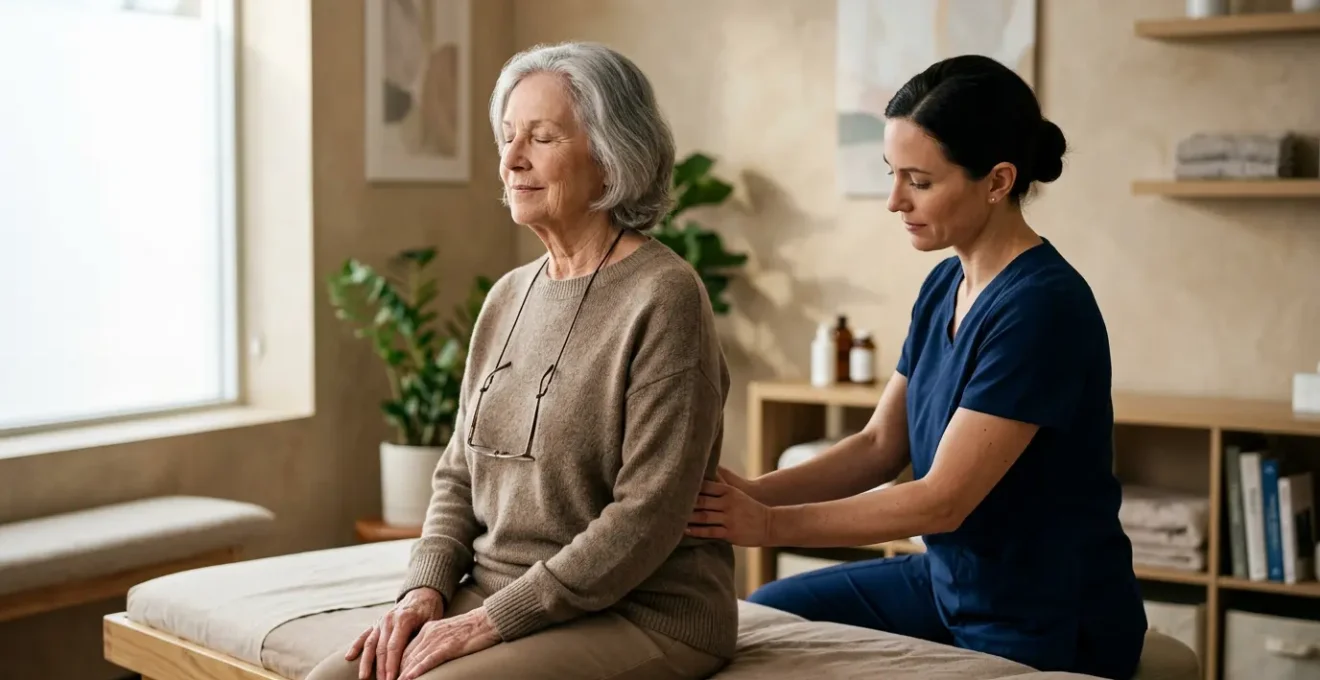
For seniors over 70, osteopathy can significantly reduce chronic back pain, but only when treatment is adapted for structural fragility, moving beyond medication-centric approaches.
- Geriatric osteopathy uses specific, gentle techniques, avoiding high-velocity thrusts that are risky for osteoporotic bones.
- It focuses on improving whole-body function and mobility, not just treating the site of pain, which often reduces the need for painkillers.
Recommendation: Seek a registered osteopath with proven experience in geriatrics who will perform a thorough assessment before any treatment.
The persistent, grinding nature of chronic back pain is a story many over 70 know intimately. It’s a constant companion that dictates what you can and cannot do, often leading to a frustrating cycle of painkillers with diminishing returns and the looming shadow of more invasive procedures. The usual advice revolves around rest or a few generic exercises, but this often fails to address the root cause and can even make joints stiffer. The conversation rarely moves beyond managing symptoms, leaving many feeling that this pain is simply an unavoidable part of ageing.
But what if the true key to relief isn’t just about managing pain, but about restoring function in a body that has a lifetime of history? This is where the specific field of geriatric osteopathy offers a different perspective. It’s not about applying the same techniques used on a 40-year-old and just « being more gentle. » Instead, it’s a specialised approach founded on a deep understanding of age-related structural changes—from bone density to tissue elasticity. The fundamental principle is that the body is an interconnected system, and a pain in the lower back might be driven by stiffness in the hip or a change in posture that has developed over decades. This approach prioritizes diagnostic precision and structural safety above all else.
This article will explore how a qualified osteopath can be a crucial partner in your pain management strategy, without relying on medication or surgery. We will deconstruct the differences between treating a 75-year-old and a younger individual, identify the critical safety markers for fragile spines, and clarify when osteopathy becomes the logical next step in your care plan. By understanding the science of adaptive treatment, you can make an informed choice for lasting relief and improved quality of life.
To navigate this complex topic, we have structured this guide to answer your most pressing questions. The following sections will provide a clear pathway to understanding the role of evidence-based osteopathy in managing senior health and chronic pain.
Summary: A Guide to Osteopathy for Chronic Pain in Seniors
- Why Does an Osteopath Treat a 75-Year-Old Differently Than a 45-Year-Old with the Same Pain?
- How to Identify an Osteopath Who Knows How to Safely Treat Fragile Elderly Spines?
- Osteopath vs Physiotherapist for Chronic Lower Back Pain in Seniors: Which Approach Works Better?
- The High-Velocity Thrust Risk That Can Fracture Osteoporotic Vertebrae
- When Should You Add Osteopathy to Your Pain Management Alongside Medication and Exercise?
- Paracetamol vs Topical NSAIDs for Knee Arthritis: Which Has Fewer Side Effects After 70?
- The Common Painkiller Combination That Doubles Confusion Risk in Anxious Seniors
- Why Does Resting Your Arthritic Joints Actually Make Them Worse?
Why Does an Osteopath Treat a 75-Year-Old Differently Than a 45-Year-Old with the Same Pain?
Treating a 75-year-old with back pain is fundamentally different from treating a 45-year-old, even if their symptoms sound identical. For a younger person, pain might stem from a recent muscle strain or a disc issue from an active lifestyle. For a senior, that same pain is often the culmination of decades of wear, postural adaptations, and underlying health changes. An osteopath specialising in geriatrics doesn’t just see « back pain »; they see a complex system with a long history. The primary focus shifts from aggressive correction to promoting adaptive biomechanics and improving overall function within the body’s current capabilities.
The key difference lies in assessing structural integrity. A senior’s body has less « buffer » for error. Bone density may be reduced (osteoporosis or osteopenia), ligaments may have lost elasticity, and cartilage is thinner. Tissues are more fragile and heal slower. Therefore, treatment must be meticulously adapted. While a 45-year-old might benefit from a wider range of techniques, treatment for a senior is highly selective. For instance, according to a national survey of osteopathic physicians, high-velocity, low-amplitude (HVLA) thrust techniques are mainly used in patients younger than 65 years, reflecting a cautious, safety-first approach with older adults.
This demographic shift is significant in clinical practice. In fact, clinical data suggests that more than 60% of osteopathic patients are now seniors aged 70 and over, requiring practitioners to possess specialised skills. The goal for a 75-year-old is often not a complete « fix, » but rather to reduce pain, improve mobility for daily activities like walking or gardening, decrease dependency on medication, and ultimately enhance their quality of life. It’s about working with the body, not against it.
This specialised approach acknowledges the unique physiological landscape of the ageing body, ensuring that all interventions are both safe and effective.
How to Identify an Osteopath Who Knows How to Safely Treat Fragile Elderly Spines?
Finding the right osteopath is crucial, especially when dealing with a fragile elderly spine. Not all practitioners have the specialised training and gentle approach required for geriatric care. A competent osteopath will always begin with a comprehensive assessment that goes far beyond the site of pain. This includes a detailed health history, a review of medications, and physical tests for balance, mobility, and neurological function. This diagnostic precision is the hallmark of a safe practitioner; they are looking for red flags and contraindications before any hands-on treatment begins.
During your initial consultation, ask direct questions about their experience with patients over 70 and their approach to conditions like osteoporosis or spinal stenosis. A knowledgeable geriatric osteopath will speak confidently about using gentle, indirect techniques. They should be able to explain why they avoid certain manipulations. Their vocabulary will include methods designed to work with the body’s own healing mechanisms, rather than forcing a change. These techniques are designed to improve motion and relieve tension with minimal strain.
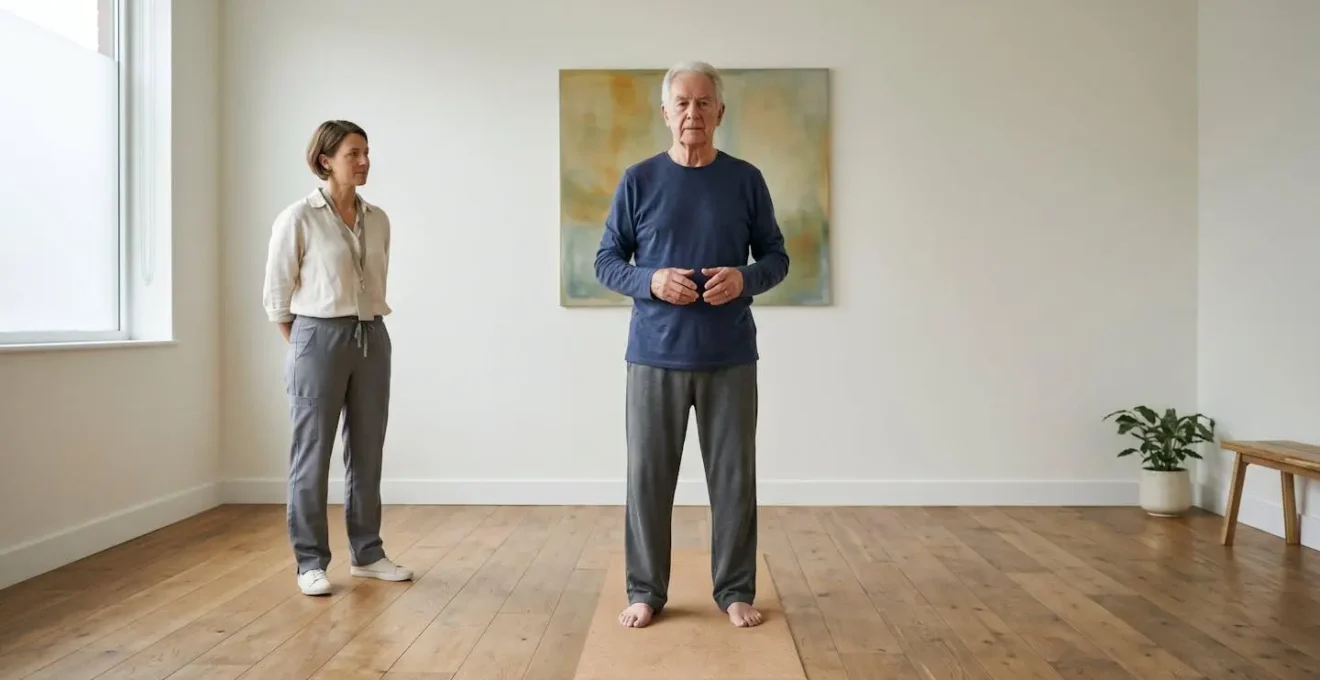
As shown in the assessment of a senior’s balance and mobility, the focus is on careful observation and gentle guidance. The practitioner maintains a safe, observant stance, emphasising patient autonomy. Key gentle techniques you should listen for include:
- Muscle Energy Techniques (MET): Uses the patient’s own gentle muscle contractions to improve joint movement.
- Myofascial Release: Applies sustained, gentle pressure to release tension in the connective tissues.
- Balanced Ligamentous Tension (BLT): A very subtle technique that uses positioning and breathing to allow the body to release tension itself.
- Functional Technique: Involves guiding a joint or tissue through its path of least resistance to gently encourage a greater range of motion.
Your checklist for choosing a geriatric osteopath:
- Qualifications & Registration: Verify they are registered with the General Osteopathic Council (GOsC) in the UK. Ask if they have postgraduate training in geriatric care.
- Initial Assessment: Does the first appointment include a thorough medical history, medication review, and physical tests for balance and fragility?
- Communication Style: Do they listen to your concerns, explain their proposed treatment plan clearly, and discuss which techniques they will (and won’t) use?
- Technique Repertoire: Do they mention using gentle, indirect techniques like MET, myofascial release, or functional technique, and explicitly state they are cautious with thrust manipulations?
- Collaborative Approach: Are they willing to communicate with your GP or other healthcare providers to ensure integrated care?
Ultimately, trust your instincts. A safe and effective osteopath will make you feel heard, respected, and confident in their ability to provide care that is both gentle and evidence-informed.
Osteopath vs Physiotherapist for Chronic Lower Back Pain in Seniors: Which Approach Works Better?
When faced with chronic lower back pain, seniors often wonder whether to see an osteopath or a physiotherapist. While both professions aim to reduce pain and improve function, their core philosophies and treatment styles differ, making one potentially more suitable than the other depending on your specific situation. There is no single « better » approach; the most effective choice depends on the nature of your pain and your personal goals.
A physiotherapist typically adopts a more symptom-focused approach. If you have pain after a specific injury or surgery, physiotherapy is excellent for targeted rehabilitation. Treatment is often exercise-based, empowering you with a set of movements to strengthen specific muscles and improve mobility around the injured area. In contrast, osteopathy takes a more holistic, whole-body view. An osteopath will investigate why the problem occurred in the first place, looking for underlying structural imbalances or dysfunctions that may be distant from the site of pain. Their approach is predominantly hands-on, aiming to restore overall systemic function.
For seniors with long-standing, widespread, or non-specific chronic pain, the osteopathic model can be particularly beneficial. Research supports its effectiveness; for instance, a systematic review and meta-analysis found that osteopathy demonstrated significant pain reduction for chronic low back pain. However, it’s important to note that the best outcomes often arise from a team effort. As Hexa Physio’s collaborative care team notes, « Physiotherapists and osteopaths will often work as a team to optimize the game plan and promote a rapid and safe return to function. »
This comparative table, based on information from The College Practice’s analysis, helps clarify the different focuses:
| Aspect | Osteopathy | Physiotherapy |
|---|---|---|
| Primary Approach | Holistic, whole-body system assessment | Symptom-focused, specific injury rehabilitation |
| Treatment Style | 90% hands-on manual therapy | 60% hands-on, 40% exercise-based |
| Session Focus | Identifying underlying structural drivers of pain | Active patient participation through therapeutic exercises |
| Ideal For Seniors With | Chronic widespread pain, unclear pain origin, long-term conditions (average 7 sessions, 70% chronic pain patients) | Specific injury recovery, post-surgery rehabilitation, neurological conditions |
| Training Duration | 4-5 years with 1,000+ hours hands-on training | 3-4 years with NHS rotations across specialisms |
The right choice hinges on whether your priority is rehabilitating a specific injury with active exercises (physiotherapy) or addressing a chronic, systemic issue with hands-on, whole-body treatment (osteopathy).
The High-Velocity Thrust Risk That Can Fracture Osteoporotic Vertebrae
The « cracking » or « popping » sound associated with some manual therapies is the result of a High-Velocity, Low-Amplitude (HVLA) thrust. While this technique can be effective for certain conditions in younger, robust individuals, for a senior with compromised bone density, it carries a significant and unacceptable risk. The primary concern is osteoporosis, a condition that makes bones brittle and prone to fracture. Applying a rapid, forceful thrust to an osteoporotic spine could potentially cause a vertebral compression fracture, leading to severe pain, disability, and a significant decline in quality of life.
This is not a theoretical danger. Osteoporosis is a widespread issue; epidemiological data shows that between 18% to 25% of elderly men and women in developed countries have osteoporosis. A responsible osteopath is acutely aware of this prevalence and makes neuro-vascular caution and bone integrity a top priority. They will screen for osteoporosis risk factors during the initial assessment and will always err on the side of caution. For a patient over 70, especially one with known or suspected low bone density, HVLA is a firm contraindication. The principle of « first, do no harm » is paramount.
Fortunately, avoiding HVLA does not mean osteopathic treatment is ineffective. In fact, research demonstrates the opposite. The focus simply shifts to a different set of tools that are both safe and potent for fragile bodies. These gentle techniques aim to achieve the same goals—improving mobility, reducing pain, and restoring function—but through persuasion rather than force.
Case Study: Safe Osteopathic Treatment for Elderly Patients with Osteoporosis
A randomized controlled trial involving 72 elderly patients (mean age 77.3) with osteoporosis provided clear evidence for the safety and efficacy of gentle osteopathy. The treatment protocol strictly avoided all high-velocity thrusts, instead using functional and soft tissue techniques. The results were significant: patients receiving this specialised osteopathic manipulative treatment (OMT) reported marked improvements in their quality of life and a reduction in disability. Crucially, there were no adverse effects reported. The study highlights that by using techniques designed to enhance tissue adaptability, it’s possible to decrease pain and functional limitations while maintaining the highest level of safety for fragile patients.
The takeaway is clear: effective treatment for seniors is not about the force of the technique, but the precision of its application and an unwavering commitment to safety.
When Should You Add Osteopathy to Your Pain Management Alongside Medication and Exercise?
Integrating osteopathy into your pain management plan is a strategic decision, not a replacement for medical advice or prescribed exercise. The ideal time to consider adding osteopathy is when your current regimen—whether it’s medication, exercise, or a combination—is no longer providing adequate relief, or when the side effects of medication are becoming a concern. If you feel « stuck » in a cycle of pain, or if your mobility and quality of life are declining despite your efforts, a collaborative care model that includes osteopathy can be a game-changer.
Osteopathy works by addressing the mechanical and structural factors contributing to your pain, which medication alone cannot do. While painkillers can mask symptoms, osteopathic treatment aims to improve the body’s underlying function, potentially reducing the need for those very medications. This is supported by research; a study in the journal *Current Perspectives on Osteopathic Manipulation* found that patients receiving osteopathic manipulative treatment (OMT) for chronic low back pain not only reported less pain and disability but also less often used opioids and NSAIDs compared to those treated by allopathic physicians.
The benefits are not just short-term. As a 2024 study in the *Journal of Osteopathic Medicine* confirmed, OMT can significantly reduce pain and psychosocial factors related to chronic low back pain over both the short and long term. Consider adding osteopathy if:
- Your pain has become chronic (lasting more than 3 months) and is not improving.
- You want to explore options to reduce your reliance on painkillers.
- Your mobility or ability to perform daily activities is limited by stiffness and pain.
- You have been told your pain is « just arthritis » or « part of getting older » and you are seeking a proactive way to improve your function.
By working on the body’s structure and mobility, osteopathy can help break the cycle of chronic pain and reduce medication dependency, offering a path towards more sustainable, long-term well-being.
Paracetamol vs Topical NSAIDs for Knee Arthritis: Which Has Fewer Side Effects After 70?
For localised joint pain like knee arthritis, a common complaint for many over 70, the choice of pain relief becomes a critical balance between efficacy and safety. The two most common over-the-counter options are oral paracetamol and topical NSAIDs (Non-Steroidal Anti-Inflammatory Drugs) like ibuprofen or diclofenac gel. While both can provide relief, their side-effect profiles in older adults are vastly different. For seniors, the guiding principle should always be to use the lowest effective dose of the safest possible option, and often, that means starting with treatments that are applied locally rather than taken systemically.
Oral NSAIDs, while effective for inflammation, pose significant risks for older adults. They can cause stomach ulcers, kidney problems, and increase blood pressure. The risks are not trivial; geriatric medicine experts have estimated that in the United States, NSAIDs cause an estimated 41,000 hospitalizations and 3,300 deaths among older adults every year. This is why many clinical guidelines, including those from NICE (National Institute for Health and Care Excellence) in the UK, are cautious.
Topical NSAIDs, on the other hand, offer a much safer alternative for localised pain. When applied as a gel or cream directly to the knee, the drug is absorbed through the skin, targeting the inflammation at its source with much lower systemic absorption. This drastically reduces the risk of gastrointestinal and cardiovascular side effects associated with the oral pills. Paracetamol remains a first-line option due to its safety profile, especially when NSAIDs are contraindicated. As the *British Journal of General Practice* notes, « NICE recommends paracetamol at the lowest effective doses as the treatment of choice for osteoarthritis in older people. » However, paracetamol primarily targets pain, not inflammation.
Therefore, for knee arthritis in an older adult, a topical NSAID often represents the best of both worlds: targeted anti-inflammatory action with a minimal risk of the serious systemic side effects that oral NSAIDs can cause. It should be considered a primary option before or alongside paracetamol, always under the guidance of a GP or pharmacist.
The Common Painkiller Combination That Doubles Confusion Risk in Anxious Seniors
For seniors managing both chronic pain and anxiety, the choice of medication is fraught with hidden dangers. A particularly concerning issue is the increased risk of cognitive impairment, such as confusion and memory problems, when certain common painkillers are used. While many factors can contribute to confusion in older adults, a key risk to be aware of is the use of high-dose NSAIDs, especially in individuals who may already be vulnerable due to anxiety or other underlying conditions.
The central nervous system (CNS) effects of NSAIDs are often overlooked. While their gastrointestinal and cardiovascular risks are well-publicised, their potential to affect brain function is less commonly discussed but equally important in a geriatric context. The risk is not uniform across all NSAIDs. According to a study on chronic NSAID use in older adults, « High-dose NSAIDs… may actually increase the risk of cognitive impairment. In particular, indomethacin appears to cause more CNS effects than other NSAIDs in the elderly. » These effects can manifest as dizziness, headaches, drowsiness, and, most worryingly, confusion.
This risk is amplified when a senior is also dealing with anxiety. Anxiety itself can affect cognitive function, and when combined with a medication that also has CNS side effects, the potential for a negative synergistic effect is high. An older person might be prescribed an NSAID for arthritis pain while also dealing with anxiety about their health, finances, or living situation. This combination can create a perfect storm, where the medication intended to relieve physical pain inadvertently exacerbates mental fog and confusion. It underscores the critical need for a holistic assessment by a GP that considers a patient’s entire physical and mental health picture before prescribing, especially when it comes to long-term pain management.
Before accepting any new prescription for pain, it is vital to discuss all existing conditions, including anxiety, with your doctor to avoid potentially harmful drug interactions and their cognitive consequences.
Key takeaways
- Specialised geriatric osteopathy is not just « gentler »; it’s a scientifically adapted approach that prioritizes the structural integrity of the ageing body.
- Safety is paramount: High-velocity thrusts (« cracks ») are contraindicated for fragile or osteoporotic spines, and a qualified osteopath will use specific, gentle techniques instead.
- Osteopathy can be a powerful addition to pain management, often helping to reduce the reliance on painkillers by addressing the root mechanical causes of pain.
Why Does Resting Your Arthritic Joints Actually Make Them Worse?
When a joint is painful and swollen from arthritis, the natural instinct is to rest it. While short periods of rest during an acute flare-up are necessary, the common belief that prolonged rest is the best medicine is a dangerous myth. In reality, inactivity is one of the worst things for an arthritic joint. The principle of « motion is lotion » is not just a catchy phrase; it’s a physiological reality. Joints are designed to move, and their health depends on it. When you stop moving a joint, the muscles around it weaken, the cartilage is deprived of nutrients, and the joint becomes even stiffer and more painful, creating a vicious cycle of decline.
The health of your joint cartilage relies on the circulation of synovial fluid, the body’s natural lubricant. This fluid is rich in nutrients that nourish the cartilage and remove waste products. Unlike muscle, cartilage has no direct blood supply, so it depends on a process of « pumping » that occurs during movement. As you move a joint, the pressure changes within the joint capsule, squeezing old fluid out of the cartilage and drawing fresh fluid in when the pressure is released. Rest halts this vital process, effectively starving the joint. This is why you often feel stiffest in the morning or after sitting for a long time; the joints have been immobile, and the « lotion » hasn’t been circulating.
This is where gentle, guided movement from therapies like osteopathy becomes essential. Osteopathic treatment for arthritis focuses on improving joint function safely. As the Fontaine Center’s geriatric team explains, « Osteopathic techniques such as gentle manipulation, stretching, and massage can help improve joint mobility, flexibility, and range of motion, making everyday activities easier and more comfortable. » Furthermore, clinical research has demonstrated that specific osteopathic exercise programmes can yield significant benefits; one study showed that participants experienced a 21% improvement in overall balance. By restoring a safe range of motion, osteopathy helps restart that crucial synovial pump, nourishing the joint and breaking the cycle of pain and stiffness.
Embracing safe, regular motion is the most powerful, non-pharmacological tool you have to manage arthritis, improve your function, and maintain your independence for years to come.