
Food refusal on a texture-modified diet is not a behavioural problem; it’s a sensory one that can be solved with culinary science at home.
- Visual appeal is paramount: Re-shaping purees into recognizable forms using food moulds and gelling agents is the single biggest factor in acceptance.
- Texture is safety: Correctly identifying the IDDSI level and avoiding common errors (like over-thickening) is non-negotiable for preventing aspiration.
Recommendation: Focus on recreating the experience of a meal, not just delivering nutrients.
Watching someone you care for push away a plate of food is profoundly distressing. When that person has dysphagia (swallowing difficulties), and a texture-modified diet is the only safe option, this rejection feels like a crisis. The figure often cited, that up to 60% of seniors on pureed diets suffer from malnutrition or food refusal, isn’t just a statistic; it’s the daily reality for countless carers across the UK. The common advice—add herbs, use colourful vegetables—is well-intentioned but often misses the fundamental point. The problem isn’t just that the food is bland; it’s that it no longer looks like food at all. It’s a scoop of beige, a loss of dignity on a plate.
The truth is, we eat with our eyes first. A lifetime of recognising a chicken breast as a chicken breast is not easily undone. When food becomes unrecognisable, the brain’s appetite signals fail to fire. This is not fussiness; it’s a deep-seated psychological and physiological response. But what if the solution wasn’t found in a spice rack, but in a chef’s toolkit? What if you could apply the principles of food science used in professional care kitchens to transform a shapeless puree back into an appealing, recognisable, and dignified meal?
This guide moves beyond the blender. As a specialist care cook, I’ll walk you through the professional techniques that make a critical difference. We will decode the essential IDDSI framework, explore the science of food moulding, and tackle the challenge of nutrient density. This is about restoring not just nutrition, but the simple, profound pleasure of a good meal.
To help you navigate these professional techniques, this article is structured to answer your most pressing questions, from the science of safety to the art of presentation. Here is a look at what we’ll cover.
Summary: From Refusal to Relief: A Carer’s Guide to Appetising Pureed Meals
- What Do the IDDSI Numbers Mean and Which Level Does Your Relative Actually Need?
- How to Mould Pureed Chicken to Look Like a Chicken Breast Instead of Baby Food?
- Apetito vs Puree Deliveries vs Homemade: Which Option Offers Best Taste for Dysphagia Patients?
- The Thickener Overdose That Makes Water Impossible to Swallow Safely
- When Can You Start Reintroducing Normal Food Textures After a Stroke Affecting Swallowing?
- Level 5 Minced vs Level 6 Soft: Which Texture Keeps Meals Appetising for Someone with Mild Dysphagia?
- How to Add 15g of Protein to Porridge Without Your Parent Noticing the Difference?
- How Can You Pack a Day’s Nutrition Into 1,200 Calories for a Senior Who Barely Eats?
What Do the IDDSI Numbers Mean and Which Level Does Your Relative Actually Need?
The first step in taking control of a texture-modified diet is to understand the language of safety: the IDDSI framework. IDDSI, or the International Dysphagia Diet Standardisation Initiative, is a global standard for classifying food textures and drink thicknesses. It’s not just a guideline; it’s your most important tool for preventing choking or aspiration. The framework runs from Level 0 (Thin drinks) to Level 7 (Regular food). For pureed diets, you’re typically working in the Level 4 (Pureed) or Level 5 (Minced & Moist) range. A Speech and Language Therapist (SLT) will determine the exact level needed, and it is crucial to adhere to it strictly.
A true Level 4 Puree must be completely smooth with no lumps, not be sticky, and hold its shape on a spoon—this is the Spoon Tilt Test. It shouldn’t be runny. Many home blenders struggle to break down fibrous foods like celery or green beans, leaving dangerous strands. The biggest mistake is assuming any ‘soft’ food is safe. Many common items fail IDDSI testing because they change texture in the mouth. As a comprehensive analysis of pureed diets for the elderly highlights, foods that melt, like ice cream or jelly, are a significant risk as they turn into a thin liquid (Level 0) in the throat, which can be easily aspirated.
This is why understanding the official testing methods is so vital. You can find simple, visual guides for tests like the Fork Drip Test and Spoon Tilt Test on the official IDDSI website, which is an invaluable resource for any carer. Understanding these tests gives you the confidence to know that the food you’re serving is not just nutritious, but truly safe. Many well-intentioned food choices are surprisingly hazardous, as the following table shows.
| Food Item | Why It Fails IDDSI Testing | IDDSI Level Concern |
|---|---|---|
| Ice cream | Melts to thin liquid in the mouth/throat, changing from solid to Level 0 (thin) | Levels 3-4 (poses aspiration risk) |
| Jello/Gelatin desserts | Turns to thin liquid when swallowed, muscles may not have time to close airway | Levels 3-4 (poses aspiration risk) |
| Bread (pureed) | Forms a sticky paste in the mouth, may clump or become too adhesive | Level 4 (fails Spoon Tilt Test) |
| Pasta (pureed) | Tends to gelatinize and form hard clumps within minutes after pureeing | Levels 4-5 (texture instability) |
| Stringy vegetables (celery, onions) | Cannot achieve smooth texture; strings remain even after blending | All pureed levels (safety hazard) |
| Hard cheeses | Gelatinize when pureed and turn into hard clumps over time | Level 4 (texture failure) |
| Nuts and seeds | Cannot be blended to completely smooth texture; particle risk remains | All pureed levels (choking hazard) |
Ultimately, knowing the correct IDDSI level is the foundation upon which all other improvements—taste, appearance, and nutrition—must be built. It is the first and most important step in restoring dignity to mealtimes.
How to Mould Pureed Chicken to Look Like a Chicken Breast Instead of Baby Food?
The single most powerful technique for combating food refusal is to make pureed food look like itself again. This is achieved through moulding, a process that uses food-grade silicone moulds and a gelling agent to reshape a puree. Seeing a shape that resembles a carrot, a piece of fish, or a chicken breast triggers the brain’s appetite response in a way a simple scoop cannot. It’s about restoring familiarity and dignity. The secret lies in choosing the right gelling agent to give the puree enough structure to hold its shape once set.
This is where a little food science comes in. Different gelling agents create vastly different textures. Agar-agar, derived from seaweed, creates a firm, brittle gel, perfect for creating a defined shape like a chicken breast. In contrast, xanthan gum creates a smoother, more fluid texture that is excellent for sauces and gravies but won’t hold a complex shape. Getting the right texture is a balance between structural integrity and a pleasant, safe mouthfeel. The image below shows the textural difference between two common agents.
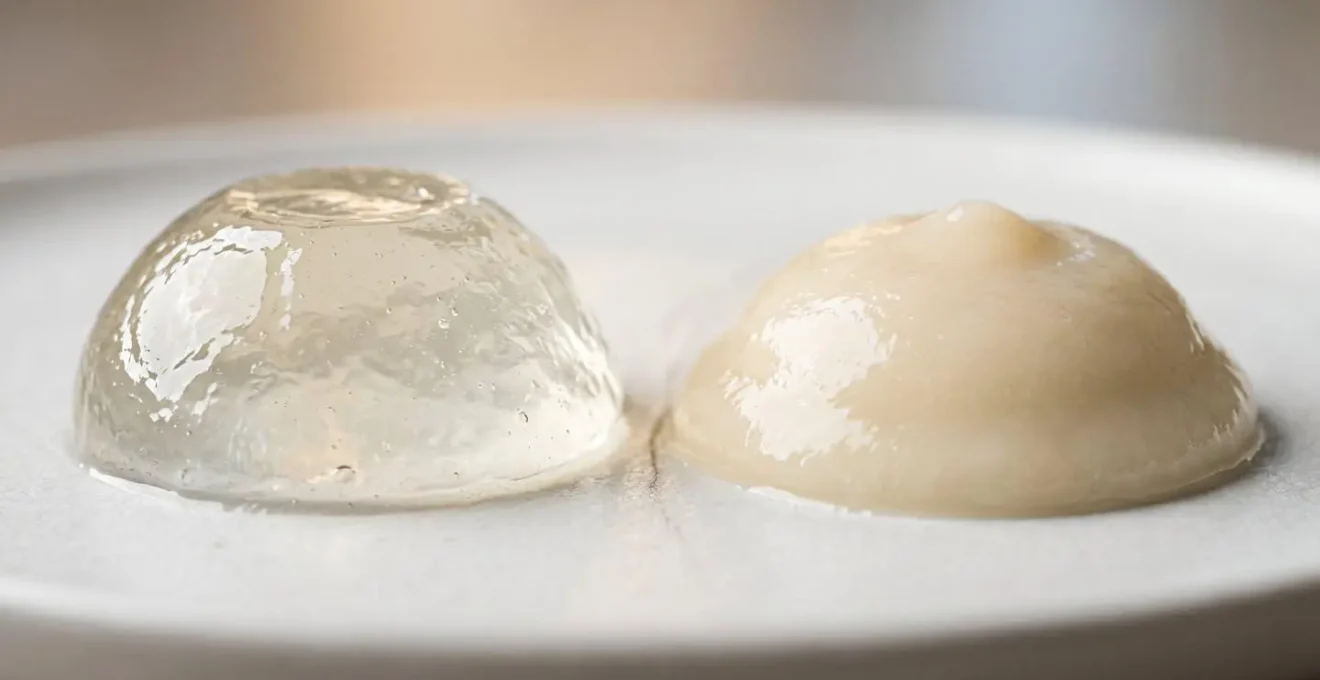
As you can see, the choice of agent dramatically affects the final result. An overview of common thickening agents demonstrates the wide range of options, but for home use, starting with agar-agar for moulding and a small amount of xanthan gum for smoothing is a professional approach. The process is simple: blend your cooked and pureed food with the gelling agent, pour it into the mould, chill until set, and then gently reheat before serving.
| Gelling Agent | Texture Profile | Firmness Level | Best Use Case | Key Characteristics |
|---|---|---|---|---|
| Agar-agar | Firm, translucent, brittle gel | High firmness | Structured shapes requiring rigidity (e.g., moulded chicken breast) | Sets at room temperature; produces very clear gel; light residual taste; may be too firm for some dysphagia levels |
| Xanthan gum | Smooth, slightly elastic, cohesive | Medium firmness with flow | Smooth purees requiring easy swallowing without rigidity | Clear, tasteless, odorless; stable viscosity; does not continue to thicken over time; amylase-resistant |
| Carrageenan | Soft, elastic, gelatin-like | Soft to medium firmness | Tender moulded foods with gentle mouthfeel | Flavorless, odorless, extremely soft, mildly elastic; commonly used in dysphagia products |
| Gelatin | Wobbly, thermoreversible gel | Soft firmness (melts at body temperature) | Foods that need to melt in the mouth | Melts in oral cavity; disperses easily with no residual taste (sheets) or slight taste (powder); animal-derived |
| Gellan gum (high-acyl) | Soft, elastic gel | Soft firmness | Dysphagia-safe foods requiring soft texture with cohesion | Made by bacterial fermentation; provides sustained viscosity compatible with dysphagia management; prevents settling |
Your Action Plan: From Puree to Plated Perfection
- Choose your mould: Start with a simple, recognisable shape (e.g., carrot, fish fillet) using a food-grade silicone mould.
- Prepare the puree: Cook the food until tender, then blend until perfectly smooth (pass through a sieve if necessary). Use a flavourful liquid like stock instead of water.
- Incorporate the gelling agent: While the puree is warm, blend in the correct amount of agar-agar powder (typically around 1-2g per 500ml of puree, but follow packet instructions).
- Mould and chill: Pour the mixture into the silicone mould, smooth the top, and chill in the refrigerator for at least 1-2 hours until completely firm.
- De-mould and serve: Gently pop the shaped food out of the mould onto a plate. Reheat carefully (a microwave on low power or gentle steaming works well) and serve with a contrasting sauce or gravy.
This simple technique can single-handedly transform the mealtime experience, turning a moment of potential conflict into an opportunity for enjoyment and connection.
Apetito vs Puree Deliveries vs Homemade: Which Option Offers Best Taste for Dysphagia Patients?
For carers, the decision between preparing every meal from scratch, using a specialist provider like Apetito, or opting for other puree delivery services is a constant balance of time, cost, and quality. There is no single « best » answer, as the right choice depends heavily on individual circumstances. Let’s break down the pros and cons from a culinary and practical perspective. Homemade meals offer unparalleled control over ingredients, flavour, and personalisation. You can tailor every dish to specific preferences, manage allergies with certainty, and use the freshest, highest-quality components. Browning meat and vegetables before pureeing, for example, develops deep, complex flavours that are impossible to replicate in mass production. However, this option is extremely time-consuming and requires significant culinary skill and equipment to ensure both safety (correct IDDSI level) and palatability.
Specialist providers like Apetito have invested heavily in the science of texture-modified foods. They are masters of the moulding and presentation techniques we’ve discussed, delivering meals that are visually appealing and nutritionally complete. Their key advantage is safety and consistency; every meal is guaranteed to meet the correct IDDSI level. For many carers, this peace of mind is invaluable. The trade-off can sometimes be in the subtlety of flavour compared to a freshly prepared homemade dish, and the cost can be a significant factor for those on a tight budget. They represent a reliable, high-quality benchmark.
A growing number of smaller, local puree delivery services are also emerging. These can be an excellent middle ground, often offering more of a « home-cooked » taste profile than larger industrial kitchens, with more flexible menus. However, the onus is on the carer to verify their credentials. Do they explicitly state they adhere to IDDSI standards? Can they provide detailed nutritional information? The quality can vary significantly, so it’s vital to do your research and perhaps order a trial batch before committing. The best approach is often a hybrid one: relying on a trusted service for convenience during busy periods, while supplementing with favourite homemade dishes when time allows.
This allows you to provide variety and a personal touch without risking burnout, ensuring the person you care for always has a safe, nutritious, and appealing meal waiting for them.
The Thickener Overdose That Makes Water Impossible to Swallow Safely
When it comes to thickening drinks for someone with dysphagia, there’s a dangerous misconception that « more is better. » In a moment of anxiety, it’s easy to add an extra half-scoop of thickener « just to be safe. » This is one of the most critical errors a carer can make. Over-thickening a drink does not make it safer; it can make it impossible to swallow. The goal of a thickener is to slow the flow of liquid just enough for the swallowing muscles to react in time and protect the airway. A prescribed IDDSI Level (e.g., Level 2 – Mildly Thick) is a precise target for a reason.
When a drink is over-thickened, it becomes heavy, cloying, and gelatinous. Instead of flowing smoothly, it can stick to the roof of the mouth or the back of the throat, requiring significant effort to move. For someone with weakened swallowing muscles, this effort can be exhausting and may even trigger the gag reflex. Furthermore, the unnatural, gloopy texture is deeply unpleasant—a major contributor to dehydration, as individuals will simply refuse to drink. The sensation is often described as trying to swallow wallpaper paste. It’s a guaranteed way to create an aversion to fluids.
The key is precision and understanding how thickeners work. Most commercial thickeners are starch-based or gum-based. It’s crucial to know that they continue to thicken for several minutes after being mixed. The texture you have 30 seconds after mixing is not the final texture. You must wait the recommended time (usually 3-5 minutes) specified on the product’s packaging before testing the consistency. Use the prescribed scoop size, level it off exactly, and follow the mixing instructions to the letter. Always test the final consistency yourself using the IDDSI Flow Test to ensure it matches the prescribed level. A few millilitres of water can make a huge difference to the final viscosity.
Remember, the goal is not to create a solid, but to achieve a specific, controlled flow. Precision, not excess, is the cornerstone of safe hydration in dysphagia care.
When Can You Start Reintroducing Normal Food Textures After a Stroke Affecting Swallowing?
For anyone recovering from a stroke or other neurological event that caused dysphagia, the journey back to a normal diet is a significant milestone. It’s a question filled with hope, but one that must be approached with extreme caution. The decision to reintroduce more complex food textures can only be made by a qualified Speech and Language Therapist (SLT). Attempting to advance the diet without professional guidance is incredibly dangerous and can lead to aspiration, pneumonia, and serious setbacks in recovery. A carer’s role is not to make this decision, but to be an expert observer and reporter for the SLT.
So, what should you be looking for? The SLT will be assessing several key indicators. A primary one is the absence of overt signs of aspiration during mealtimes. This includes coughing or choking during or after swallowing, a wet or « gurgly » sounding voice, and recurrent chest infections. However, it’s vital to know about « silent aspiration, » where food or liquid enters the airway with no outward signs like coughing. This is why professional assessments, sometimes including a videofluoroscopy (a moving X-ray of the swallow), are essential. You can support the process by keeping a detailed log of meals, noting any difficulties, changes in voice, or signs of fatigue during eating.
If the SLT determines that an upgrade is appropriate, it will be a gradual, step-by-step process. This often involves moving from Level 4 Pureed to Level 5 Minced & Moist. The therapist will provide specific food examples and preparation techniques. They might recommend starting with very soft, moist foods that require minimal chewing. Your role is to follow these instructions precisely and report back on how the new textures are tolerated. Any sign of difficulty means an immediate return to the previously safe texture and a consultation with the SLT. Patience is paramount; recovery from dysphagia is a marathon, not a sprint. Celebrating small victories, like successfully managing a spoonful of a new texture, is key to maintaining morale for both you and the person you care for.
Your careful observation and adherence to the SLT’s plan are the most important contributions you can make to a safe and successful recovery journey.
Level 5 Minced vs Level 6 Soft: Which Texture Keeps Meals Appetising for Someone with Mild Dysphagia?
For individuals with mild dysphagia who retain some ability to chew, the transition from pureed foods to more textured options is a critical step in restoring a sense of normality to mealtimes. The two key stages in this journey are IDDSI Level 5 (Minced & Moist) and Level 6 (Soft & Bite-Sized). While they may seem similar, the difference between them is significant in terms of both safety and appetite. Choosing the right one, under the guidance of an SLT, can make the difference between an enjoyable meal and a frustrating, tiring ordeal.
Level 5 Minced & Moist is a stepping stone from puree. The food is finely minced into particles no larger than 4mm (for adults), cohesive enough to be scooped, and served with enough moisture to prevent it from being dry. Think of a very moist, finely minced shepherd’s pie filling. It requires minimal chewing. For this texture to be appetising, the key is moisture and flavour. Using a thick, rich gravy or sauce is not just for taste; it’s a safety requirement to ensure the minced particles are lubricated and hold together. A dry, crumbly mince is a choking hazard. Presenting the components separately on the plate (minced meat, mashed potato, pureed carrot) is far more appealing than mixing them all together.
Level 6 Soft & Bite-Sized represents a significant leap forward in chewing ability. The food is tender and moist, cut into bite-sized pieces no larger than 1.5cm. The defining test for Level 6 is that a piece of food can be easily mashed with gentle pressure from a fork. This includes foods like flakes of cooked fish, soft-cooked vegetables, or casserole meat that falls apart. This level is often far more appetising because it offers a greater variety of textures and recognisable food pieces. The challenge here is ensuring everything on the plate meets the standard. A perfectly soft piece of chicken served with a hard, roasted potato is not a Level 6 meal. Every single component must be mashable with a fork.
For mild dysphagia, progressing to Level 6 as soon as it is deemed safe by an SLT is often the best way to boost appetite, as it most closely resembles a « normal » meal, providing crucial psychological and sensory satisfaction.
How to Add 15g of Protein to Porridge Without Your Parent Noticing the Difference?
Porridge is a breakfast staple in the UK, often well-accepted by seniors due to its soft texture and comforting nature. This makes it a perfect vehicle for « invisible » nutritional fortification, especially for boosting protein intake. Getting an extra 15g of protein into a single bowl is not only possible but can be done without altering the taste or texture in any noticeable way. This is a crucial strategy for combating sarcopenia (age-related muscle loss) and promoting wound healing. The secret lies in choosing the right high-protein, low-flavour additions.
The most effective and readily available options are powders that dissolve easily into the warm liquid of the porridge. Here are three professional choices:
- Unflavoured Whey Protein Isolate: This is a powerhouse, offering around 25g of protein per 30g scoop. You would only need about 18g of the powder to hit your 15g protein target. Choose an « unflavoured » or « natural » isolate, which has a very neutral taste. Mix the powder with the milk *before* adding it to the oats to prevent clumping.
- Skimmed Milk Powder: A fantastic, low-cost option found in any supermarket. Four level tablespoons (around 32g) of skimmed milk powder will add approximately 11g of protein and also boost calcium. To reach the 15g target, you could add this plus one finely mashed hard-boiled egg yolk, which adds another 3-4g of protein and healthy fats.
- Plant-Based Protein Powders: For those who are dairy-free, unflavoured pea or soy protein isolate powders work well. As with whey, mix it into the cold liquid first. They can have a slightly more discernible « earthy » taste, so you may need to start with a smaller amount and build up.
The technique is as important as the ingredient. Always mix the powder with a small amount of the cold liquid (milk or water) to form a smooth paste before adding it to the oats and the rest of a liquid. This prevents lumps from forming. Preparing the porridge with whole milk instead of water will add further protein and calories. With these simple additions, a humble bowl of porridge can be transformed into a high-protein, nutrient-dense meal that provides a powerful start to the day, all without the person eating it being any the wiser.
This « stealth nutrition » approach is one of the most effective tools in a carer’s arsenal for maintaining the health and strength of a senior with a poor appetite.
Key takeaways
- The IDDSI framework is your non-negotiable safety guide; use the Fork Drip Test and Spoon Tilt Test to verify every meal.
- Re-shaping food is the key to psychological acceptance. Invest in simple food-grade silicone moulds and a good gelling agent like agar-agar.
- Nutrient density is achieved through « invisible » additions like full-fat cream, skimmed milk powder, or unflavoured protein powder, not just by increasing volume.
How Can You Pack a Day’s Nutrition Into 1,200 Calories for a Senior Who Barely Eats?
When a senior’s appetite is severely limited, the concept of « three square meals a day » becomes unrealistic. The goal shifts from volume to density. Your mission is to make every single spoonful as nutritionally powerful as possible, packing the required calories, protein, vitamins, and minerals into a much smaller total amount of food. A target of 1,200 calories might seem low, but for a frail, sedentary older person with a tiny appetite, it can be a realistic and sufficient goal if those calories are of high quality. This strategy is known as nutrient fortification.
The first principle is to eliminate « empty » items. Every liquid used in cooking or mixing should be a source of nutrition. Instead of water to thin a puree or make porridge, use whole milk or even single cream. Instead of plain water to drink (if thickened), consider fortified soups or milk-based drinks. Healthy fats are your best friend here, as they are the most calorie-dense nutrient. A single tablespoon of olive oil adds over 100 calories. You can blend avocado into smoothies, stir a knob of butter into mashed potatoes, or add double cream to soups. These additions are often undetectable but significantly boost the calorie count.
The « little and often » approach is paramount. Six small, nutrient-dense « mini-meals » or snacks are far more manageable than three large, intimidating plates. A fortified meal could be as simple as a small bowl of full-fat Greek yoghurt (high in protein and fat) mixed with a spoonful of cream, or a small cup of soup enriched with skimmed milk powder and a drizzle of olive oil. Using smaller plates and bowls can also make portions appear less overwhelming. By focusing on fortification and a « little and often » schedule, you shift the pressure from trying to get someone to eat *more*, to simply making what they *do* eat count for more. It’s a strategic retreat that can lead to a nutritional victory.
Start today by applying just one of these techniques—perhaps swapping water for whole milk in the next puree—and observe how these small, consistent changes can make a profound difference to the health of the person you care for.