
The common belief is that a rollator is just simple support; the reality is it’s a calibrated tool that, when set up incorrectly, can accelerate physical decline.
- Incorrect handle height forces a hunched posture, leading to spinal degeneration and muscle strain.
- Proper setup transforms a rollator from a passive aid into a tool for biomechanical augmentation, improving gait and conserving energy.
Recommendation: Use the 5-step calibration checklist in this guide to adjust your rollator today and treat it not as a crutch, but as a piece of performance equipment for daily life.
It’s a familiar sight in any British town centre: a senior navigating the pavement, hunched over a rollator with their shoulders up by their ears. They bought it to regain freedom, yet their posture tells a story of discomfort and strain. The prevailing wisdom suggests a rollator is a simple tool for support, a reluctant concession to age. You take it out of the box, and you’re good to go. This assumption is not only wrong; it’s actively detrimental to long-term health and independence. The shocking truth is that an unadjusted or poorly used rollator can do more harm than good, reinforcing the very postural problems it’s meant to alleviate.
This guide challenges the passive view of walking aids. We will not simply list features or tell you to ‘buy a lightweight one’. Instead, we will reframe the rollator as a piece of precision equipment that requires ‘mobility calibration’. The true key to confident outdoor mobility lies not in just *having* a rollator, but in mastering its setup to achieve biomechanical augmentation. It’s about understanding how this tool interacts with your body to preserve postural integrity, conserve energy, and push back the physical limitations that keep you indoors.
We will dissect the critical adjustments that make the difference between strain and stability, explore why material choice matters on uneven British kerbs, and identify the exact moment an upgrade from a cane becomes a proactive step towards independence, not a signal of decline. This is your expert manual for turning a simple walking aid into a powerful ally for a more active life.
To help you navigate this essential information, we’ve structured this guide to address the most critical aspects of rollator use and selection, moving from foundational principles to specific, practical advice.
Summary: Unlocking Your Rollator’s Full Potential
- Why Does a Rollator Get You Out of the House When a Frame Keeps You Indoors?
- How to Set Your Rollator Brakes, Height, and Seat for Maximum Comfort and Safety?
- Aluminium Rollator vs Steel Rollator: Which Handles Cobblestones and Kerbs Better?
- The Hunched Rollator Walk That Accelerates Spinal Degeneration
- When Should You Start Using a Rollator to Maintain Independence Rather Than Signal Decline?
- Wooden Ramp vs Threshold Ramp vs Vertical Platform Lift: Which Works for a 3-Step Entrance?
- When Should You Upgrade from a Cane to a Rollator for Safer Outdoor Walking?
- Why Does the Wrong Wheelchair Width Cause Pressure Sores Within 3 Months?
Why Does a Rollator Get You Out of the House When a Frame Keeps You Indoors?
The fundamental difference between a rollator and a walking frame (or Zimmer frame) lies in their mode of operation: dynamic versus static support. A walking frame provides a highly stable, fixed base of support, but it requires the user to lift it and place it forward with every step. This « stop-start » motion is energy-intensive and interrupts the natural rhythm of walking. It’s excellent for short distances indoors, like moving from the living room to the kitchen, but it actively discourages longer, continuous walks outside. The physical effort of repeatedly lifting the frame becomes a barrier, effectively tethering the user to their home.
A rollator, by contrast, is a dynamic tool. Its wheels allow for a smooth, continuous gait that more closely mimics natural walking. Instead of halting your momentum, it rolls with you, providing support while encouraging forward motion. This is the key that unlocks outdoor mobility. The built-in seat offers a profound psychological and physical advantage: the freedom to walk further, knowing you can rest securely at any moment. This turns a trip to the shops or a walk in the park from a daunting challenge into a manageable and enjoyable activity. Research into biomechanics confirms this distinction, highlighting the tangible benefits of a rolling aid.
As one biomechanical analysis from a research team notes:
Studies have shown that the walking performance in elderly subjects measured in terms of distance, cadence and velocity is improved when they walk with a rollator.
– Biomechanical analysis research team, PMC – Biomechanical analysis of rollator walking
This improvement is not just about support; it’s about facilitating a more natural and efficient movement pattern, which is the cornerstone of maintaining outdoor independence and quality of life.

The image above perfectly captures this concept of extended freedom. The rollator isn’t just a support; it’s a mobile base camp, enabling the user to venture further with the confidence that a safe resting spot is always at hand. This transforms the outdoors from an obstacle course into an accessible environment.
How to Set Your Rollator Brakes, Height, and Seat for Maximum Comfort and Safety?
Treating your rollator setup with the same precision as a tailored suit is non-negotiable for safety and health. This process of mobility calibration is the single most important factor in determining whether the device helps or hinders you. The most critical adjustment is the handle height. A common mistake, often made with good intentions by family members, is setting the handles too high, believing it will force an upright posture. In reality, it does the opposite.
As one physical therapy expert quoted by Rollz International points out, « with handles that are too high you get the opposite effect. » You’re forced to shrug your shoulders and push down with excessive force, leading to neck, shoulder, and back strain. Conversely, handles that are too low cause you to hunch over, compromising your postural integrity and shifting your centre of gravity dangerously forward. The correct height allows you to walk *inside* the frame with an upright posture, with your hands resting lightly on the grips and your arms slightly bent.
Beyond height, brake adjustment is paramount. The brakes should be responsive but not overly sensitive. You should be able to engage them easily to slow down on a slope or to lock them securely before attempting to sit. Always test the « parking brake » function by pushing firmly on the rollator before you commit your weight to the seat. The seat itself is not just for rest; it’s part of the safety system. Ensure you are comfortable and stable when seated, with your feet flat on the ground. The following checklist provides a systematic method for achieving a perfect setup.
Your 5-Step Rollator Calibration Checklist: Proper Height Adjustment
- Stand upright as close to the rollator as possible, wearing your normal walking shoes, without leaning on it.
- Relax your shoulders completely and let your arms hang naturally down by your sides.
- Adjust the handles so that the top of the grip aligns perfectly with the crease of your wrists. Ensure both sides are set to the exact same height.
- Grip the handles. Your arms should now be slightly and comfortably bent at the elbows, at an angle of approximately 20-30 degrees.
- Test your setup. Walk a few steps forward inside the rollator’s footprint, not behind it. You should be able to maintain an upright posture without straining your shoulders or back.
Aluminium Rollator vs Steel Rollator: Which Handles Cobblestones and Kerbs Better?
The choice between an aluminium and a steel rollator is a classic trade-off between portability and stability, a decision especially pertinent on the varied surfaces of British streets. Steel rollators are heavier, which can be a disadvantage when lifting one into a car boot. However, that extra mass provides a distinct advantage on uneven ground. A heavier frame feels more ‘planted’ and is less prone to being deflected by small obstacles. The inherent weight helps to dampen some of the vibrations from cobblestones or rough pavement, offering a greater sense of security for users who prioritize stability above all else.
Aluminium rollators, being significantly lighter, are the clear winner for portability and general manoeuvrability. They are easier to lift over kerbs and navigate through tight spaces. However, their lower mass means they transmit more vibration from the ground to the user’s hands and arms, which can be fatiguing over longer distances on poor surfaces. This is where advanced materials like carbon fibre have entered the market, offering the light weight of aluminium but with superior vibration-dampening properties. In fact, on uneven surfaces, vibrations can be up to 65% lower with carbon fibre models compared to similar aluminium ones. This makes them an excellent, albeit more expensive, choice for active users who frequently encounter rough terrain.
Ultimately, the best material depends entirely on the user’s primary environment and physical ability. For someone mainly using the rollator on smooth indoor surfaces and needing to transport it frequently by car, aluminium is ideal. For a user who needs maximum stability for outdoor walks and has less need for transport, steel can provide a greater sense of confidence. The following table breaks down the key differences to help guide your decision, based on an analysis of rollator materials.
| Property | Aluminium Rollator | Steel Rollator |
|---|---|---|
| Weight | Lightweight (12-16 lbs) | Heavier (18-25 lbs) |
| Portability | Easy to lift in/out of car | Difficult to transport alone |
| Stability Feel | Adequate for most users | Feels more planted and solid |
| Vibration Properties | Transmits more vibration | Mass helps reduce some vibration |
| Maneuverability | Easy to navigate curbs | Higher inertia makes lifting harder |
| Durability | Rust-resistant, good longevity | Coated but can rust over time |
| Best For | Active users, frequent travel | Higher weight capacity, stability priority |
The Hunched Rollator Walk That Accelerates Spinal Degeneration
The ‘hunched rollator walk’ is a direct and dangerous consequence of improper ‘mobility calibration’. When a user leans forward and pushes their rollator far ahead of them, they are not augmenting their biomechanics; they are fighting against them. This posture forces the spine into a flexed ‘C’ shape, putting continuous, uneven pressure on the vertebral discs and straining the muscles of the back and neck. Over time, this doesn’t just cause discomfort; it can actively accelerate degenerative processes like kyphosis (a forward rounding of the back) and put the user at a significantly higher risk of falls.
This poor posture is almost always caused by incorrectly adjusted handle height. As safety researchers note, the margin for error is small: « If the handles are too high, more strength is required to maintain balance, provoking muscle strain and fatigue. If the handles are too low, you’ll be forced to lean forward and risk falling. » The goal is to maintain postural integrity, with your head up, shoulders back and relaxed, and your body moving within the footprint of the rollator’s wheels. This upright stance keeps your centre of gravity stable and allows the rollator to support you effectively, rather than you supporting the rollator.
Case Study: The Biomechanical Impact of Rollator Use on Joint Loading
A biomechanical study of rollator walking revealed how fundamentally the device can alter gait mechanics. The study found that rollator use caused a 50% reduction in the force required from the knee extensor muscles compared to normal walking. However, it also showed that the hip was more flexed, while the knee and ankle joints were less flexed. This demonstrates that while a rollator can reduce load on certain joints, an improper setup can lead to an unnatural walking pattern, reducing the range of motion in key joints and altering muscle activation in ways that can be detrimental over the long term.
Correcting this involves a conscious effort to ‘walk into’ the rollator, taking normal-sized steps and keeping the device close to your body. Your hands should be guiding the rollator, not white-knuckle gripping it for balance.
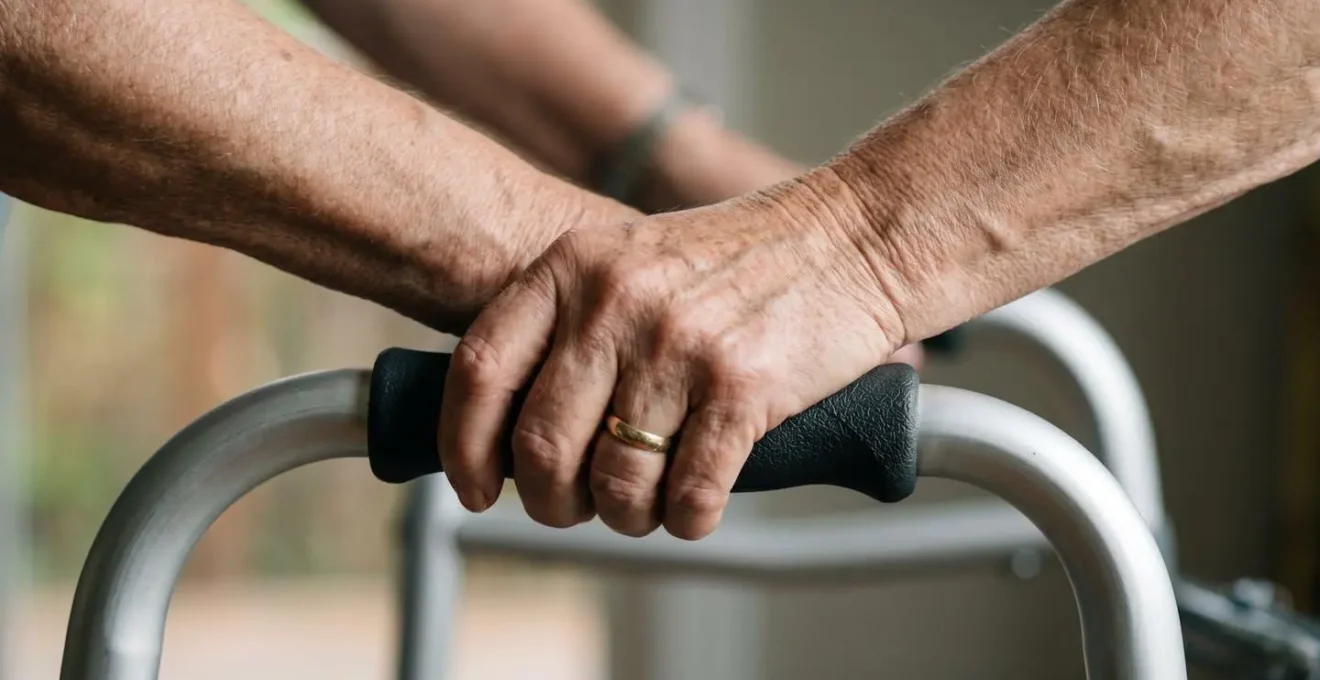
The image above highlights the ideal hand and wrist position: a neutral, relaxed grip where the arm and hand form a straight line. This is the foundation of good posture and efficient energy transfer, preventing the strain that leads to the damaging hunched walk.
When Should You Start Using a Rollator to Maintain Independence Rather Than Signal Decline?
The decision to start using a rollator is often fraught with emotion, wrongly perceived as a public admission of frailty or a final step towards losing independence. This perspective is fundamentally flawed. The most strategic time to adopt a rollator is long before it becomes an absolute necessity. It should be viewed as a proactive choice to preserve and extend independence, not as a reaction to its decline. The key is to cross the ‘confidence threshold’—the point at which the fear of falling, fatigue, or pain begins to limit your activities and shrink your world.
If you find yourself turning down invitations, avoiding trips to the shops, or no longer enjoying a walk in the park because you’re worried about your balance or stamina, that is the signal. At this point, a rollator is not a crutch; it’s an upgrade. It’s a tool that empowers you to continue doing the things you love, safely and with greater confidence. Waiting until a serious fall occurs means you are acting out of crisis, not strategy. By adopting a rollator earlier, you actively prevent the deconditioning and social isolation that comes from a sedentary lifestyle imposed by fear.
This proactive mindset is championed by healthcare professionals who see the transformative effect of the right equipment. As Occupational Therapist Claudia Weinberg states in a guide on walking aids, it’s about enhancing your life:
The correct walking aid can significantly improve independence and quality of life.
– Claudia Weinberg, Occupational Therapist, Safety & Mobility – Walking Aids Guide
Reframing the rollator as a tool for biomechanical augmentation and energy conservation allows you to make the decision based on logic and ambition, not fear. It’s about choosing to stay in the game, to remain active and engaged with the world on your own terms. Research confirms that users who make this choice are overwhelmingly positive about the outcome, considering the device an essential part of their active life.
Wooden Ramp vs Threshold Ramp vs Vertical Platform Lift: Which Works for a 3-Step Entrance?
Extending your rollator’s domain begins at your own front door. A 3-step entrance presents a significant barrier, but choosing the right solution depends on a careful balance of space, budget, and user ability. There are three primary options: a wooden ramp, a threshold ramp system, or a vertical platform lift (VPL).
A traditional wooden or modular metal ramp is a common solution. For a 3-step entrance (typically a rise of around 21 inches or 53 cm), a safe ramp gradient for an independent rollator user is 1:12. This means for every inch of height, you need 12 inches of length. Therefore, a 3-step rise requires a ramp that is at least 21 feet (over 6 metres) long. This is often impractical for many British homes due to limited space at the front of the property. While it’s a permanent and sturdy solution, the significant footprint is its biggest drawback.
A threshold ramp system is a more compact alternative. These are often shorter, steeper ramps made of rubber or lightweight aluminium, designed specifically for overcoming small rises like door sills or single steps. For a 3-step entrance, you would need a series of linked ramps or a more specialised, steeper portable ramp. This can be a cost-effective solution, but the steeper gradient may require assistance to safely navigate up and down with a rollator. It is best suited for users with good upper body strength who can control the rollator on an incline.
The Vertical Platform Lift (VPL) is the most space-efficient and safest option, but also the most expensive. A VPL is essentially a small, personal elevator that moves straight up and down. It has a tiny footprint, often no larger than a square metre, and can easily handle a 3-step rise. It requires no physical exertion from the user—you simply roll onto the platform and press a button. This makes it the ideal solution for users with limited strength, significant balance issues, or those who may progress to needing a wheelchair. While the upfront cost is higher, it is the most future-proof and accessible solution for overcoming multi-step entrances.
When Should You Upgrade from a Cane to a Rollator for Safer Outdoor Walking?
The walking cane is often the first step in acknowledging a need for mobility support. With almost half of all mobility aid users relying on one, it’s a popular and discreet choice. A cane is excellent for providing a single point of additional stability and taking a small amount of weight off one leg. However, its effectiveness has clear limits, especially for outdoor walking where terrain is unpredictable. The critical moment to consider an upgrade is when your need shifts from light support to a requirement for a stable base and energy conservation.
A cane provides only one extra point of contact with the ground. A rollator provides a wide, stable base of support on four wheels, drastically reducing the risk of a sideways or backwards fall. If you find yourself feeling unsteady on uneven pavements, slopes, or when encountering a dropped kerb, the cane is no longer providing sufficient stability. This is a clear indicator that a rollator would offer a safer alternative.
Furthermore, the concept of energy conservation is crucial. While a cane can help, its use can also demand cognitive and physical effort. As researchers have noted, the dynamics of energy use with walking aids are complex. One PM&R KnowledgeNow review highlights this contrast:
Cane use has been found to increase energy expenditure in healthy, young users, hypothesized to be due to increased cognitive demands of learning a new task. In contrast, aid-dependent ambulators demonstrated decreased energy requirements with cane use.
– PM&R KnowledgeNow researchers, Energy Expenditure During Basic Mobility and Approaches to Energy Conservation
A rollator, by allowing a more natural and continuous walking pattern and bearing more of the user’s weight, is a superior tool for conserving energy over longer distances. If fatigue is the primary reason you are limiting your outdoor activity, upgrading to a rollator will allow you to walk further with less effort, while also providing a convenient seat for rest breaks. The upgrade is a strategic move to a more capable platform for outdoor independence.
Key Takeaways
- Calibration is Crucial: Proper handle height (at wrist level) is the most critical adjustment to prevent a hunched posture and ensure safety.
- A Tool for Independence, Not a Sign of Decline: Adopt a rollator proactively when you feel your world shrinking due to fear of falling or fatigue, not after a crisis.
- Posture is Paramount: Always walk *inside* the rollator’s footprint with an upright spine. A rollator should follow you, not be pushed ahead of you.
Why Does the Wrong Wheelchair Width Cause Pressure Sores Within 3 Months?
While this guide focuses on rollators, understanding the principles of ‘mobility calibration’ extends to all assistive devices, with wheelchair sizing being a critical example. An incorrect wheelchair width is a primary catalyst for pressure sores (also known as pressure ulcers) because it directly creates the two main causal factors: intense, localized pressure and shearing forces. This can happen alarmingly quickly, often leading to skin breakdown within a few months, or even weeks, of consistent use.
If a wheelchair is too wide, the user lacks proper lateral support. To reach the wheels for propulsion, they are forced to lean to one side, creating an asymmetrical posture. This constant leaning concentrates their entire upper body weight onto one ischial tuberosity (sitting bone) instead of distributing it evenly across both. This sustained, high-pressure point restricts blood flow to the skin and underlying tissue, leading to cell death and the formation of a sore.
Conversely, if a wheelchair is too narrow, it creates intense friction and pressure points along the hips and thighs. The sides of the seat frame or armrest panels dig into the tissue. Every small movement, shift in position, or act of propelling the chair creates a ‘shearing’ force, where the skin is pulled in one direction while the underlying bone moves in another. This stretches and tears small blood vessels and damages the tissue structure from the inside out, creating a pathway for a severe pressure sore to develop.
Proper wheelchair prescription involves measuring the user precisely and selecting a chair that provides a snug, supportive fit—often with only an inch of total clearance. This ensures weight is distributed as evenly as possible and eliminates the damaging forces that lead to these dangerous and painful wounds. It reinforces the core message: a mobility device is not a one-size-fits-all product. It is a piece of medical equipment that must be calibrated to the individual’s body to be safe and effective.
Now that you understand the critical importance of proper setup, take a moment to perform a safety and comfort audit on your own rollator. Use the checklist provided as your guide to transform it from a simple aid into a calibrated tool for confident, independent mobility.