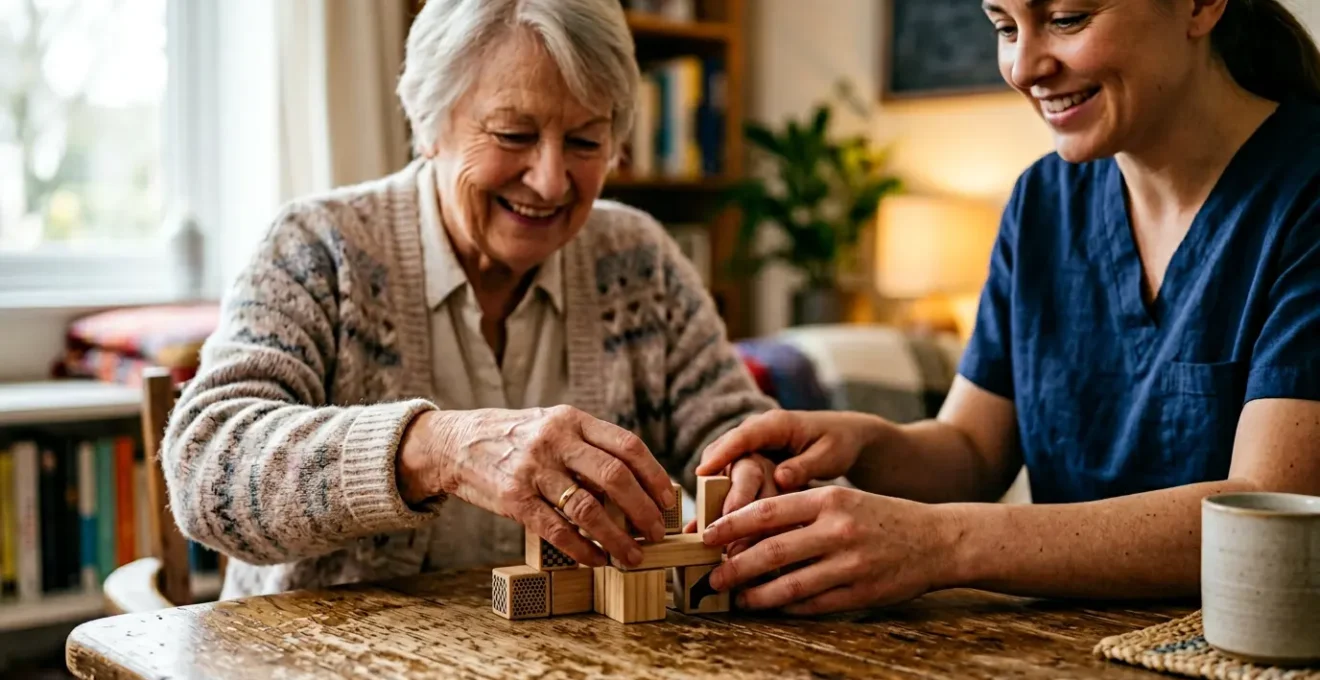
Contrary to common belief, occupational therapy isn’t just a reactive measure after a hospital stay; it’s a proactive strategy for re-engineering daily tasks to maintain your independence and identity at home.
- An OT focuses on adapting the *activity* and *environment* to fit you, rather than focusing solely on your medical condition.
- Struggles with small tasks like buttons are often early warning signs of bigger challenges, which OT can address before they escalate.
Recommendation: Instead of giving up activities that have become difficult, request a free functional assessment from your local council to explore adaptive strategies.
It starts with something small. A stubborn jam jar that won’t twist open. A button on a favourite shirt that suddenly feels fiddly and frustrating. The common response is a quiet sigh, a feeling of resignation, and the thought, « Well, I’m just getting older. » You might mention it to your GP, who is rightly focused on your medical health, managing prescriptions and monitoring conditions. But what if the real solution isn’t in a pill bottle? What if the key to staying independent and continuing the activities you love lies in looking at the problem from a completely different angle?
This is where an occupational therapist (OT) comes in. While a doctor asks, « What’s the condition? », an OT asks, « What do you want to be able to do, and what’s stopping you? » It’s a fundamental shift in perspective. Instead of seeing a person with arthritis, we see a grandmother who wants to keep baking for her family but finds kneading dough painful. Instead of a patient with reduced mobility, we see a keen gardener who can no longer bend down to tend to their plants. Our focus isn’t the diagnosis; it’s the function.
The common misconception is that OT is something you only get after a major event like a stroke or surgery. But its real power lies in proactive, creative problem-solving long before a crisis hits. It’s a collaborative process of analysing a task, breaking it down, and finding clever ways to make it possible again. This is the expertise your GP, with their immense but different skill set, may not have the time or training to explore.
This article will walk you through the practical, functional mindset of an occupational therapist. We will explore how to access this support (often for free and without a GP referral), examine the specific strategies we use for common challenges like cooking and dressing, and reveal why a simple struggle with buttons can be a critical predictor of future care needs—and how to intervene early.
To help you navigate these solutions, this guide is structured to answer your most pressing questions about maintaining independence at home. The following sections break down the role of occupational therapy into practical, real-world scenarios.
Summary: Why an OT’s Perspective Is a Game-Changer for Staying at Home
- What Can an OT Do for You If You Have Not Had a Stroke or Surgery?
- How to Get a Free OT Home Assessment Through Your Council Without a GP Referral?
- Long-Handled Utensils vs Perching Stools: Which Keeps Arthritic Seniors Cooking Safely?
- The Self-Limiting Mistake of Giving Up Activities Before Trying Adaptive Strategies
- When Should You Request an OT Assessment to Stay Home Instead of Moving to Residential Care?
- Button Hooks vs Velcro Adaptations vs Dressing Sticks: Which Keeps Arthritic Seniors Dressing Alone?
- Where Exactly Should Grab Rails Go Around a Toilet to Prevent a Fall Getting Up?
- Why Does Struggling with Buttons Predict Care Home Admission Within 2 Years?
What Can an OT Do for You If You Have Not Had a Stroke or Surgery?
The most common myth about occupational therapy is that it’s a recovery service reserved for post-operative patients or those who have had a serious medical event. While that is a vital part of our work, a huge portion of what we do is preventative. In fact, data shows that over one-third of occupational therapists work with seniors in community and home settings to maintain their health and prevent future problems. The goal is to keep you living well in your own home for as long as possible, not just to help you get back there from a hospital bed.
Think of an OT as a ‘life-task engineer’. If you’ve started noticing that daily activities are becoming more difficult, tiring, or even painful, that’s the perfect time to engage with us. We don’t wait for a fall to happen; we look at the ‘near-misses’ and the environmental factors that could lead to one. We don’t wait for you to stop cooking; we look at why peeling vegetables has become a struggle and find a different way to do it. This proactive approach focuses on enabling ability rather than just managing disability.
The scope of preventative OT is broad and tailored to your specific goals. It’s about preserving your identity—as a cook, a gardener, a social person—by finding new ways to perform the tasks that make you, you. The core benefits extend far beyond just physical support:
- Overcoming daily life challenges: We help you find new techniques or simple tools to manage dressing, preparing meals, managing your home, and participating in social activities.
- Preventing falls: We analyse your movement and your environment to problem-solve the best ways to stay active while significantly reducing your risk of falling.
- Home environment modifications: Before you need a major adaptation, we can suggest small, effective changes, like better lighting or reorganising cupboards, alongside simpler equipment like bathtub benches.
- Boosting health and wellness: By empowering you to remain active and engaged, OT has a powerful positive influence on mental health, confidence, and overall life satisfaction.
- Supporting family and caregivers: We can also work with your family, providing them with strategies and knowledge to support you effectively without taking over your independence.
Ultimately, preventative OT is an investment in your future. It’s about making small, intelligent changes now to avoid large, disruptive ones later. It acknowledges that a life isn’t just about being medically stable; it’s about being able to live it in a way that feels meaningful and autonomous.
How to Get a Free OT Home Assessment Through Your Council Without a GP Referral?
One of the biggest barriers to getting support is the belief that you must first go through your GP. While your doctor is a crucial part of your healthcare, you have the right to request a social care assessment directly from your local council’s adult social services department. This is a game-changer for accessing OT support proactively. This assessment is designed to understand your needs for living safely and independently at home, and it’s typically free of charge.
The process is often called a ‘self-referral’. Navigating council websites can be daunting, but the key is to look for sections on ‘Adult Social Care’, ‘Help to Live at Home’, or ‘Requesting an Assessment’. The language you use in your request is important. You are not asking for a diagnosis; you are highlighting functional difficulties. Using phrases like « I have growing concerns about my safety at home, » « I am finding daily tasks like dressing/cooking increasingly difficult, » or « I want to prevent a fall » will direct your request to the right team.
It’s wise to be prepared for the process. While urgent cases are prioritised, it’s important to know that for non-urgent needs, some councils report waiting times of up to 12 months, so starting the process early is key. Being specific about your challenges will lead to a more effective assessment. A ‘difficulty diary’—a simple log of what you struggled with each day for a week—can be incredibly powerful evidence. The more concrete your examples, the better the OT can understand your needs.
Your Action Plan: Requesting a Council OT Assessment
- Initiate the Self-Referral: Find the ‘Adult Social Care’ section on your local council’s website. You may need to register for an online account with an email address to make a formal request.
- Use Key Phrases: In your application, clearly state your difficulties with daily tasks, concerns about safety, and your desire to prevent falls or a crisis.
- Prepare a ‘Difficulty Diary’: For one week before your assessment call, note down specific tasks that were hard, what made them hard, and how long they took. (e.g., « Tuesday: Couldn’t open the milk. Grip was too weak. Had to wait for my neighbour. »)
- Request a ‘Functional Assessment’: When you speak to them, ask for a ‘functional assessment’ or ‘reablement support’ rather than just an ‘equipment assessment’. This encourages a more holistic look at your needs beyond just providing gadgets.
- Be Patient but Persistent: After your request, expect initial contact, usually by phone, within about 20 working days. If you don’t hear back, a polite follow-up is perfectly acceptable.
This direct route empowers you to take control of your situation, addressing challenges on your own terms and timeline. It shifts the dynamic from being a passive patient to an active partner in your own care and well-being.
Long-Handled Utensils vs Perching Stools: Which Keeps Arthritic Seniors Cooking Safely?
For many, the kitchen is the heart of the home, a place of creativity and connection. When arthritis makes cooking a painful chore, it’s not just a meal that’s lost; it’s a piece of one’s identity. With 47.3% of U.S. adults aged 65 and older living with a doctor-diagnosed form of the condition—a figure mirrored in the UK—this is a widespread challenge. The common reaction is to simplify meals or stop cooking altogether. But as an OT, my first question is never, « What can’t you do? » It’s, « What’s the specific barrier, and how can we engineer a way around it? »
The answer to the question « Which is better: long-handled utensils or a perching stool? » is a classic OT response: « It depends on the problem. » A long-handled spoon is a brilliant solution for a dexterity or reach issue, but it’s useless for someone whose primary problem is endurance and can’t stand for more than five minutes. A perching stool solves the endurance problem but does nothing for a weak grip. This is the core of OT task analysis: we match the solution to the specific functional barrier, not the medical diagnosis.
This paragraph introduces the concept of matching tools to specific needs in the kitchen. For a clearer understanding, the illustration below highlights an example of an adaptive utensil designed for this purpose.

As you can see, the built-up grip on this tool is designed to reduce strain on finger joints, a perfect solution for a grip strength problem. This is just one example of how a small adaptation can make a huge difference. An OT assessment deconstructs the entire process of making a meal—from opening the fridge to chopping vegetables and lifting pans—to identify every single barrier and find a corresponding solution.
The following table illustrates this problem-solving matrix. It shows how we think, moving from the difficulty you experience to the underlying issue and then to a targeted recommendation. This method ensures that any equipment provided is not just a random gadget but a precise tool to solve a specific problem.
| Primary Difficulty | Underlying Issue | Recommended Solution | Expected Outcome |
|---|---|---|---|
| Pain when standing for 10+ minutes | Endurance/Balance problem | Perching stool | Allows seated food preparation, reduces fall risk |
| Weak grip on pans/utensils | Fine motor/Dexterity issue | Long-handled utensils with built-up grips | Increases leverage, reduces joint strain |
| Cannot open jars/bottles | Grip strength decline | Electric/adaptive jar opener | Eliminates twisting motion stress |
| Difficulty cutting food | Grip strength + wrist alignment | Rocker knife | Distributes force over larger hand surface |
This targeted approach not only keeps you safer but also conserves precious energy and boosts confidence, turning the kitchen from a place of frustration back into a space of enjoyment and independence.
The Self-Limiting Mistake of Giving Up Activities Before Trying Adaptive Strategies
We see this all the time. A client says, « I’ve had to give up my gardening, my back can’t take the bending anymore. » Or, « I don’t go to my book club because getting dressed up is just too much effort. » This act of ‘giving up’ is rarely a single decision. It’s a slow, quiet retreat from the activities that bring joy and meaning to life. It is perhaps the most common, and most damaging, self-limiting mistake people make as they age. It’s based on the false assumption that if an activity becomes difficult, the only option is to stop doing it.
Occupational therapy is built on the opposite principle: if a valued activity becomes difficult, we don’t abandon it; we adapt it. Giving up an activity creates a negative spiral. It leads to physical deconditioning, as muscles weaken from disuse. It leads to social isolation, which is a major risk factor for depression and cognitive decline. And it shrinks a person’s world, reducing their confidence and sense of self. The OT’s role is to intervene before this spiral takes hold, by demonstrating that there is almost always another way.
This might involve ‘activity grading’—breaking a complex task into smaller, more manageable steps. For the gardener, instead of giving up entirely, we might suggest starting with a single raised planter bed. This eliminates the need for bending and allows them to enjoy the satisfaction of gardening on a smaller, more achievable scale. For the person struggling to dress, we might analyse which specific part is the problem—is it the buttons? The overhead pulling? The socks?—and introduce a single tool, like a button hook, that solves that one specific issue.
This approach is proven to work. It empowers individuals by shifting their mindset from « I can’t » to « How can I? ». A powerful example of this is seen in a well-regarded intervention programme.
Case Study: The CAPABLE Program and Activity Adaptation
The CAPABLE (Community Aging in Place—Advancing Better Living for Elders) program is a home-based intervention that perfectly illustrates this principle. It combines the skills of an OT, a nurse, and a handyman to address both personal and environmental barriers. Studies on the program show that participants successfully resumed meaningful activities they had previously abandoned, such as gardening and cooking. This was achieved through creative, adaptive strategies identified by the OT, including using raised garden beds, introducing long-handled tools to eliminate bending, and applying activity grading techniques that broke down complex cooking tasks into simple, manageable steps. The result was not just a return to activity, but a significant improvement in confidence and well-being.
The key is to seek advice early. The moment an activity starts to feel like a struggle is the moment to ask for help in finding a new way to do it, not the moment to cross it off your list for good.
When Should You Request an OT Assessment to Stay Home Instead of Moving to Residential Care?
For the vast majority of people, the goal is to live in their own home for as long as possible. Yet, the move to residential care is often triggered by a crisis—a significant fall, a hospital admission, or a sudden decline that makes living alone seem unsafe. The tragedy is that in many cases, this crisis could have been prevented. An occupational therapy assessment is one of the most powerful tools for proactively addressing the issues that lead to these crises, but many people wait too long to ask for one.
The time to request an assessment is not when the situation has become untenable; it’s when the first « red flags » appear. These are subtle but significant changes in your ability to manage daily life. They are the early warning signs that the balance is tipping, and that without intervention, a crisis could be on the horizon. Ignoring these signs is a common mistake. Acknowledging them and seeking support is the most effective way to ensure you can stay in your own home safely and on your own terms.
As OTs, we look for patterns. A single instance of struggling might not be a concern, but a trend of increasing difficulty is a clear signal. For example, falls are the leading cause of injury among seniors, but the real red flag isn’t just the fall itself; it’s the ‘near-misses’ and the growing fear of falling that leads to inactivity. That fear is a critical trigger for an OT assessment. You should consider requesting an assessment if you recognise yourself in several of the following situations:
- You have had one or more falls, or several ‘near-misses’ (stumbles or trips where you just managed to catch yourself), in the last six months.
- You are skipping meals, eating simple snacks instead of proper food, because the process of cooking has become too difficult or exhausting.
- You find yourself avoiding going out or seeing people because the effort of getting washed and dressed is too hard or painful.
- Daily tasks that were manageable three months ago, like making the bed or carrying shopping, now require significant effort and leave you tired.
- You have stopped participating in hobbies you once enjoyed (like gardening, knitting, or walking) because of physical barriers in or around your home.
- Family members or friends have started to express genuine concern about your safety when you are at home alone.
Viewing these challenges not as a personal failure but as practical problems in need of a solution is the key. An OT assessment provides a professional, objective roadmap of solutions, giving you and your family a clear plan to enhance your safety and prolong your independence at home.
Button Hooks vs Velcro Adaptations vs Dressing Sticks: Which Keeps Arthritic Seniors Dressing Alone?
The simple act of getting dressed is a complex sequence of movements requiring fine motor skills, grip strength, balance, and flexibility. For someone with arthritis, it can become a daily battle. The frustration of not being able to fasten a button or pull on a pair of trousers can be deeply demoralising, often leading to a reliance on others or a decision to simply not go out. However, a vast array of simple, low-cost adaptive tools exists to solve these very specific problems. The key, as always in occupational therapy, is matching the right tool to the right barrier.
As the Healthline Medical Review Team notes in their guide on assistive devices, even a simple tool can make a world of difference. They state:
Button hooks pull buttons of all sizes through buttonholes for you. They may help you get dressed when RA makes the joints in your fingers stiff and painful.
– Healthline Medical Review Team, 32 Assistive Devices for Rheumatoid Arthritis
But a button hook is only the answer if fiddly buttons are the primary problem. If the issue is a frozen shoulder that prevents you from reaching behind your back to pull up a zip, a button hook is useless. In that case, a dressing stick with a hook on the end would be the correct solution. If hand weakness is so significant that even using a button hook is difficult, then adapting clothing with Velcro or magnetic closures might be the most effective long-term strategy. An OT assessment dissects the action of dressing to pinpoint exactly where the process breaks down.
The following guide shows how an OT thinks when selecting a dressing aid. It’s a process of elimination and precise matching based on the user’s specific physical limitations.
| Adaptive Tool | Primary Function | Addresses Which Barrier | Best For |
|---|---|---|---|
| Button Hook | Pulls buttons through buttonholes | Fine motor/Dexterity issues | Stiff, painful finger joints |
| Dressing Stick | Extends reach for pulling garments | Reach/Flexibility limitations | Limited shoulder mobility, hip restrictions |
| Velcro Adaptations | Replaces buttons/snaps entirely | Replacement strategy for severe dexterity loss | Advanced arthritis, significant hand weakness |
| Adaptive Clothing | Magnetic closures, elastic waists | Eliminates need for tools | Most effective first-line solution for many |
By using the correct, targeted tool, the daily frustration of dressing can be transformed back into a simple, manageable routine, preserving dignity, independence, and the freedom to wear what you want, when you want.
Where Exactly Should Grab Rails Go Around a Toilet to Prevent a Fall Getting Up?
A grab rail seems like a simple solution. When getting up from the toilet becomes difficult, the common advice is to « install a grab rail ». But this advice is dangerously incomplete. A poorly placed grab rail can be useless at best and, at worst, can actually increase the risk of a fall by encouraging an unstable pulling motion. The question isn’t *if* you should have a grab rail, but *where* it should go, *what type* it should be, and *how* it should be oriented to support your unique pattern of movement.
As an OT, we never prescribe equipment without first completing a functional assessment. This means observing how you actually move. Do you push up with both hands? Do you lean heavily to one side? Do you twist as you stand? The answers to these questions determine the entire setup. A person who pushes up from a seated position needs a stable horizontal surface to press down on, making horizontal rails on both sides of the toilet ideal. In contrast, a vertical rail can encourage a pulling motion, which can destabilize someone with poor balance.
This wide-angle view of an accessible bathroom demonstrates how strategically placed rails create a safe and functional space. The placement is not random; it’s engineered for movement.

As the image illustrates, the space around the toilet is just as important as the rails themselves. There must be enough clearance for safe movement. The standard height for a horizontal grab rail is 33 to 36 inches from the floor, but even this is just a guideline. The perfect height for you depends on your seated height and arm length. A proper assessment customises the solution to fit your body and your movement.
The process of determining the right placement is methodical and person-centred. It involves several key steps of observation and measurement:
- Observe the natural transfer: We watch how you currently stand up from the toilet or a similar height chair to understand your body’s preferred movement pattern.
- Measure hand placement: We note exactly where your hands go for support during the movement. The rails must be placed where your hands naturally want to be.
- Assess push vs. pull: We determine if you need a surface to push down on (more stable) or if you tend to pull yourself up (less stable). This dictates the orientation of the rail.
- Consider the entire pathway: The assessment includes the route to and from the bathroom. Are hallway rails or better night lighting needed to prevent a fall on the way?
- Customise height and position: We adjust the standard height guidelines based on your individual body measurements to ensure optimal leverage and support.
- Recommend dual support: For maximum stability, a two-handed transfer using two rails (one on each side) is almost always the safest and most effective setup.
By moving beyond the generic advice and focusing on a personalised, functional assessment, a simple grab rail is transformed from a piece of metal on a wall into a critical tool that ensures safety, confidence, and independence in the most private of spaces.
Key Takeaways
- Occupational therapy is a proactive service focused on adapting tasks and environments to keep you independent, not just a reactive service after a crisis.
- You can self-refer for a free OT assessment through your local council’s adult social services without needing a GP referral.
- The right adaptive equipment is not about the diagnosis (like arthritis) but about matching a specific tool to a specific functional barrier (like weak grip vs. poor endurance).
Why Does Struggling with Buttons Predict Care Home Admission Within 2 Years?
It sounds dramatic, but a simple, persistent struggle with fastening buttons is one of the most reliable early predictors an OT sees for a future need for residential care. This isn’t because buttons themselves are life-critical. It’s because this small difficulty is a ‘proxy’—a visible symptom of a collection of underlying declines that have a powerful domino effect on a person’s independence. As stated in clinical assessment standards, this is a key diagnostic clue:
Difficulty with buttons is a proxy for a combination of declining fine motor skills, grip strength, and sensation—all of which are critical for countless other daily tasks.
– Occupational Therapy Clinical Assessment Standards, Healthline Review on Assistive Devices for Rheumatoid Arthritis
These three abilities—fine motor control, grip, and sensation—are not just for buttons. They are essential for opening medication packets, holding cutlery, using a phone, turning a key in a lock, and hundreds of other small but vital daily activities. When they begin to decline, a predictable and dangerous cascade of dependency is set in motion. This is not inevitable, but it is a common pattern for those who do not receive early intervention.
The progression often follows a clear, six-step path from a minor inconvenience to a major life crisis. Understanding this ‘cascade of dependency’ is crucial because it reveals the most effective point for intervention: right at the very beginning.
- Step 1 – The Initial Signal: The struggle with buttons begins, indicating a subtle decline in fine motor skills and grip strength.
- Step 2 – Activity Restriction: Because dressing becomes difficult and frustrating, the person starts to avoid going out.
- Step 3 – Social Isolation: Reduced social contact and community engagement increase the risk of loneliness, depression, and cognitive decline.
- Step 4 – Physical Deconditioning: Staying at home leads to inactivity. Muscles weaken, and balance deteriorates from lack of use.
- Step 5 – Increased Fall Risk: The combination of physical weakness, poor balance, and a home environment that hasn’t been adapted creates a high-risk situation.
- Step 6 – The Crisis Event: A serious fall or other acute medical event occurs, often leading to hospitalisation and a subsequent, urgent discussion about moving to a care home.
The growing recognition of OT’s role in preventing this cascade is reflected in workforce projections, with one report showing a projected 14% growth in employment from 2024 to 2034 for occupational therapists. This highlights a systemic shift towards preventative care.
Intervening at Step 1 with a simple tool like a button hook or a clothing adaptation is easy, low-cost, and highly effective. It stops the entire cascade before it starts. This is the power of the OT perspective: seeing the big picture in the smallest of struggles and providing the right solution at the right time.