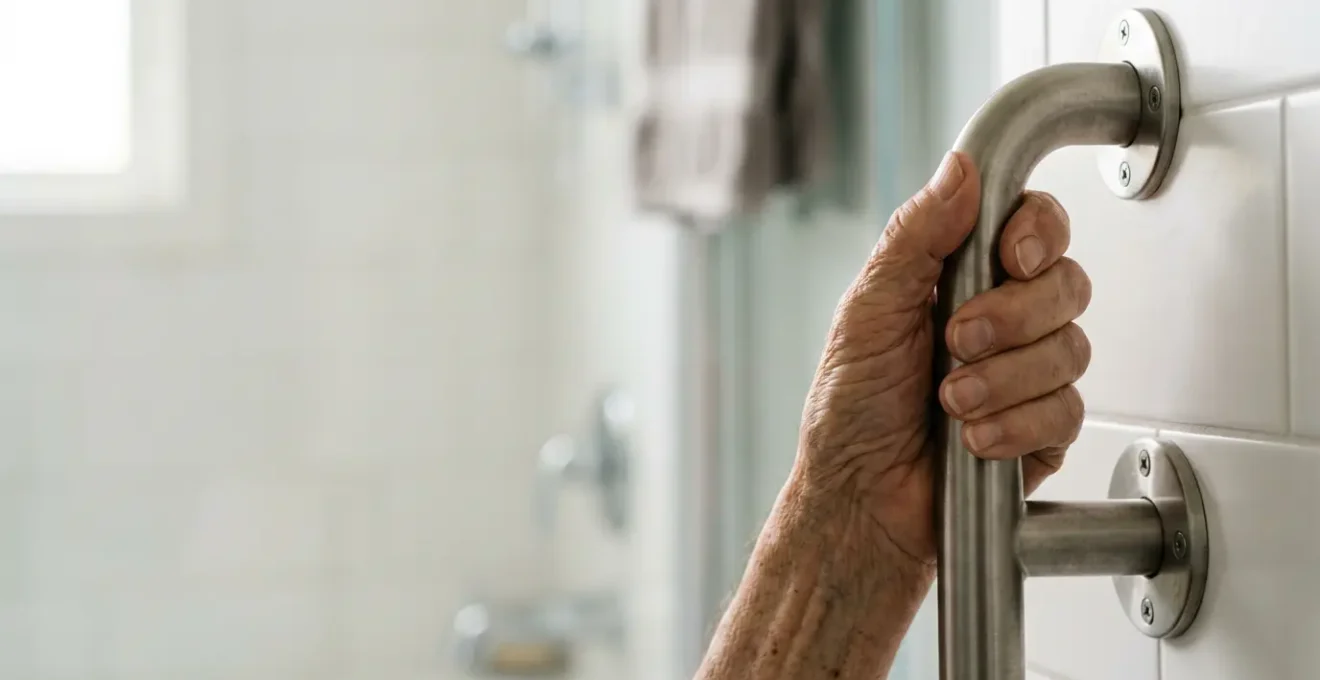
In summary:
- The strength of your wall is more critical than the quality of the grab rail itself; a weak wall means a useless rail.
- Correct toilet rail placement is dictated by the body’s natural sit-to-stand movement, not guesswork.
- Only screw-in grab rails are safe for load-bearing; suction rails fail under the dynamic force of a fall.
- Rail height must be at your elbow when standing to provide maximum leverage and support.
- Proactive installation before an incident occurs is a proven strategy to significantly reduce fall-related injuries.
The moment of hesitation before standing up. The slight wobble when stepping out of the bath. For many seniors and their families, these small signs of instability are the first warnings. The common advice is immediate and simple: « You need to install some grab rails. » While well-intentioned, this advice often misses the most critical detail. The difference between a grab rail that is a decorative bathroom accessory and one that is a life-saving device isn’t the rail itself, but the science behind its installation. Simply having something to grab is a dangerously incomplete solution.
The market is flooded with options, from sleek chrome bars to « easy-install » suction cups, creating a false sense of security. But as professional installers, we see the aftermath of improperly fitted aids every day. A rail fixed into weak plasterboard or placed at the wrong height doesn’t just fail to help; it can actively contribute to a fall by providing a false promise of support that gives way at the critical moment. The real key to safety isn’t just *that* you install a rail, but *why* specific rules about wall materials, positioning, and height exist.
This guide will take you beyond the vague recommendations. We will break down the evidence-backed principles that turn a simple steel bar into a robust safety system. We will explore the biomechanics of movement, the physics of force, and the non-negotiable standards that prevent a slip from becoming a hospital admission. By understanding the « why » behind each placement, you can ensure the safety modifications you make are truly effective.
This article provides a detailed breakdown of the critical factors for safe and effective grab rail installation. Explore the sections below to understand the science behind preventing falls.
Summary: The Science of Safe Grab Rail Installation for Fall Prevention
- Why Does the Wall Material Matter More Than the Rail Quality for Preventing Falls?
- Where Exactly Should Grab Rails Go Around a Toilet to Prevent a Fall Getting Up?
- Screw-In Rails vs Suction Rails: Which Is Safe Enough for a Senior Who Weighs 14 Stone?
- The Rail Height Mistake That Gives Seniors Something to Grab but Still Lets Them Fall
- When Should You Install Bathroom Grab Rails: After a Near-Miss or Before Any Incidents?
- Why Poor Lighting in Your Hallway Could Be the Reason for Your Next Hospital Stay?
- Why Does a 2-Inch Higher Toilet Seat Reduce Knee Strain by 40% When Standing?
- Why Does the Standard UK Toilet Height Make Rising Dangerous After Hip Surgery?
Why Does the Wall Material Matter More Than the Rail Quality for Preventing Falls?
It’s a common mistake to focus solely on the grab rail—its finish, its brand, its stated weight capacity. However, a £200 stainless steel rail is utterly useless if the wall it’s attached to cannot handle the force. As professional installers say, « Grab bars are only as strong as the strength and rigidity of the material to which they are mounted. » This principle of load-bearing integrity is the absolute foundation of fall prevention. A grab rail is not just a piece of metal; it’s a system, and the wall is the most critical component.
Think of it this way: when a person slips, they don’t gently pull on the rail. They grab it with sudden, dynamic force. This force is transferred through the mounting screws directly into the wall substrate. If that substrate is standard plasterboard (drywall), the screws can easily rip out, taking a chunk of the wall with them and failing at the most crucial moment. To be truly effective, rails must be anchored into something solid, like a wooden stud, masonry (brick or block), or a professionally installed reinforcement plate behind the wall.
The goal is to create a single, unified structure where the rail, fixings, and wall work together to resist sudden, high-impact loads. A high-quality rail on a weak wall provides a false sense of security, which is more dangerous than no rail at all. It’s why a professional assessment always starts with evaluating the wall structure, not with browsing a rail catalogue. Prioritising the anchor point over the accessory is the first rule of effective installation.
Where Exactly Should Grab Rails Go Around a Toilet to Prevent a Fall Getting Up?
The placement of grab rails around a toilet isn’t a matter of convenience or aesthetics; it’s a science based on human biomechanics. The simple act of standing up from a seated position is a complex sequence involving shifts in centre of gravity and coordinated muscle engagement. A properly placed rail acts as a biomechanical lever, reducing the muscular effort and joint strain required, thereby minimising the risk of imbalance and falls.
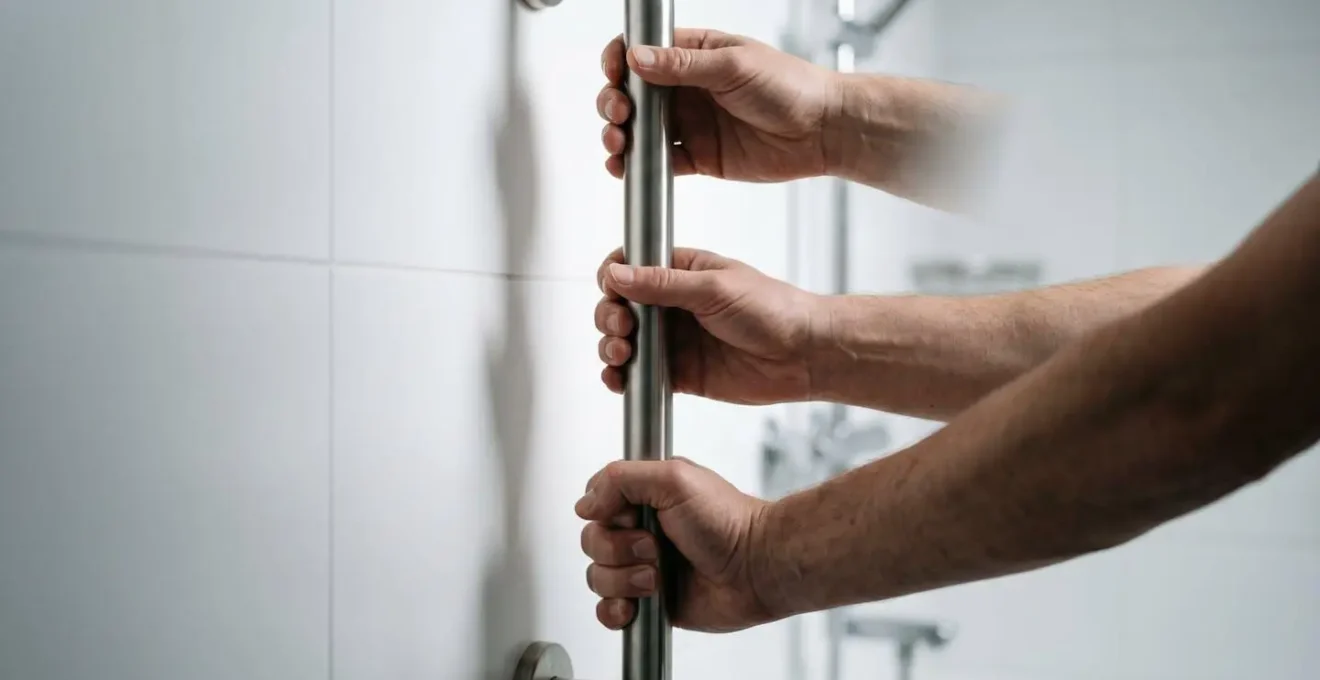
As the image above illustrates, the movement involves pushing up and forwards. Therefore, rails must support this entire motion. A peer-reviewed study confirms this, showing that using bilateral grab bars at the correct height and width significantly reduced peak ankle, knee, and hip joint moments during toilet transfers. The ideal setup typically involves two points of contact: a horizontal rail on the side wall and a vertical or angled rail in front or a hinged rail that can be lowered. A horizontal rail allows a user to pull themselves forward and up, while a second rail provides a stable point to push against as they come to a standing position.
Simply placing a single horizontal bar behind the toilet is a common but critical error. It encourages the user to pull backwards, which is counterintuitive to the forward motion needed to stand and can easily lead to a loss of balance. The goal is to create a « support zone » that mirrors the body’s natural movement path, providing stable leverage from the start of the movement to the final, stable standing position. This turns the toilet area from a high-risk fall zone into a secure and manageable space.
Action Plan: Auditing Your Toilet Rail Placement
- Points of contact: Identify where a person naturally places their hands to push up. Are rails available at these points?
- Support the full motion: Is there a rail for the initial pull-forward and another for the final push-up to a standing position?
- Check for conflicts: Does the rail placement interfere with the use of a walker, walking stick, or access for a caregiver?
- Assess leverage: Is the horizontal rail at a height that allows the user to get their forearm over it for maximum leverage?
- Plan for weakness: On which side does the user have more weakness? Ensure the primary support rail is on their stronger side to allow for effective pulling.
Screw-In Rails vs Suction Rails: Which Is Safe Enough for a Senior Who Weighs 14 Stone?
This question gets to the heart of a dangerous misconception in home safety. For a senior weighing 14 stone (196 lbs, or 88kg), or any weight for that matter, the answer is unequivocal: only a properly installed screw-in grab rail is safe. The fundamental reason lies in the difference between static and dynamic force. A suction rail might hold a person’s weight if they lean on it gently (static force), but it is not designed to, and will not, withstand the sudden, immense shock load of a person slipping and grabbing it to break their fall (dynamic force).
Safety experts are clear on this point. As one guide warns, suction bars cannot support large weight and don’t provide significant stability for transfers or fall prevention. Their grip relies on a perfect, non-porous, and completely clean surface—conditions that are rarely guaranteed in a real-world bathroom with grout lines, temperature changes, and soap residue. The risk of failure is unacceptably high.
We have heard of stories where suction cup grab bars do not remain attached when a user grabs one to break a fall.
– GrabBars.com Safety Team, Professional Safety Equipment Guidelines
In contrast, a screw-in rail, when anchored correctly into a solid wall stud or masonry, becomes part of the building’s structure. It can withstand hundreds of pounds of dynamic force, providing a reliable anchor point when it’s needed most. For someone weighing 14 stone, the force generated during a fall can easily exceed 300-400 pounds. A suction cup is simply not a safety device in this context; it’s an accident waiting to happen. Choosing a screw-in rail isn’t a preference; it is the only responsible choice for genuine fall prevention.
The Rail Height Mistake That Gives Seniors Something to Grab but Still Lets Them Fall
Installing a grab rail at the wrong height is one of the most common and dangerous mistakes in home safety. A rail that is too high or too low fails to provide the proper biomechanical advantage, rendering it ineffective during a moment of imbalance. The goal isn’t just to have something to touch, but to have a secure anchor at a height that maximizes a person’s strength for both pushing and pulling. The correct height isn’t arbitrary; it’s based on human anatomy.
The rail should be at elbow height when standing, allowing a 90-degree bend when grabbing it, which is the strongest position for both pushing and pulling.
– EA Mobility Occupational Therapy Guide, Professional Grab Rail Positioning Standards
This « 90-degree rule » is critical. When your elbow is bent at 90 degrees, your bicep and tricep muscles are in their optimal position to exert maximum force. A rail placed too high forces the user to reach up, weakening their grip and destabilising their shoulder. A rail placed too low forces them to bend over, shifting their centre of gravity forward and actually increasing the risk of a fall. The ideal placement is one that feels natural and allows for this powerful 90-degree arm position.
While individual anatomy varies, extensive research shows that grab rails positioned at 33 to 36 inches from the floor generally corresponds to hip or elbow height for most adults, providing the best leverage. This height ensures the user can get their forearm onto the rail if needed, distributing the load and providing a much more stable platform than a simple hand grip. Getting the height right is the difference between a functional safety device and a poorly placed piece of metal.
When Should You Install Bathroom Grab Rails: After a Near-Miss or Before Any Incidents?
This is a question of mindset: are safety measures a reaction to a crisis, or a proactive strategy to prevent one? The data overwhelmingly supports the latter. Waiting for a « near-miss » or, worse, an actual fall, is a gamble with devastating potential consequences. Proactive installation of home safety features like grab rails is one of the most effective interventions available for maintaining independence and preventing serious injury. The time to install them is now, before they are desperately needed.
The evidence is compelling. A landmark study found a 30% reduction in fall-related injuries among older adults who had grab rails installed in their homes. This is the statistic that underpins the entire rationale for proactive hazard mitigation. It’s not just a feeling of being safer; it’s a measurable, significant decrease in actual, life-altering injuries. A 30% reduction in risk is a powerful argument for taking action before an incident forces your hand.
Thinking of grab rails as « for old people » or a sign of decline is a dangerous and outdated perspective. A more accurate view is to see them as a smart home upgrade, similar to installing a smoke detector or a security system. They are a practical tool that mitigates a known and serious risk. Considering that falls are a leading cause of injury and loss of independence for seniors, installing these simple devices is a logical, evidence-based decision to protect well-being and prolong the ability to live safely and comfortably at home. The best time to fix the roof is when the sun is shining, and the best time to install grab rails is before the first stumble.
Why Poor Lighting in Your Hallway Could Be the Reason for Your Next Hospital Stay?
Falls in the home don’t just happen in the bathroom. Hallways, stairs, and the pathways between rooms are common « transition zones » where lighting plays a critical safety role. As we age, our eyes require more light to see clearly, and they adapt more slowly to changes in brightness. A dimly lit hallway isn’t just atmospheric; it’s a minefield of hidden hazards that can directly lead to a fall. Poor lighting impairs depth perception and the ability to detect obstacles, making a simple trip to the bathroom at night a high-risk journey.

Shadows can obscure the edge of a rug, a misplaced pair of shoes, or a transition strip between different flooring types. Insufficient contrast makes it difficult to judge the height of a step or the distance to a piece of furniture. For someone with developing cataracts or other visual impairments, these challenges are magnified tenfold. The solution is often simple and inexpensive, yet profoundly effective.
Poor lighting contributes to many falls. Good lighting is one of the least expensive and most effective safety improvements.
– Elder Law Answers Home Safety Guide, Aging in Place Safety Recommendations
Effective hallway lighting involves creating bright, even illumination from the bedroom door to the bathroom. This can be achieved with higher-wattage bulbs, additional light fixtures, or nightlights that automatically switch on in the dark. A particularly effective solution is installing motion-activated LED strip lighting along the skirting boards, which provides a clear, low-level pathway without causing harsh glare. Treating lighting as a foundational element of home safety is just as important as installing grab rails.
Why Does a 2-Inch Higher Toilet Seat Reduce Knee Strain by 40% When Standing?
The act of standing from a low toilet seat is essentially a deep squat, an exercise that places significant force on the knee joints. For a senior with arthritis, muscle weakness, or general joint pain, this repeated strain can be both painful and a major source of instability. A raised toilet seat works by simply reducing the depth of that squat. By raising the starting position by just a few inches, you dramatically decrease the angle of flexion in the knee, which in turn reduces the force required from the quadriceps muscles to stand up.
Imagine lifting a heavy weight. It is much easier to lift it from a waist-high table than from the floor. A raised toilet seat applies the same principle. It changes the biomechanics of the movement to give your body a mechanical advantage. This reduction in knee strain is not just about comfort; it’s a critical factor in fall prevention. When the knees feel weak or unstable during the effort of standing, the risk of toppling sideways or forwards increases significantly. This is a common cause of bathroom falls, which can have severe consequences. According to CDC data, over 300,000 seniors are hospitalized annually with hip fractures, many of which result from falls in the home.
By making the act of standing less of an effort, a raised toilet seat helps maintain balance and control throughout the entire motion. A 2-inch or 4-inch raised seat, often combined with supportive grab rails, creates a safety system that addresses both muscle strain and balance. It’s a simple, targeted modification that directly counters a major biomechanical stressor, making the bathroom a safer environment one flush at a time.
Key Takeaways
- The ultimate strength of a grab rail is determined by the wall’s load-bearing integrity, not the rail itself.
- Effective placement follows human biomechanics, providing leverage throughout the entire sit-to-stand or transfer motion.
- Proactive installation of professionally-anchored, correctly-placed aids is a proven strategy to reduce fall-related injuries.
Why Does the Standard UK Toilet Height Make Rising Dangerous After Hip Surgery?
For anyone recovering from total hip replacement surgery, the standard UK toilet height presents a direct and significant danger. Post-surgery, patients are given strict instructions to avoid certain movements to prevent dislocating the new joint. The most critical of these is the « 90-degree rule »: the hip must not be allowed to bend beyond a 90-degree angle. Unfortunately, the design of a standard-height toilet makes violating this rule almost unavoidable.
Sitting down on a low toilet forces the body into a deep flexion that puts direct stress on the new hip joint and the surrounding surgical site. This single movement can be enough to cause a catastrophic failure of the replacement, leading to excruciating pain, a return to hospital, and potentially another major surgery. As clinical guidelines state, the risk is not theoretical; it is a clear and present biomechanical threat.
A standard-height toilet forces the hip to bend well beyond 90 degrees, putting direct stress on the new joint and surgical site, which dramatically increases the risk of hip dislocation.
– Queensland Health Clinical Guidelines, Total Hip Replacement Precautions and Bathroom Equipment
This is why occupational therapists are so insistent on prescribing bathroom adaptations before a patient is discharged from hospital. The solution is to artificially raise the height of the toilet seat to ensure the 90-degree rule is respected at all times. This can be achieved with a simple raised seat, a toilet frame, or an over-toilet commode. The choice of equipment is less important than the principle: preventing dangerous levels of hip flexion.
Case Study: Post-Operative Bathroom Safety Mandates
Official health guidelines for occupational therapists in Australia mandate the prescription of bathroom safety equipment for all patients with total hip replacement precautions. These guidelines explicitly state that standard toilet heights violate the crucial 90-degree hip flexion rule. Therefore, health professionals are required to assess and prescribe equipment like raised toilet seats or frames to prevent post-operative hip dislocation, highlighting that such equipment is a medical necessity, not an optional convenience.
Understanding these principles is the first step. The next is applying them. A professional home safety assessment can identify these hidden risks and provide tailored solutions, ensuring that every grab rail and safety aid is not just present, but perfectly placed to do its job.