
That new walking cane, bought to provide stability, may be the direct cause of your new wrist, shoulder, or back pain. An incorrect height forces your body into a state of continuous biomechanical stress.
- A cane that is too high forces your shoulder upward, causing strain, while one too low leads to a detrimental slouch.
- Using the cane on the correct side—opposite your weaker leg—is non-negotiable for a safe, symmetrical gait.
Recommendation: Use the simple wrist-crease measurement outlined in this guide to set your cane to its optimal height immediately. This single adjustment is the most critical step you can take for your long-term posture and safety.
You purchased a walking cane with the best of intentions: to gain a little more confidence, to maintain your independence, and to feel more secure on your feet. Yet, instead of the promised stability, you’re now contending with a nagging wrist pain, a new shoulder ache, or a posture that feels more stooped than before. You are not alone, and it is not your fault. The high street and online retailers often treat a walking cane like a simple accessory, but it is a precise medical instrument. The difference between a tool that supports you and one that actively works against you often comes down to a matter of inches.
The common advice to « measure the cane to your wrist bone » is a starting point, but it lacks the critical context of *why* this is so important and the cascading negative effects of getting it wrong. A poorly fitted cane initiates a postural cascade, where a small, seemingly insignificant height error creates a chain reaction of stress that travels from your hand and wrist up through your elbow, shoulder, and into your spine. This guide, written from the perspective of a British Healthcare Trades Association (BHTA) accredited specialist, moves beyond generic tips. We will delve into the biomechanics of proper cane use to provide a corrective framework.
This is not just a « how-to » manual; it is a « how-to-fix-it » guide for anyone who has bought a cane ‘off the shelf’ and now rightly questions its comfort and effectiveness. We will cover the precise method for setting your cane height, understanding which type of cane is right for your needs, correcting the most dangerous usage habits, and knowing when it’s time to consider a different mobility aid altogether, such as a rollator. The goal is to transform your cane from a source of discomfort into a true extension of your body—one that enhances your posture, eliminates pain, and genuinely prevents falls.
In the following sections, we will systematically address the most critical questions surrounding walking cane selection and use. This structured approach will provide you with the expert knowledge needed to ensure your mobility aid is a source of strength and confidence.
Summary: A Specialist’s Guide to Correct Walking Cane Use
- Why Does a 2-Inch Height Difference in Your Cane Cause Shoulder Pain Within a Month?
- How to Set Your Cane to the Perfect Height Using Just a Doorframe and Your Wrist?
- Offset Cane vs Quad Cane: Which Offers Better Stability After a Hip Replacement?
- The Wrong-Side Cane Habit That Increases Fall Risk by 60%
- When Should You Upgrade from a Cane to a Rollator for Safer Outdoor Walking?
- When Should You Install Bathroom Grab Rails: After a Near-Miss or Before Any Incidents?
- Why Does Slow Movement Strengthen Balance Faster Than Walking at Normal Speed?
- Why Do 70% of Rollator Users Never Adjust the Handle Height After Purchase?
Why Does a 2-Inch Height Difference in Your Cane Cause Shoulder Pain Within a Month?
The seemingly minor issue of a cane being an inch or two too high or too low is the primary cause of user-related pain. It is not about comfort; it is about biomechanics. When your cane is too high, you are forced to hunch your shoulder up to place weight on it. This constant, unnatural elevation puts your shoulder joint and the surrounding muscles under significant strain, leading to impingement, rotator cuff irritation, and radiating neck pain. As one mobility guide highlights, this creates a domino effect. Canes Galore’s « Walking Cane Heights Guide » explains:
A cane that’s too tall pushes your shoulder upward, creating an uneven gait and causing neck strain, shoulder pain, and upper back discomfort.
– Canes Galore, Walking Cane Heights Guide
Conversely, a cane that is too short forces you to stoop and lean over to use it. This posture places immense pressure on your lower back and puts your wrist at an unnatural angle, leading to carpal tunnel-like symptoms and instability. The body is an interconnected system. Forcing one part into an incorrect position creates a compensatory chain of stress. That two-inch error doesn’t just affect your arm; it compromises your entire posture, making your gait less efficient and increasing the very instability you sought to correct. This is why a properly fitted cane doesn’t just help you walk—it helps you walk *upright*.
How to Set Your Cane to the Perfect Height Using Just a Doorframe and Your Wrist?
Setting your cane height is the single most important adjustment you will make. Fortunately, it does not require complex tools. The gold-standard method used by physiotherapists and mobility specialists can be done at home using your own body as the measure. The goal is to achieve a slight, comfortable bend in your elbow—around 15 to 20 degrees—when holding the cane. This angle allows for optimal support without creating strain on your joints.
To find this perfect height, stand as straight as possible in the shoes you most commonly wear. Let your arms hang naturally at your sides. The correct height for your cane is where the very top of the handle meets the crease of your wrist. This simple anatomical landmark ensures the 15-20 degree elbow bend is achieved automatically when you grasp the handle. Using this method prevents the guesswork that leads to the postural problems discussed earlier.
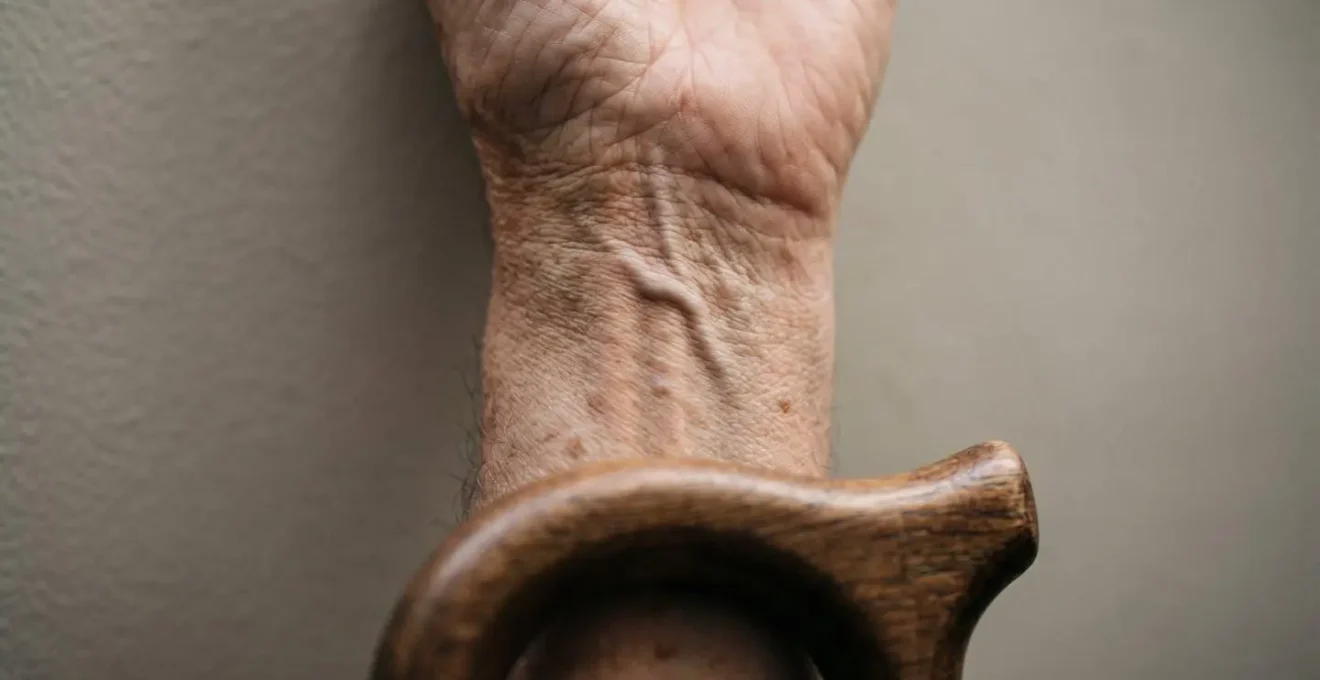
The visual guide above demonstrates the correct positioning. By aligning the top of the cane handle with this specific point on your wrist, you create a direct line of support through your arm, which helps maintain an upright posture and a natural walking rhythm. If your cane is adjustable, this is the point to which you should set it. If you are buying a new wooden cane, this is the measurement you need before it is cut to size.
Action Plan: The 5-Step Cane Height Check
- Stand fully upright in your everyday shoes, with your shoulders relaxed and arms hanging loosely at your sides.
- Have someone measure from the floor to the crease of your wrist. This measurement is your ideal cane height. The top of the cane handle should align with this point.
- Grasp the cane handle. Your elbow should have a comfortable, natural bend of approximately 15 to 20 degrees.
- Walk a few steps around a room. Pay close attention to your shoulder: there should be no hiking or tension. Your wrist should feel neutral, not bent at an awkward angle.
- If you feel any strain, re-check the measurement. For adjustable canes, make small changes in half-inch increments until the fit feels completely natural and supportive.
Offset Cane vs Quad Cane: Which Offers Better Stability After a Hip Replacement?
After a significant procedure like a hip replacement, choosing the right type of cane is critical. The decision often comes down to an offset cane versus a quad cane, and the best choice depends entirely on your stage of recovery. An offset cane has a single tip but features a J-shaped handle that centres the user’s weight directly over the shaft, providing excellent support with a natural gait. A quad cane has a wider, four-pronged base that allows it to stand on its own and offers maximum static stability.
However, more stability is not always better. The wide base of a quad cane can encourage a slow, rocking gait, which can be counterproductive to rehabilitating a normal walking pattern. It is often best suited for the very early stages of recovery (Phase 1), when you are indoors and need maximum support while standing. As you progress and begin to build endurance and walk outdoors (Phase 2), an offset cane is often the superior choice as it promotes a more fluid, symmetrical walking pattern. The following comparison, based on guidance from trusted health sources like the Mayo Clinic, breaks down the key differences.
| Feature | Offset Cane | Quad Cane |
|---|---|---|
| Base of Support | Single point | Four-point wider base |
| Weight | Lighter, easier to maneuver | Heavier, more cumbersome |
| Gait Pattern | Encourages natural, fluid gait | Promotes slower, rocking gait |
| Static Stability | Moderate (when standing still) | Excellent (can stand upright on its own) |
| Dynamic Mobility | High (outdoor, varied surfaces) | Lower (better for indoor use) |
| Best Phase | Phase 2: Building endurance, outdoor mobility | Phase 1: Immediate post-op, maximum safety indoors |
| Rehabilitation Goal | Restores symmetrical walking pattern | Provides maximum support, risk of dependence |
The key takeaway is to see these aids as part of a progression. A quad cane provides safety when you are most vulnerable, but transitioning to an offset cane as your strength improves is crucial for regaining a natural and efficient gait for the long term.
The Wrong-Side Cane Habit That Increases Fall Risk by 60%
One of the most common and dangerous mistakes is holding the cane on the wrong side. Intuition might tell you to hold the cane on the same side as your weaker or painful leg, but this is biomechanically incorrect and significantly increases instability. The correct method is to hold the cane in the hand opposite your affected leg. This widely cited principle is not arbitrary; it is fundamental to how our bodies are designed to walk.
When you walk, your arms naturally swing in opposition to your legs. Your right arm swings forward with your left leg, and vice-versa. This creates a balanced, symmetrical gait. By holding the cane on the opposite side of your injury, you are mimicking this natural movement. As you step forward with your weaker leg, you move the cane forward at the same time. This allows you to shift a portion of your body weight onto the cane, effectively offloading the affected leg and reducing pain and stress on the joint. It creates a wider, more stable base of support triangularly between your two feet and the cane.
Case Study: The Biomechanics of Gait Symmetry
Physical therapy clinics consistently observe the impact of correct cane placement. As highlighted in a demonstration by Capital Region Physical Therapy, using the cane on the opposite side is instrumental for rehabilitation. When patients hold the cane in the hand opposite their injured or weak leg, they can effectively transfer weight off that leg during the walking cycle. This promotes a normal gait pattern and proper swing phase biomechanics, which is crucial for recovery. Holding it on the same side forces a « compensatory lean, » where the user leans away from the painful side, creating an unnatural, lurching gait that is inefficient and dramatically increases the risk of a fall.
Holding the cane on the same side as your weakness narrows your base of support and forces your body to lean away, disrupting your balance. Correcting this single habit is one of the most effective ways to improve your stability and reduce your risk of falling.
When Should You Upgrade from a Cane to a Rollator for Safer Outdoor Walking?
A walking cane is an excellent tool for improving balance and taking a small amount of weight off a limb. However, it has its limits. There comes a point where a cane is no longer sufficient to ensure your safety, particularly during outdoor walks on uneven ground. Recognizing this functional threshold is key to preventing falls. Upgrading to a four-wheeled rollator is not a sign of defeat; it is a proactive step towards maintaining your independence and mobility safely.
A rollator provides a much wider and more stable base of support than any cane. It is designed to bear a significant portion of your weight, which a single-point cane is not. This makes it a better choice if you experience fatigue, generalised weakness, or significant balance issues that a cane cannot fully correct. The built-in seat also offers a crucial safety feature, allowing you to take rest breaks whenever needed, preventing over-exertion which can lead to falls. The decision to upgrade should be based on an honest assessment of your needs.

Consider upgrading from a cane to a rollator if you notice any of the following signs:
- You find yourself leaning heavily on your cane for support, rather than just for balance.
- You feel unsteady or have « near misses » even when using your cane correctly.
- You avoid going for walks because you fear you won’t have the stamina to make it back.
- Your balance is affected by conditions like Parkinson’s, neuropathy, or significant arthritis.
- You need to carry items like a shopping bag or oxygen tank, which is unsafe to do while relying on a cane for balance.
Making the switch is about choosing the right tool for your current level of mobility, allowing you to continue enjoying outdoor activities with confidence.
When Should You Install Bathroom Grab Rails: After a Near-Miss or Before Any Incidents?
The question of when to install bathroom grab rails is a perfect example of a broader principle in home safety: proactivity versus reactivity. The bathroom, with its combination of hard surfaces and water, is one of the most high-risk areas in the home for falls. Too often, the decision to install safety equipment like grab rails is made *after* a slip or a fall has already occurred. This reactive approach leaves a dangerous window of vulnerability. The most prudent strategy is to install them proactively, *before* they are desperately needed.
Think of grab rails not as a sign of frailty, but as a piece of permanent, reliable safety equipment, like a seatbelt in a car. You hope you never need it to its full extent, but it provides constant peace of mind. Installing them when you are still mobile and confident allows you to get used to their presence and incorporate them into your routine naturally. Waiting until your mobility is significantly compromised can make the installation process itself more difficult and means you’ve spent a period of time at an unnecessarily high risk. As research from the Agency for Healthcare Research and Quality shows, nearly one-third of falls were preventable through proper intervention, and home modifications are a cornerstone of that prevention.
You should consider installing grab rails if your balance is beginning to feel less certain, if you have any medical conditions that can cause dizziness or weakness, or simply as a sensible, forward-thinking home improvement. Key locations include next to the toilet, and both inside and outside the bath or shower. A professionally installed grab rail provides a secure anchor point that a towel rack or sink basin was never designed to offer. It is a small investment in infrastructure that pays huge dividends in long-term safety and confidence at home.
Why Does Slow Movement Strengthen Balance Faster Than Walking at Normal Speed?
Improving balance is not about speed; it’s about control and feedback. It may seem counterintuitive, but performing exercises and movements slowly and deliberately can strengthen your balance far more effectively than simply walking at a normal pace. The reason lies in a concept called proprioception—your body’s ability to sense its own position, motion, and equilibrium. It’s an internal feedback loop between your muscles, joints, and brain.
When you move quickly, your brain relies on momentum and established motor patterns. You are essentially on autopilot. When you slow down a movement, however, you force your brain to switch off autopilot. It must actively process the continuous stream of real-time sensory feedback coming from the nerves in your feet, ankles, and legs. This conscious processing strengthens the neural pathways responsible for balance. You are giving your brain the time it needs to learn, adapt, and create a more accurate internal map of your body in space.
Study: The Power of Controlled Movement
Evidence-based research consistently shows that combining assistive devices with specific training yields the best results. A study highlighted by walking-cane experts demonstrates that progressive resistance training combined with slow, controlled movements improves gait speed and functional independence more effectively than standard walking alone. The slowness of the movement is critical, as it allows the brain to actively process the proprioceptive feedback. This active training reduces fall risk far more than simply using a device without targeted exercise, building both physical stability and the user’s confidence in their own balance.
Simple exercises like shifting your weight slowly from one foot to the other, or practicing standing on one leg for a few seconds (while holding onto a stable surface), are incredibly powerful. This mindful approach to movement retrains your body’s balance system from the ground up, providing a more robust and reliable foundation for all your daily activities.
Key Takeaways
- Height is Non-Negotiable: The top of your cane handle must align with your wrist crease. This single adjustment prevents a cascade of postural problems.
- Walk the Right Way: Always hold the cane on the side *opposite* your weaker or painful leg to mimic natural gait and ensure maximum stability.
- Know When to Upgrade: A cane is for balance, not heavy weight-bearing. If you’re leaning heavily or feel unstable, a rollator is the safer choice for maintaining mobility.
Why Do 70% of Rollator Users Never Adjust the Handle Height After Purchase?
The critical issue of improper equipment height is not limited to canes. It extends to all mobility aids, including rollators. It is a startling fact that a majority of users may be compromising their safety and posture without even realising it. According to mobility aid specialists, studies indicate that up to 70% of mobility aid users are using devices that are not correctly fitted to their needs. With rollators, the most common error is setting the handles too high.
This often happens for a well-intentioned but misguided reason: family members or users themselves believe a higher handle will force a more « upright » posture. In reality, it does the exact opposite. As a Rollz Mobility Expert points out, the consequences are predictable:
I often see people walking with a rollator that is set too high… People within the environment of the user think ‘the higher, the better, otherwise mom walks bent over the rollator’. Undoubtedly it is well-intentioned, but with handles that are too high you get the opposite effect.
– Rollz Mobility Expert, Rollator Height Adjustment Guide
Handles that are too high force the user to shrug their shoulders and push the rollator far out in front of them, leading to a stooped posture and placing all the user’s weight on their hands and wrists. This not only causes pain but also reduces the rollator’s effectiveness as a braking and stability tool. The correct height for rollator handles follows the exact same principle as for a walking cane: they should be set to the height of the user’s wrist crease when standing tall with arms at their sides. This ensures the user walks *inside* the frame with an upright posture, not hunched over and pushing it from behind.
Now that you are equipped with this specialist knowledge, the next logical step is to apply it. Take five minutes today to check your own cane or rollator against the wrist-crease standard. It is a small, simple action that can make a profound and immediate difference to your safety, comfort, and long-term postural health.