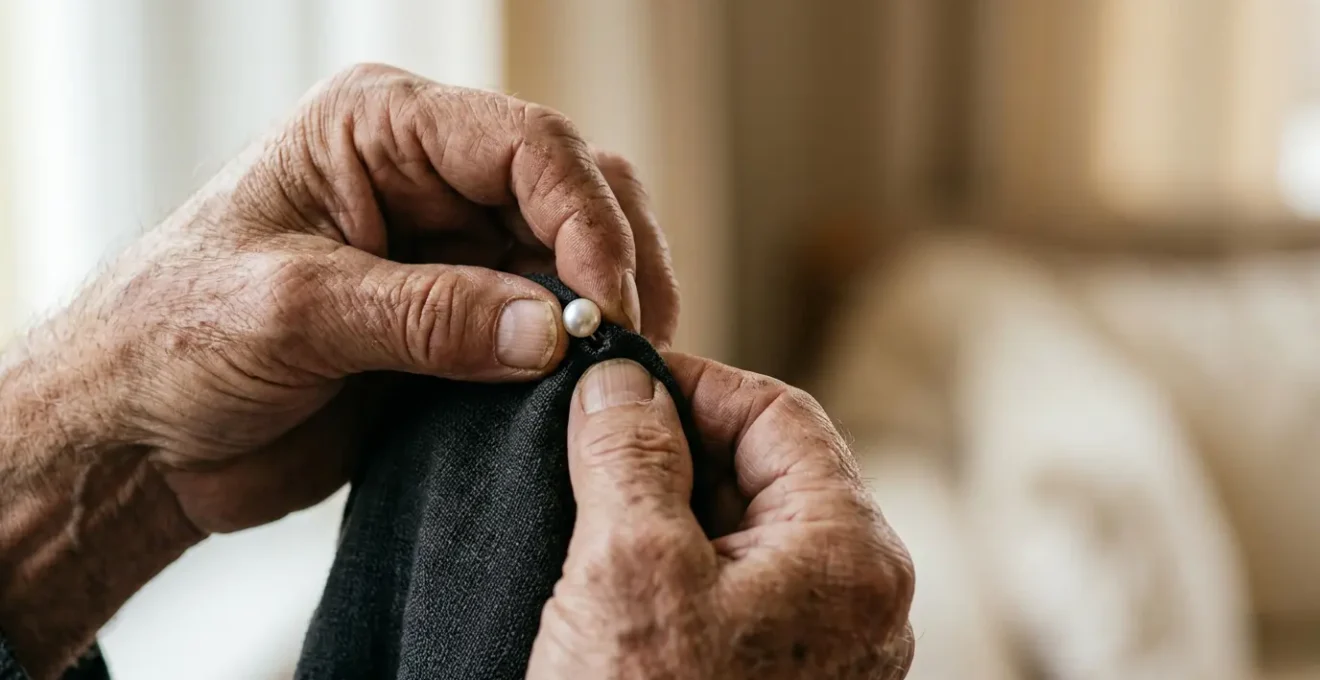
The small, often-missed difficulties with personal care—like struggling with a button—are the most reliable predictors of a senior’s future independence and need for higher levels of care.
- Assessing function (what a person can physically *do*) provides more actionable insight than focusing only on a medical diagnosis.
- Well-intentioned « over-helping » by family can unintentionally accelerate functional decline and create learned dependency.
Recommendation: Adopt an Occupational Therapist’s mindset: analyse the task, adapt the environment, and provide only the minimum necessary assistance to empower, not enable.
For a family member, it often starts with a small, nagging observation. A favourite shirt left unworn because the buttons are too fiddly. A subtle reluctance to take a bath or shower. These moments are easy to dismiss as just « part of getting older. » However, from an Occupational Therapist’s perspective, these are not trivial signs of ageing; they are critical data points. The struggle with a button is not about the button itself; it’s about a potential loss of fine motor skills, a decrease in finger strength, or a change in sensation that can signal underlying issues like arthritis. This difficulty is a canary in the coal mine, predicting a cascade of challenges in performing essential Activities of Daily Living (ADLs).
The common response is to either ignore it until it becomes a crisis or to jump in and « help » by doing the task for them. Both approaches are flawed. Ignoring the signs allows small, manageable problems to grow into complex, overwhelming ones. Conversely, taking over tasks prematurely can strip a person of their skills and confidence, a phenomenon we call ‘learned helplessness’. The key isn’t to simply manage decline, but to proactively support function. This requires a shift in mindset—away from simply « caring for » someone and towards a clinical, problem-solving approach that analyses the specific barrier and finds a targeted solution.
This article will guide you through that very process. We will deconstruct the common challenges in personal care, from bathing to dressing, through the systematic lens of an OT. You will learn not just to spot the signs, but to understand what they mean functionally. We will explore how to assess for help without causing offence, analyse the real-world effectiveness of adaptive aids, and understand the profound risks of over-helping. Finally, we will clarify when and how to engage with formal systems like council assessments and why an OT’s perspective can unlock solutions your GP might never consider, preserving dignity and independence for as long as possible.
This guide provides a structured pathway, applying a clinical and functional lens to the deeply personal challenges of ageing. Follow along to understand not just the problems, but the practical, dignity-preserving solutions.
Summary: Struggling with Buttons: A Functional Guide to Preserving Independence
- Why Is Difficulty Bathing the First Sign of a Larger Independence Crisis?
- How to Check Whether Your Parent Needs Help with Personal Care Without Causing Offence?
- Button Hooks vs Velcro Adaptations vs Dressing Sticks: Which Keeps Arthritic Seniors Dressing Alone?
- The Over-Helping Mistake That Makes Seniors Lose Skills Faster Than Illness Would
- When Should You Request a Council Needs Assessment to Access Funded Personal Care?
- What Can an OT Do for You If You Have Not Had a Stroke or Surgery?
- Why Does a 2-Inch Higher Toilet Seat Reduce Knee Strain by 40% When Standing?
- Why Does an Occupational Therapist See Solutions Your GP Never Considers?
Why Is Difficulty Bathing the First Sign of a Larger Independence Crisis?
Difficulty with bathing is often the first domino to fall in the complex chain of personal care independence. While it may manifest as a simple reluctance or a change in hygiene habits, the underlying reasons are a potent mix of physical challenge and high-stakes risk. The bathroom is statistically the most dangerous room in the house for older adults. The combination of hard, slippery surfaces and the physical demands of getting in and out of a bath or shower creates a perfect storm for falls. In fact, an alarming 80% of falls inside the home for older adults occur in the bathroom.
An older person’s fear of falling is rational and evidence-based. This fear alone can lead to bath avoidance, creating a cycle of declining hygiene and social isolation. From a functional standpoint, bathing requires a sequence of complex abilities:
- Balance and Mobility: Stepping over a high tub wall or standing on a wet surface.
- Strength: Lowering oneself into and rising from a low bath.
- Flexibility and Reach: Washing one’s back or feet.
- Endurance: The entire task can be physically exhausting.
A decline in any of these areas makes the task more difficult and dangerous. Therefore, when someone begins to struggle with bathing, it’s rarely a sign of laziness. It’s a critical functional indicator that their physical capacity may no longer match the demands of their environment. This mismatch is what constitutes an independence crisis in its earliest stage, demanding intervention not with judgment, but with functional problem-solving like grab bars, shower seats, or walk-in showers.
How to Check Whether Your Parent Needs Help with Personal Care Without Causing Offence?
Approaching the topic of personal care is one of the most delicate conversations a family can have. It risks making a parent feel scrutinised, incapable, or like a burden. The key is to shift the focus from a subjective judgment (« You don’t seem clean ») to an objective, collaborative assessment of function. Instead of making accusations, you become a supportive detective, gathering information. An OT doesn’t guess; we observe and categorise. You can adopt this same professional, non-emotional approach.
The goal is to determine the least amount of help needed to maintain safety and dignity. Before you even speak, observe the outcomes. Are they managing, or are there signs of struggle? Look for changes in routine, unkempt hair, or body odour, but view these as data, not failings. Then, when you do talk, frame it around their comfort and safety. You could say, « I noticed you haven’t worn your favourite cardigan lately. Are the buttons getting a bit stiff? » or « That bath can be slippery. I was wondering if a grab bar might make it feel a bit safer. » This opens a dialogue about the environment or the task, not about their personal competence.
Use a graded system in your mind to classify the level of help required for different Activities of Daily Living (ADLs). This removes emotion and provides a clear picture.
Your Action Plan: Assess the Level of Assistance Needed
- Independent: No help of any kind is needed for the task.
- Supervision or Cueing: The person can do the task but needs verbal prompts for safety (« watch your step ») or encouragement to complete it.
- Minimal Assistance: They perform most of the activity but require a light touch or helping hand for a specific part (e.g., steadying themselves).
- Moderate Assistance: The person does a significant part of the task but requires considerable physical help to complete it.
- Maximal Assistance / Total Dependence: The individual participates very little or not at all, relying almost entirely on a caregiver for the task.
By using this framework, you can pinpoint exactly where the breakdown occurs. Perhaps dressing is independent, but bathing requires supervision. This specificity is crucial for finding the right solution and is far more constructive than a vague, upsetting conversation about « needing a carer. »
Button Hooks vs Velcro Adaptations vs Dressing Sticks: Which Keeps Arthritic Seniors Dressing Alone?
The simple act of getting dressed can become a daily battle when conditions like arthritis compromise hand strength, dexterity, and joint movement. For an OT, the goal is always to find the simplest, most effective adaptation that enables continued independence. Choosing the right tool isn’t about finding the most high-tech gadget; it’s about matching the tool to the specific functional limitation. Let’s break down the common options.
This is a significant global issue, with research showing that 18 million people worldwide were living with rheumatoid arthritis in 2019, a majority of whom are over 55. The solutions range from low-tech adaptations to specialised tools.
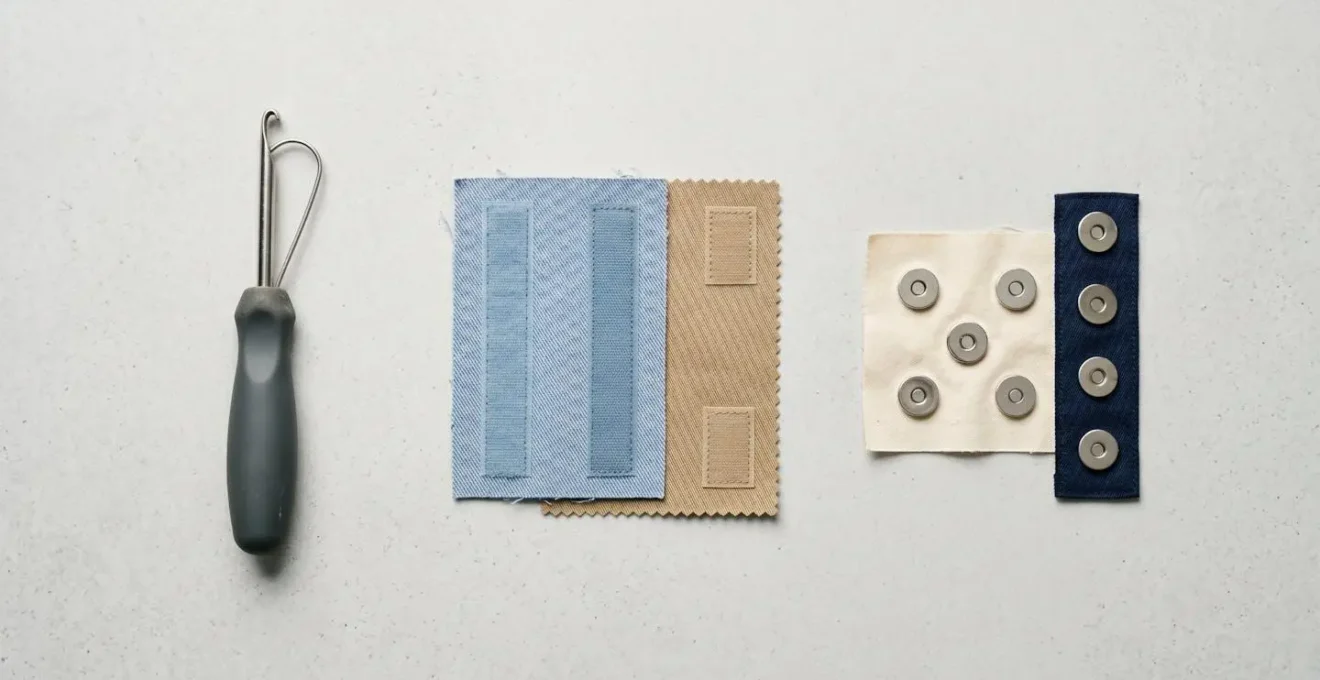
Button Hooks are ideal for individuals who have difficulty with the pincer grip required to manipulate small buttons but retain good wrist and arm movement. It requires a small amount of learning to thread the hook through the buttonhole and loop it over the button. Dressing Sticks, often with a hook on one end, are designed for those with limited reach or flexibility. They help with pulling on trousers, positioning shirts over the shoulder, or pushing off socks. Their primary function is to extend the user’s reach. Velcro or Magnetic Closures are adaptations made to the clothing itself. They are the most intuitive solution, eliminating the need for fine motor skills entirely. This is often the best choice for individuals with significant hand pain, tremors, or cognitive difficulties, as there is no tool to learn or manipulate. The trade-off is that it requires modifying existing clothes or purchasing adaptive clothing.
Your Action Plan: Auditing Dressing Difficulties
- Pinpoint the Barrier: Is the primary issue fine motor control (fiddly buttons), reach (putting on a jacket), strength (pulling up trousers), or a combination?
- Inventory Existing Clothing: What are the most problematic items? Fastenings like small back-zips, tiny buttons, or tight cuffs are common culprits.
- Test Low-Tech First: Before buying aids, could the solution be simpler? Think elastic shoelaces, replacing buttons with slightly larger ones, or choosing pull-on clothing.
- Match the Tool to the Person: Consider cognitive load. A button hook requires learning; Velcro does not. Does the person have the patience and ability to learn a new tool?
- Plan for Integration: The best tool is the one that gets used. Involve the person in the choice and practice using it in a low-stress situation, not when they’re in a hurry to go out.
The Over-Helping Mistake That Makes Seniors Lose Skills Faster Than Illness Would
One of the most powerful and counter-intuitive principles in supporting an ageing parent is this: doing too much can be more damaging than doing too little. This phenomenon, known as learned helplessness or staff-induced dependency, occurs when a person’s functional abilities decline not because of their illness, but because tasks are consistently done for them. It is born from a caregiver’s love, kindness, and often, a desire for efficiency. It’s quicker to button your father’s shirt than to wait for him to struggle with it. But in that moment of « help, » you have removed an opportunity for him to practice and retain a skill.
The brain and body operate on a « use it or lose it » principle. Every time a person successfully navigates a small challenge, they strengthen neural pathways and maintain muscle memory. When we step in too soon, we interrupt this process. As one professional caregiver aptly noted:
Caregivers, by nature, want to care, help, ease burdens, but can sometimes unknowingly trigger an enabling loop for the Senior to establish expectations based around their Caregivers’ support style.
– AgingCare community professional caregiver, AgingCare.com
This isn’t just theory; it’s been observed in clinical settings. The desire for speed and efficiency can inadvertently cause harm by promoting dependency.
Case Study: Staff-Induced Dependency in a Care Setting
A classic study of learned dependence in nursing homes found a recurring pattern where staff would encourage residents to be dependent on them for personal hygiene tasks. This wasn’t malicious; it was a response to workload pressures. Staff found it faster to perform the tasks themselves rather than patiently wait for a resident to do it. The unintended consequence was a rapid acceleration of the residents’ functional decline, as they lost the ability and motivation to perform these tasks independently.
The OT’s approach is to provide graded assistance—offering the absolute minimum help required for the person to succeed. This might mean setting up the clothes in order, starting the button for them, or providing a steadying hand, but always allowing the person to complete as much of the task as they can. It takes more patience, but it is an investment in preserving long-term function.
When Should You Request a Council Needs Assessment to Access Funded Personal Care?
When family support and simple adaptations are no longer enough to ensure safety and well-being, it’s time to consider formal support. In the UK, the gateway to accessing council-funded personal care is through a Needs Assessment, a legal requirement established under the Care Act 2014. You should request an assessment when a person has, or appears to have, a need for care and support, and is not able to achieve two or more specified outcomes, such as maintaining personal hygiene or being safe in their own home.
The time to request this is not at the point of absolute crisis, but when you can clearly demonstrate a consistent and ongoing inability to manage essential daily tasks. The detailed, objective observations you’ve been making—using the graded assistance framework—become invaluable evidence. A request for an assessment should not be based on a medical diagnosis (e.g., « Mum has arthritis ») but on the functional impact of that condition (« Mum is unable to get dressed without significant physical help and cannot bathe safely due to her arthritis »).
To request an assessment, you simply contact the adult social services department of the local council where the person lives. You can do this on your parent’s behalf, with their permission. The request can be made online or by phone. Be prepared to articulate the specific difficulties clearly:
- « My father is having falls in the bathroom and is now afraid to shower. »
- « My mother cannot manage her buttons or zips and requires help getting dressed and undressed every day. »
- « We are concerned about nutrition as my parent is struggling to stand long enough to prepare a hot meal. »
The assessment itself is a conversation with a social worker or a trusted assessor to determine the individual’s needs and what support might help them. The outcome is not always a package of care; it could also be recommendations for equipment, home adaptations, or signposting to voluntary services. Having a clear, evidence-based picture of the functional challenges is the most powerful tool you have to navigate this process successfully.
What Can an OT Do for You If You Have Not Had a Stroke or Surgery?
There is a common misconception that Occupational Therapists are only involved after a catastrophic event like a stroke, a major surgery, or a serious injury. While we are a crucial part of post-acute rehabilitation, this view misses the most powerful and proactive aspect of our profession: preventative and maintenance therapy. An OT’s primary focus is function. We are trained to analyse the interaction between a person, their daily activities (occupations), and their environment. This skill is invaluable for addressing the slow, gradual decline in function that often characterises the ageing process.
You don’t need a specific medical event to benefit from an OT. You just need a functional problem. This could be:
- « I’m afraid I’m going to fall in the shower. »
- « I can’t get up from my favourite armchair without a huge effort. »
- « I’ve stopped cooking because standing in the kitchen is too tiring. »
- « I can no longer do up my own buttons. »
For an OT, these are the starting points for an investigation. We don’t just see a problem; we see a mismatch between a person’s ability and the demands of a task. Our intervention is to bridge that gap. As one research team summarised, our role is proactive and preventative, especially concerning home safety.
An OT can evaluate a person’s ability to perform daily activities in their home, teach the individual how to accomplish these activities more safely, and/or make suggestions for home modifications to reduce potential fall hazards.
– National Center for Injury Prevention and Control research team, PMC study on falls among older adults
An OT assessment for someone experiencing gradual decline might involve recommending energy conservation techniques, introducing simple adaptive equipment, or suggesting minor environmental changes that can have a major impact on safety and independence. We are problem-solvers for daily life, and our work is most effective when we can intervene early, before a small problem becomes a life-changing crisis.
Why Does a 2-Inch Higher Toilet Seat Reduce Knee Strain by 40% When Standing?
The raised toilet seat is a classic example of an OT solution: simple, low-cost, and profoundly effective because it is based on a solid understanding of biomechanics. To understand its impact, we must first analyse the task of standing up from a seated position. This movement, which we do multiple times a day, requires a significant amount of force from the major muscle groups in the legs (quadriceps, glutes) and places considerable strain on the knee and hip joints.
The difficulty of this movement is directly related to the starting angle of your joints. When you sit on a standard, lower toilet, your hips are often positioned below your knees. This creates a deep squat position. To stand up from here, your body must generate a large upward and forward force, with the knee joints bearing a massive amount of stress. For someone with arthritis, muscle weakness, or knee pain, this can be an excruciating or even impossible task. This difficulty is a major contributor to bathroom falls, as people may use unstable objects like the sink or a towel rail to pull themselves up.
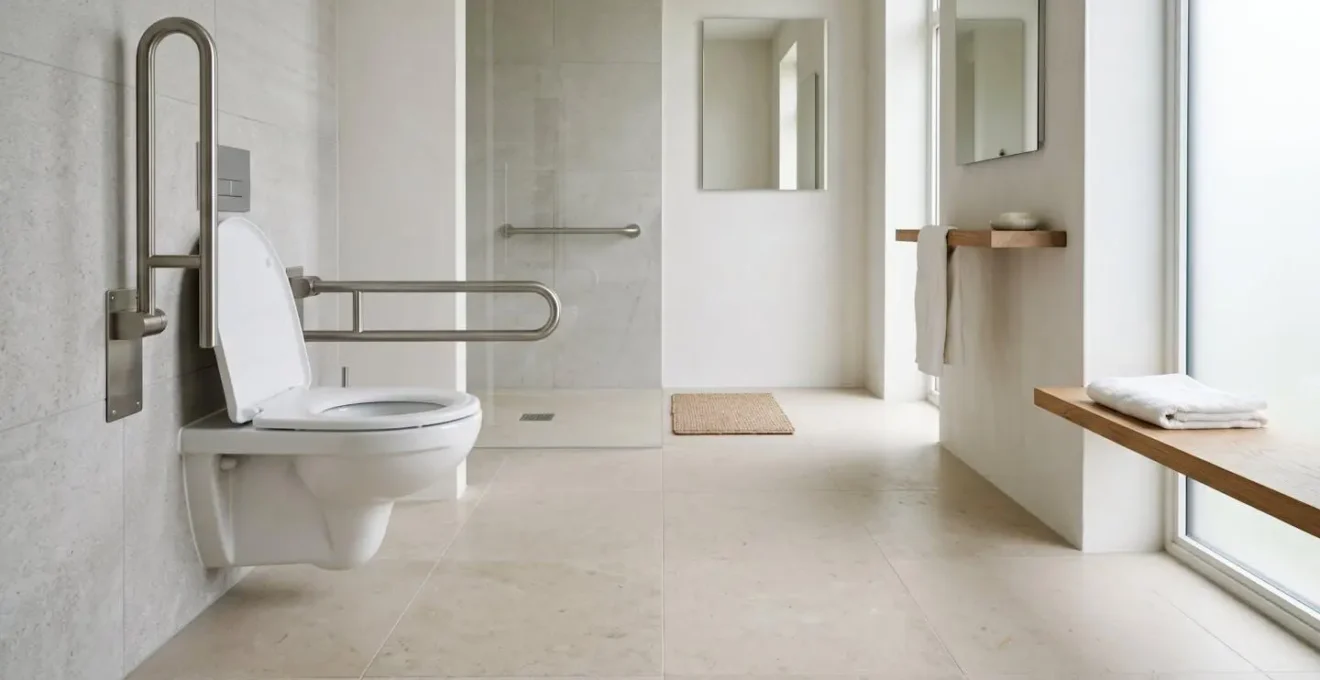
By adding just a few inches of height, a raised toilet seat fundamentally changes the physics of the situation. It elevates the starting position so that your hips are level with or higher than your knees. This reduces the depth of the squat and decreases the angle of flexion in the knee. As a result, the amount of force required from your muscles to stand up is significantly lessened, and the strain on the knee joint is dramatically reduced—by up to 40% or more, depending on the individual and seat height. This small environmental modification doesn’t « fix » the person’s weak knees; it adapts the environment so that their existing strength is sufficient for the task. It’s a perfect illustration of the OT principle: change the environment, not the person. When combined with sturdy, correctly placed grab bars, it creates a secure system that empowers independent and safe toileting.
Key takeaways
- Functional Decline is the Real Metric: The most important indicator of a senior’s well-being isn’t their list of diagnoses, but their ability to perform Activities of Daily Living (ADLs) like bathing and dressing.
- The « Over-Helping » Trap is Real: Doing tasks for a loved one out of kindness or for speed can unintentionally accelerate their loss of skills and independence. The goal is to assist, not take over.
- Environment is Key: Often, the most effective and dignity-preserving solution is not a carer, but an adaptation to the environment (like a raised toilet seat or grab bar) that makes the existing space work for the person’s current ability.
Why Does an Occupational Therapist See Solutions Your GP Never Considers?
When facing a health challenge, the General Practitioner (GP) is the primary and essential port of call. A GP is a diagnostic expert, trained to identify disease, prescribe medication, and refer to medical specialists. Their focus is on the pathology: What is the disease? How do we treat it? An Occupational Therapist (OT), however, asks a different set of questions. Our focus is on function: How does this disease affect your ability to live your life? How can we adapt the task or the environment so you can continue to do the things that are important to you?
This difference in perspective is fundamental. A GP might diagnose arthritis in the hands and prescribe anti-inflammatory medication. An OT sees the functional consequence—an inability to do up buttons—and seeks a practical solution, like a button hook or Velcro adaptations. We are trained to perform a task analysis, breaking down an activity into its component parts to see exactly where the difficulty lies. As Dr. Archie, a certified expert, puts it:
OTs are the best people to do these assessments. We use our distinct knowledge to take a complex situation and distill it into the root causes of the problem.
– Dr. Archie, certified Living in Place Professional, AskSAMIE
This is particularly critical in the context of the home, where most life happens. While a GP’s work is based in the clinic, an OT’s natural habitat is the person’s own environment. This allows us to see real-world challenges that are invisible in a 10-minute office appointment. This home-centric approach is vital because, according to research from the American Occupational Therapy Association, while 60% of falls occur inside the home, most of these are preventable with the right assessment and modifications. A GP treats the after-effects of a fall; an OT works to prevent it from happening in the first place by identifying and mitigating the risks—the loose rug, the poor lighting on the stairs, the toilet that’s too low.
The two roles are not in opposition; they are complementary. The GP manages the disease, while the OT manages the person’s ability to live with it. By focusing on function, OTs can unlock a range of practical, non-medical solutions that preserve independence, enhance safety, and improve quality of life in ways that lie outside the typical scope of medical practice.
Ultimately, the journey to supporting a loved one begins with observation, not intervention. By adopting a functional, problem-solving mindset, you can move beyond simply worrying about their decline and begin actively supporting their independence. Start by looking at the tasks, not just the person, and ask the core OT question: « What is the smallest change I can make to the environment or the task that will have the biggest positive impact on their ability to manage on their own? »